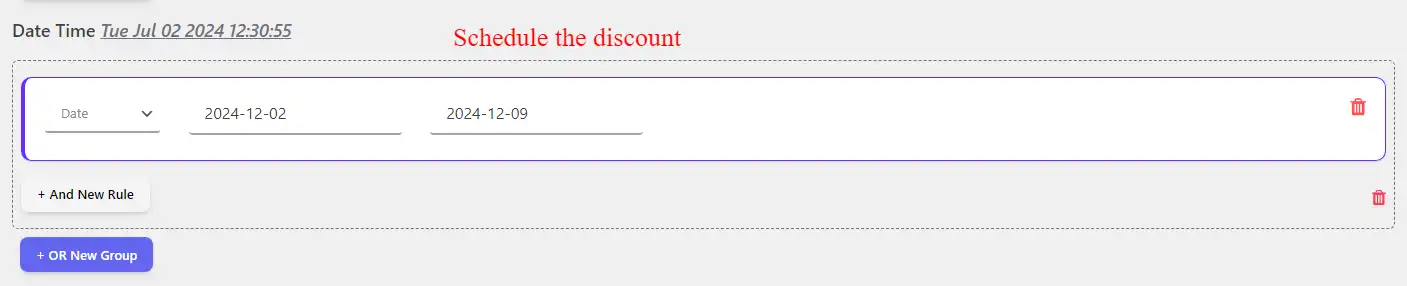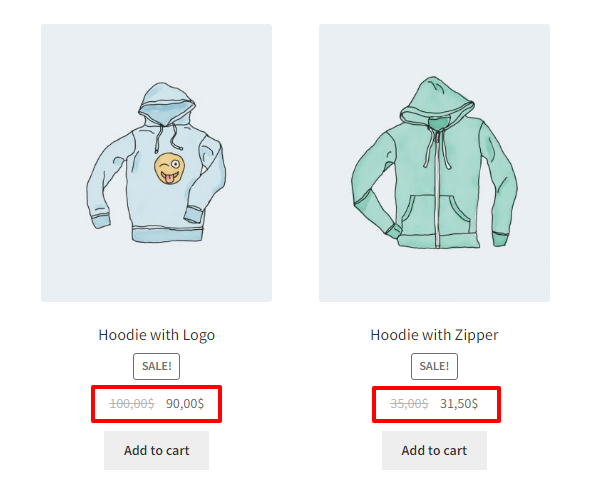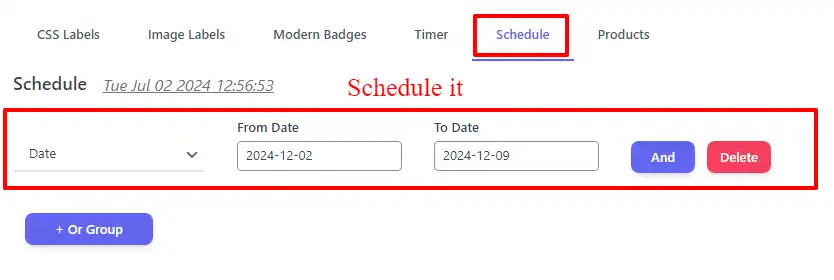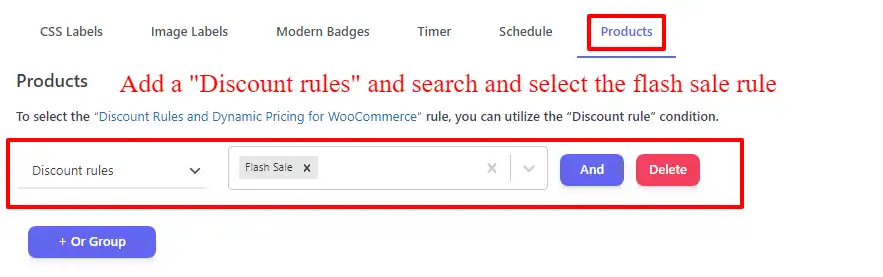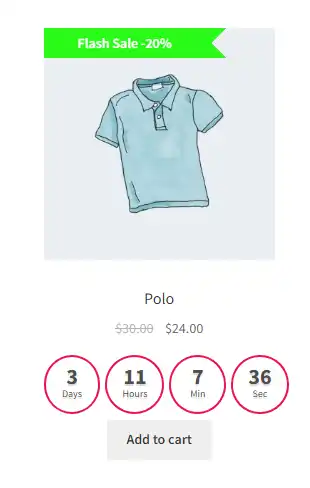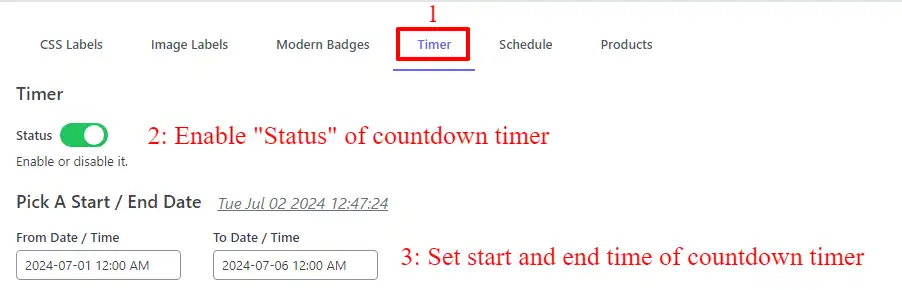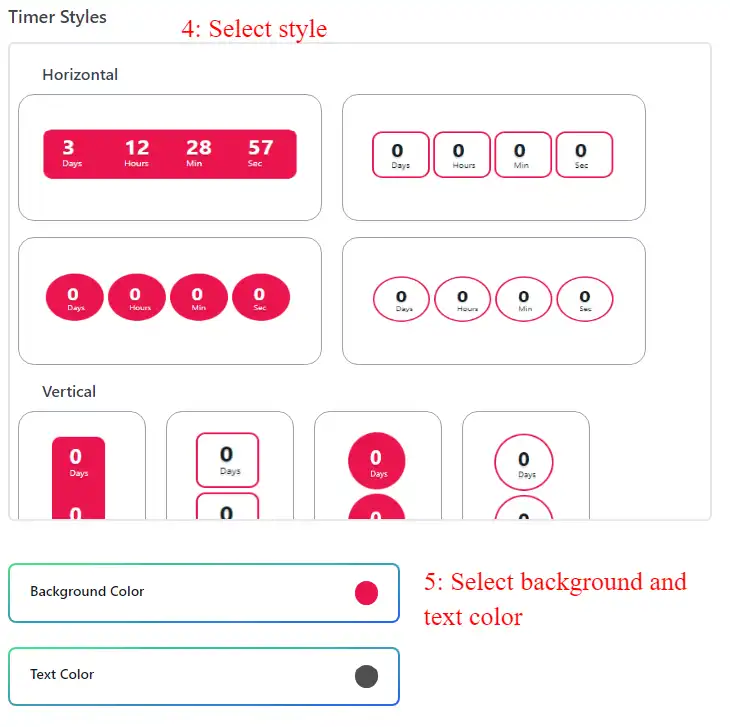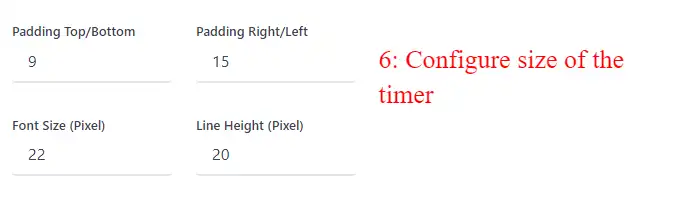
Posted on — Leave a comment

Best Free WooCommerce Side Cart Plugins Compared

A free WooCommerce side cart plugin lets customers check their basket, update items, and move toward checkout while staying on the page they are browsing. Some free plugins also let you recommend an accessory, accept a coupon, or show how much more a customer needs to spend for free shipping.

In this guide, we compare five of the best free WooCommerce side cart plugins, including their features, demos, pricing, and screenshots. Start with AsanaPlugins if you want conditional offers across your store, or compare Caddy if a free shipping bar and in-cart recommendations are your main priorities.

Disclosure: AsanaPlugins develops the first plugin on this list. Features and listed prices were checked against official sources on October 31, 2026. This is a feature comparison, not a performance test. However, vendor demos and screenshots may include Pro features, which we identify below.

1. Side Cart & Upsell for WooCommerce by AsanaPlugins

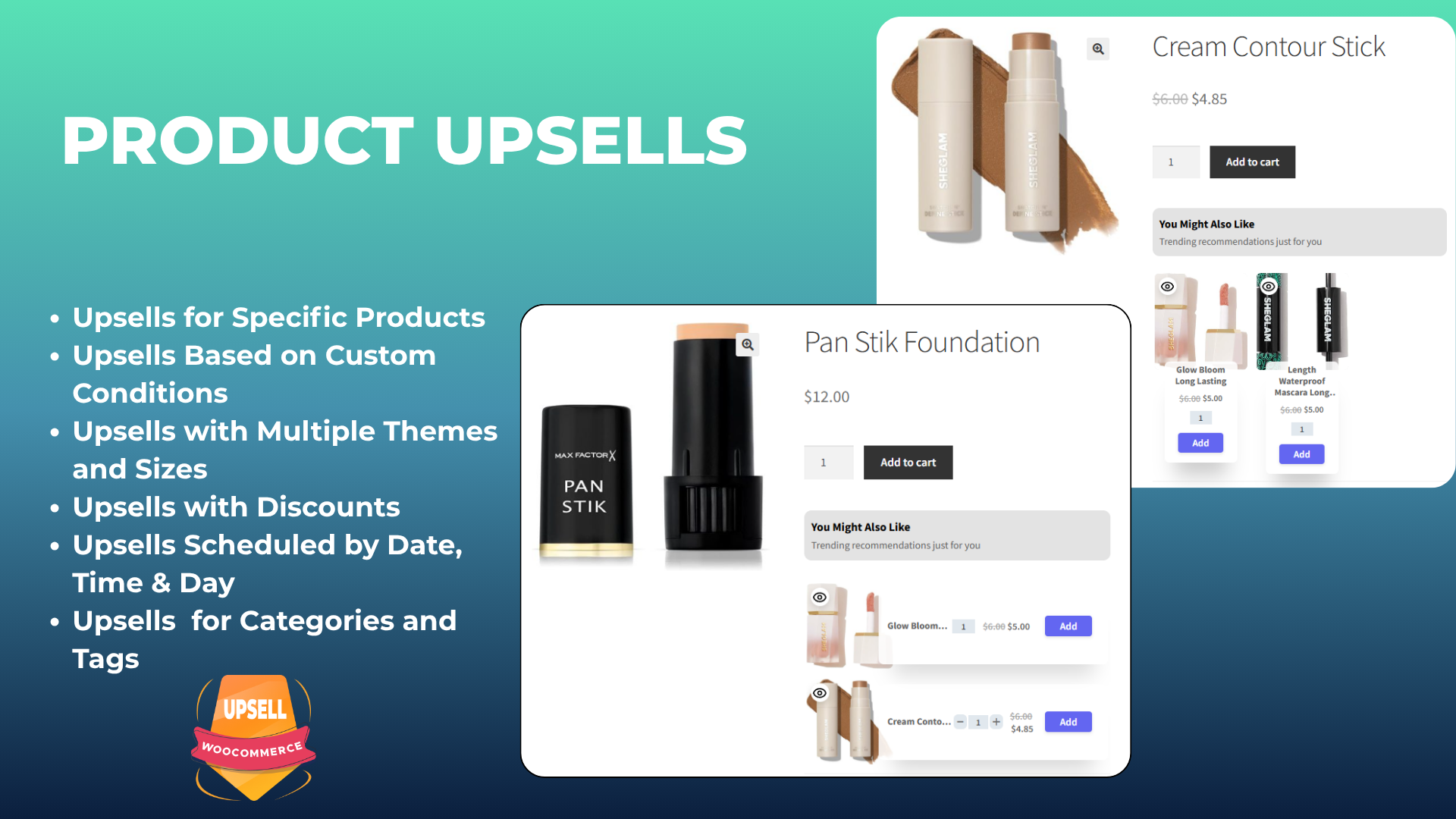
Side Cart & Upsell for WooCommerce brings a slide-out cart and product offers into one plugin. Customers can review their basket in the drawer, while you choose relevant recommendations for the product page, side cart, Cart page, and Checkout page.

If you want a WooCommerce side cart plugin with targeted offers, this one gives you control over each offer. You can build conditions around the shopper or basket, then recommend an appropriate product with an optional discount. For example, an accessories store could suggest a matching belt when a customer adds an item from a selected category. However, the free edition supports up to three side-cart upsell rules.

Examples

🚀 Free WooCommerce Side Cart Features

Included in the free version:

  • Open the floating cart icon, then review items in the AJAX drawer.
  • Build up to three side-cart upsell rules so you can target different offers.
  • Show product recommendations as well as related-product campaigns.
  • Also offer product add-ons for complementary items.
  • Offers on the Cart and Checkout pages.
  • Conditions based on login status, user role, cart contents, item quantity, and subtotal.
  • Apply offer discounts automatically so shoppers can see the savings.
  • For example, adjust the cart appearance, text, and icons to match your store.

Available in Pro:

  • Unlimited side-cart rules and dedicated exclusions for items already in the cart or previously purchased.
  • Free shipping progress bar and reward milestones.
  • Premium cart theme, promo banner, and countdown.
  • Upsell, add-ons, and downsell popups.
  • Additional offer layouts and product quick view.

See the side-cart upsell documentation for the rule limit and available controls. Therefore, choose this plugin when targeted offers matter more than having a shipping bar on the free plan.

📽️ Demo

Explore the AsanaPlugins storefront demo, then follow our free side-cart setup tutorial to build your own drawer. The demo also showcases Pro options.

💵 Free WooCommerce Side Cart Pricing (Free vs Pro)

📽️ Video Tutorial

Alternatively, watch the official free-features overview for a closer look at the plugin.

🖼️ Free WooCommerce Side Cart Screenshots

Free WooCommerce side cart plugin by AsanaPlugins with upsells on desktop and mobile.
Product upsell recommendations on WooCommerce product pages.
Cart-page upsell offers for complementary WooCommerce products.
Checkout-page upsell recommendations before order completion.
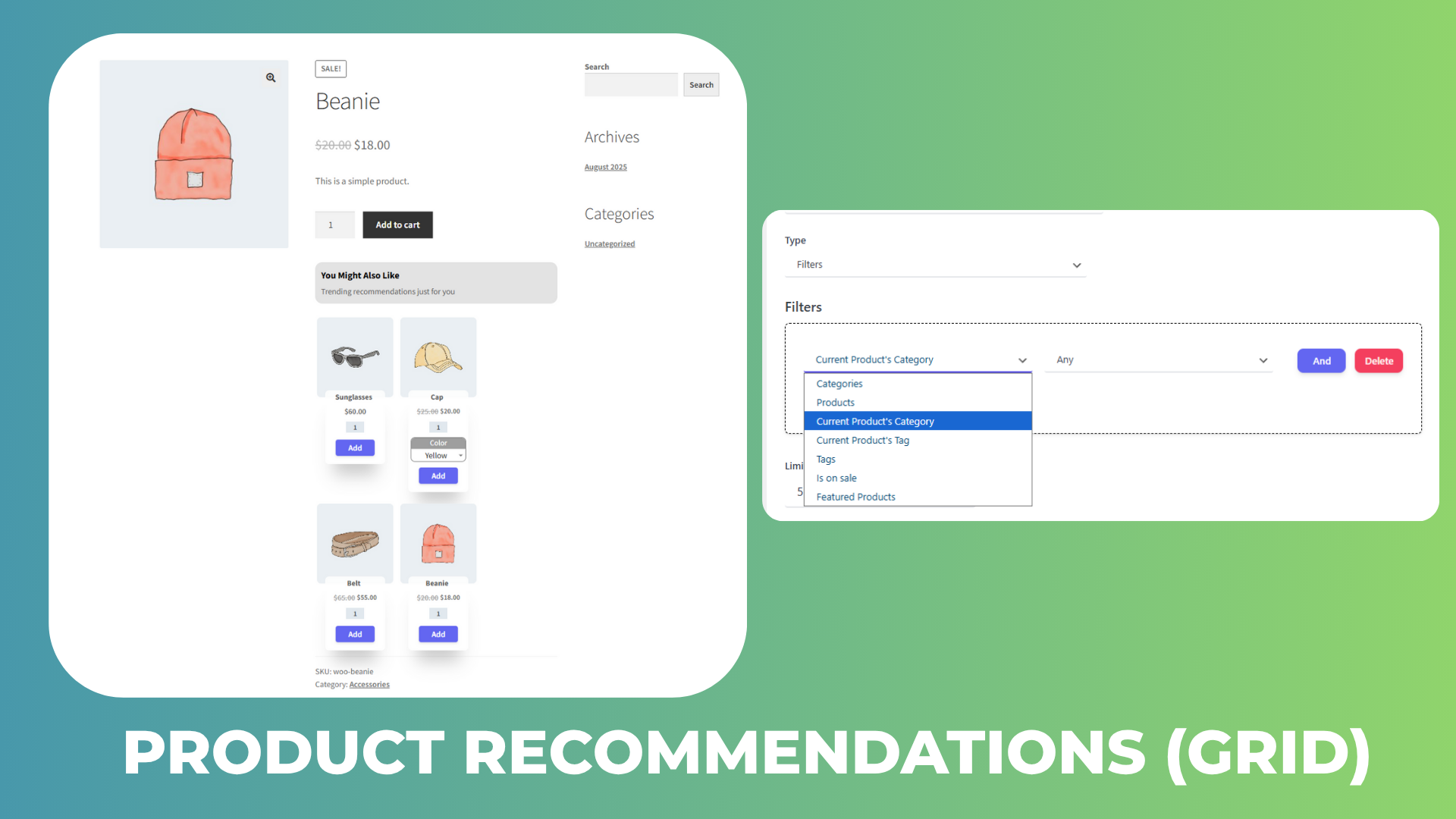
Product recommendations grid and category-based selection controls.
Related products displayed on product and cart pages.
Product add-ons for complementary items on a WooCommerce product page.
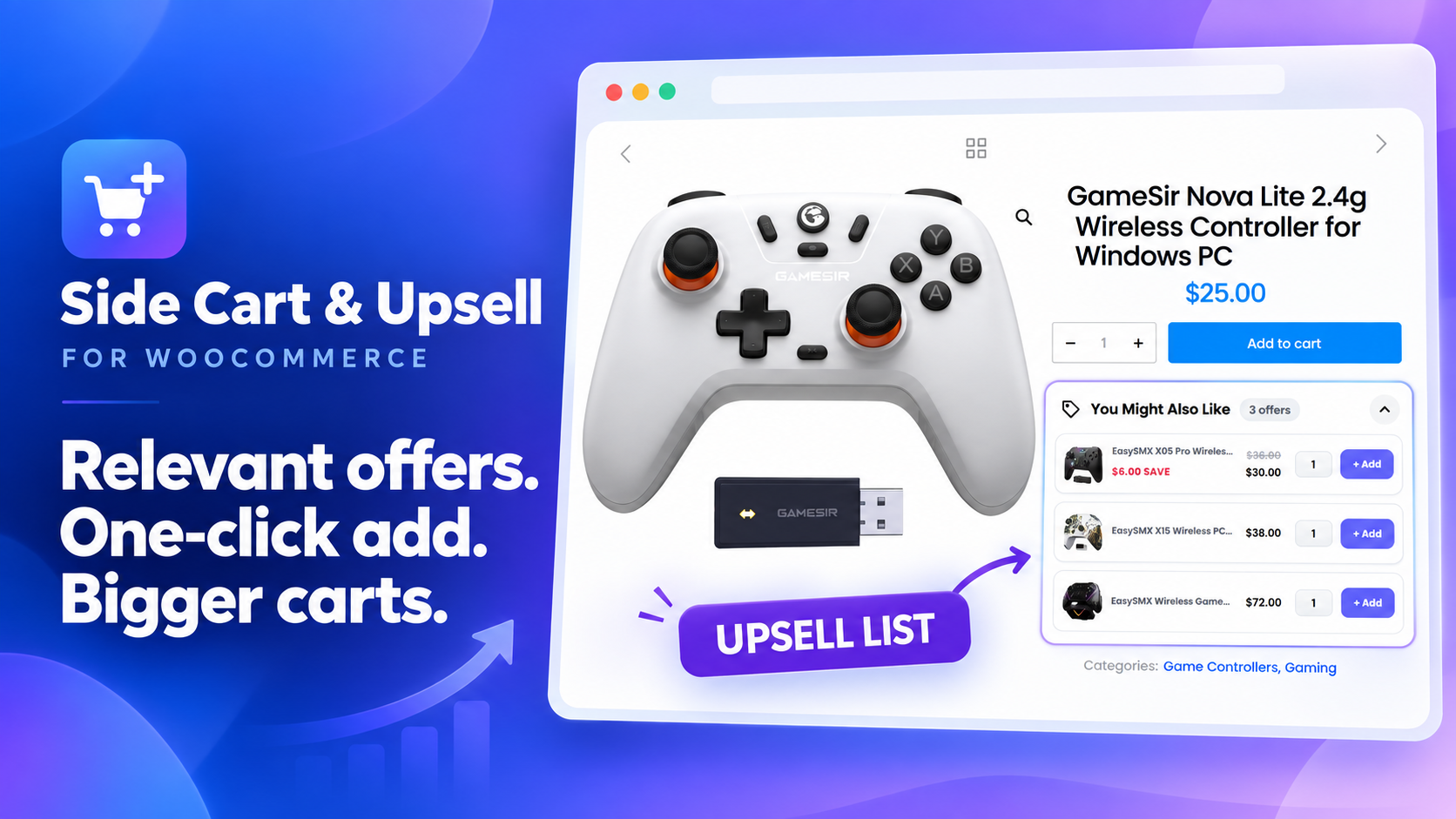
Product upsell list with one-click add buttons on a product page.

2. Caddy — Free WooCommerce Side Cart & Shipping Bar

Caddy is a useful side cart plugin when you want recommendations and shipping progress in the drawer. Lite also lets shoppers apply coupons and save products for later when they are logged in.

Caddy documents its use of the WooCommerce Store API and WordPress Interactivity API. However, these describe how it is built; they do not prove that it is faster than other cart plugins.

🚀 Free WooCommerce Side Cart Features

Included in Lite:

  • Open the floating cart drawer and then adjust item quantities.
  • Show upsell recommendations as well as cross-sells inside the cart.
  • Free shipping progress meter.
  • Coupon entry in the drawer.
  • Logged-in shoppers can save products for later and then return to them.
  • In addition, customize the drawer with CSS.

Pro adds: advanced workflows, cart analytics, multi-tier rewards, and further design controls. Basic recommendations are free. In contrast, the automation engine is a paid feature.

📽️ Demo

Visit the Caddy live demo to explore the drawer. Check the tier of any advanced feature you try.

💵 Pricing

  • Lite: free.
  • Single: $99/year for one website.
  • Multi-Site: $199/year for five websites.
  • Agency: $399/year for unlimited websites.

Source: Caddy pricing. In addition, annual plans include support and updates.

🖼️ Side Cart Screenshots
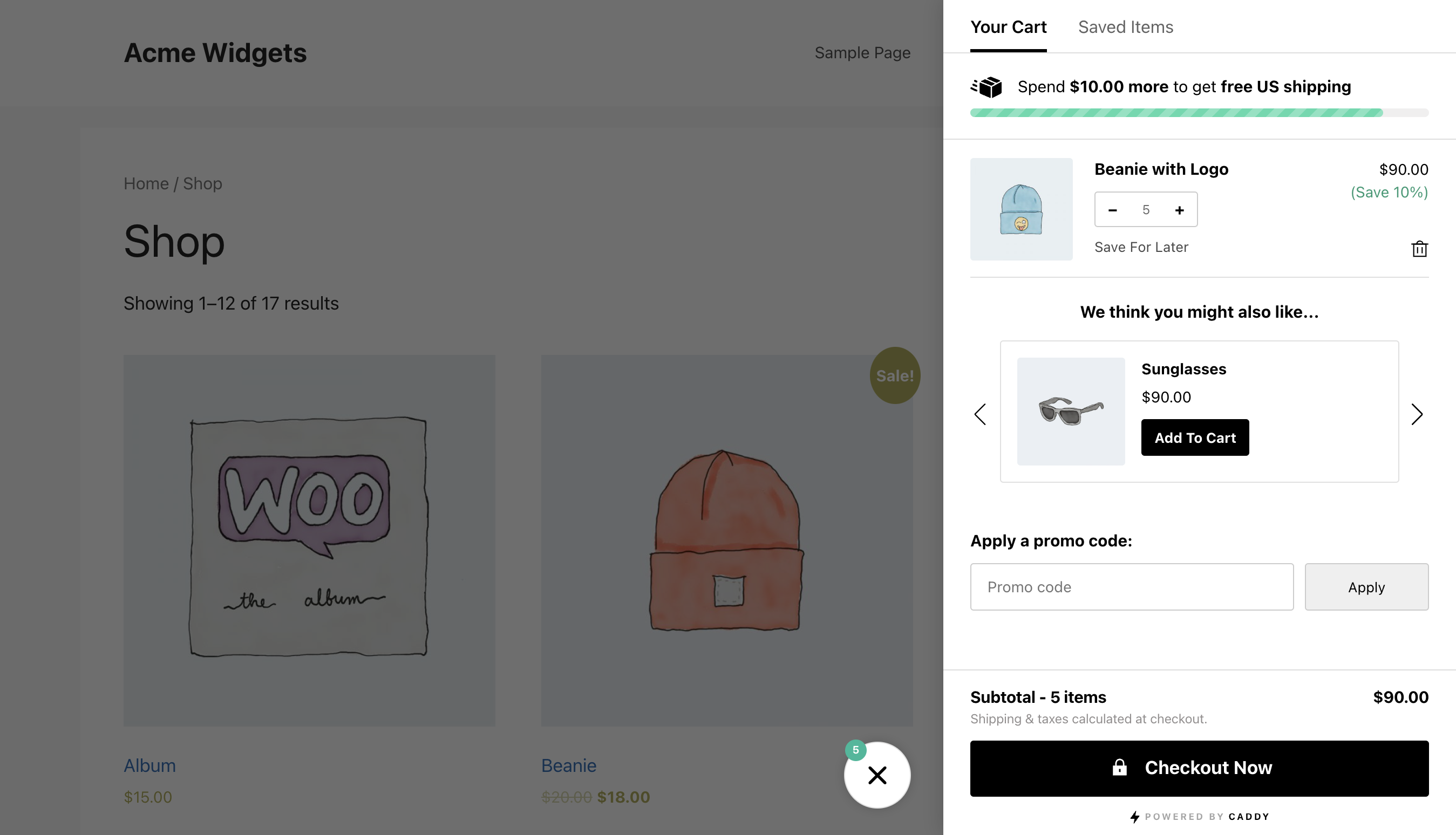
Caddy WooCommerce side cart with a shipping progress bar, product recommendation, coupon field, and saved-items tab.
Caddy side cart open over a WooCommerce shop page, showing a recommendation and shipping goal.

3. Side Cart WooCommerce by Xootix

Xootix Side Cart WooCommerce focuses on a configurable cart drawer with a floating basket and appearance controls. For example, consider it when you want to adjust the cart’s layout and keep shoppers on the current page.

🚀 Free WooCommerce Side Cart Features

Included in the free version:

  • AJAX drawer for viewing and managing items.
  • Floating basket and menu integration.
  • For example, change the cart width, height, colors, and icons.
  • Hide the drawer on selected pages so it appears only where you need it.
  • Also edit quantities in the free edition, starting with version 2.8.0.

Pro adds: product recommendations, in-drawer coupons, shipping calculation, rewards, and additional payment options.

The 2.8.0 changelog confirms free quantity editing, although an older marketing section still groups quantity management under Pro.

📽️ Demo

Try the Xootix side-cart demo. However, the demo includes paid recommendations and reward features.

💵 Pricing

  • Free: base cart plugin.
  • Pro, single site: $29.
  • Pro, up to five sites: $89.
  • Pro, unlimited sites: $139.

Source: Xootix product page. The license includes one year of updates. After that, renew it to keep receiving updates and register new sites.

🖼️ Side Cart Screenshots

Xootix WooCommerce side cart with Pro recommendations, reward milestones, cart items, and payment buttons.
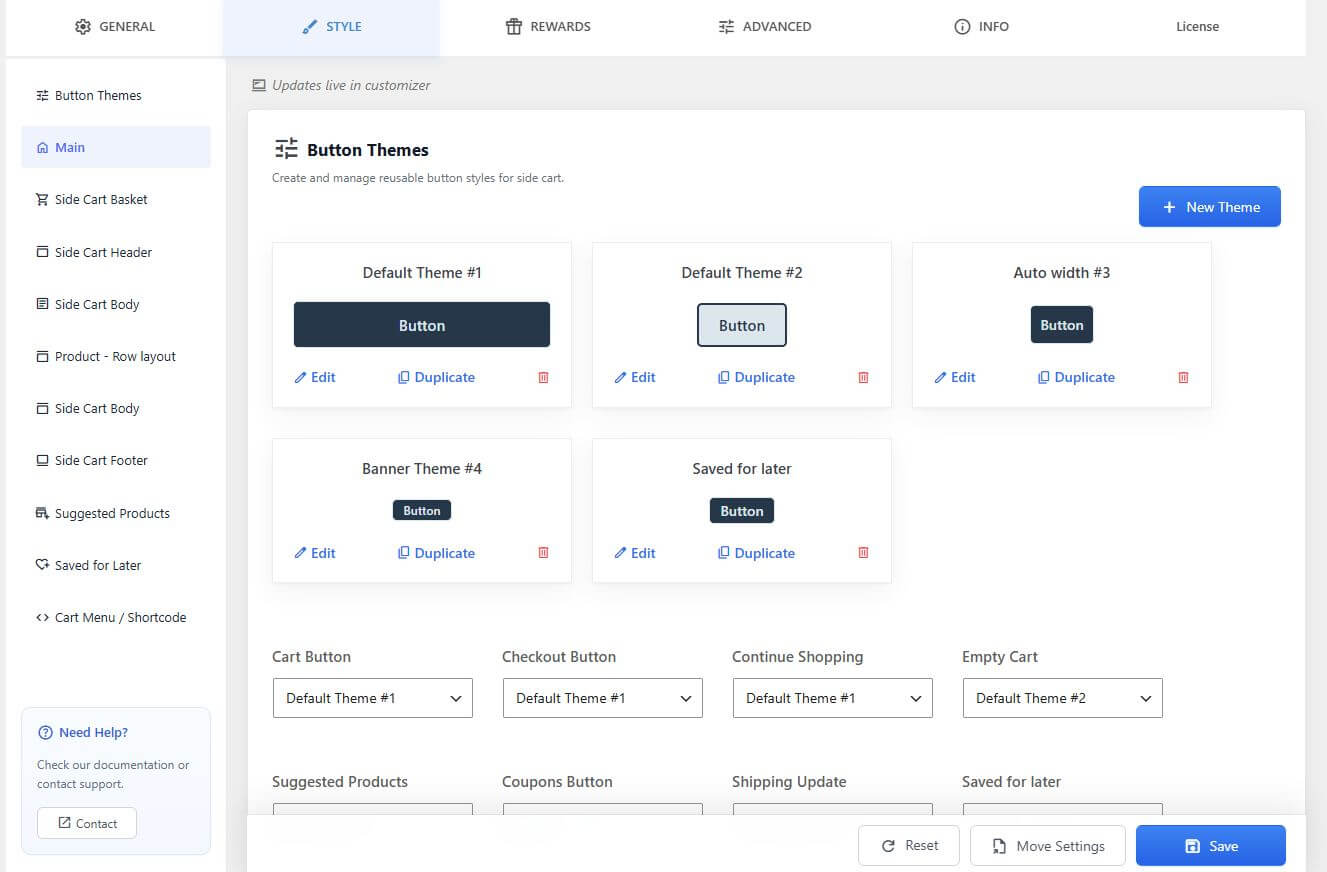
Xootix WooCommerce side cart button theme settings screen.

4. Sliding Cart for WooCommerce by FunnelKit

FunnelKit Cart Lite gives shoppers a drawer where they can change quantities, remove products, and apply a coupon. Therefore, this WooCommerce side cart plugin suits stores that want cart controls without buying an upsell toolkit immediately.

🚀 Free WooCommerce Side Cart Features

Included in Lite:

  • Slide-in cart with a cart icon.
  • AJAX item changes and removal.
  • Quantity editing inside the drawer.
  • For example, keep the coupon field open or let shoppers expand it.
  • In addition, adjust the cart text, colors, and styling.

Pro adds: in-cart upsells and cross-sells, milestone rewards, free-shipping incentives, and additional checkout options. These are distinct from the free coupon field.

📽️ Demo

Explore the official cart showcase and the free and Pro setup walkthrough. However, the showcase includes premium features.

💵 Pricing

  • Cart Lite: free on WordPress.org.
  • Paid cart features: available through qualifying FunnelKit plans. Compare the specific Slide Cart Pro features in the current plan table, including introductory and renewal terms.

Installing Cart Lite does not include every FunnelKit funnel or automation product.

🖼️ Side Cart Screenshots
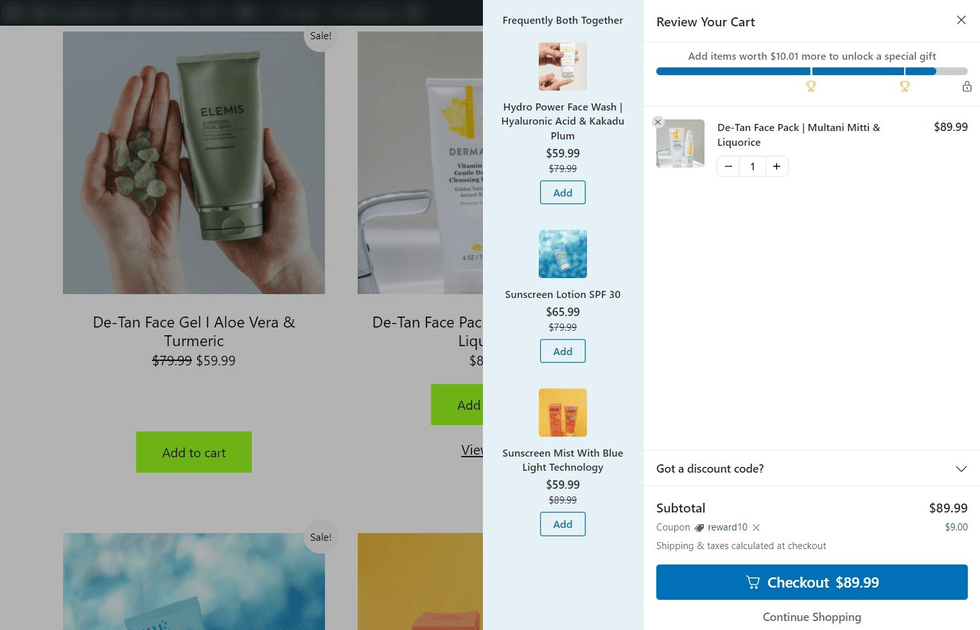
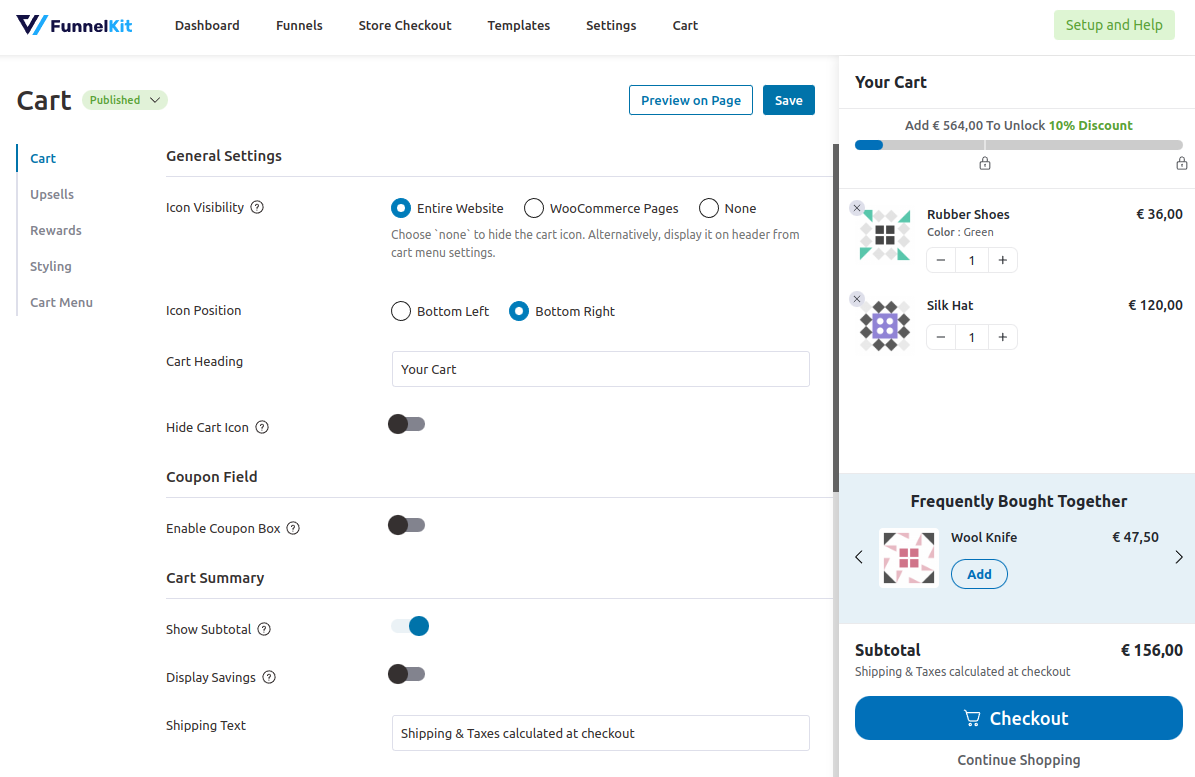
FunnelKit WooCommerce side cart with Pro product suggestions, reward progress, a cart item, and a coupon field.
FunnelKit WooCommerce cart drawer showing Pro shipping rewards, a recommended product, coupon field, and checkout.
FunnelKit WooCommerce side cart settings and preview with Pro rewards and recommendations.

5. Modern Cart — WooCommerce Side Cart & Popup Cart

Modern Cart offers a slide-out cart with a coupon form and shipping progress. As a result, it is another free WooCommerce side cart plugin to compare when a visible shipping goal matters most.

🚀 Free WooCommerce Side Cart Features

Free features documented by the vendor:

  • Side-cart drawer and floating cart icon.
  • Change items and quantities with AJAX so the page does not need to reload.
  • Also let shoppers enter a coupon directly in the cart.
  • Show a free shipping progress bar so shoppers can see the remaining amount.

Pro adds: in-cart product recommendations and additional display and design controls.

Popup availability needs checking: the directory listing says both drawer and popup modes are included, but the settings guide labels the Cart Type selector Pro. Therefore, verify the free version before choosing it specifically for a popup.

📽️ Demo

Open the official Modern Cart demo launcher to explore the product. However, the demo may include Pro features.

💵 Pricing

  • Free: base plugin from WordPress.org.
  • Pro annual: advertised at $99 for the first year, renewing at $149/year, for up to three websites.
  • Pro lifetime: advertised at $299 for up to three websites.

Source: Modern Cart pricing. Because offers can change, check the selected term before purchase.

🖼️ Side Cart Screenshots

Modern Cart WooCommerce cart drawer showing cart items, Pro product suggestions, a coupon field, subtotal, and checkout button.

Which free WooCommerce side cart plugin should you choose?

The right free WooCommerce side cart plugin depends on the feature you need today. For example, AsanaPlugins suits stores that want conditional offers across product, cart, and checkout pages. In contrast, Caddy is a strong alternative when free recommendations and a shipping bar matter most. Xootix offers a configurable drawer, FunnelKit Lite includes convenient coupon and item controls, and Modern Cart provides another shipping-bar option.

Before choosing, test a simple product, a variable product, a coupon, and a complete test order with your theme. Next, check mobile scrolling and keyboard access, and make sure the shipping message agrees with checkout. Above all, activate one cart drawer at a time while comparing.

Ready to try the first option? Follow our WooCommerce side-cart setup tutorial or use the Side Cart & Upsell documentation to create your first drawer and offer.

Posted on — Leave a comment

How to Add a Side Cart to WooCommerce Without Code

Here’s how to add a side cart to WooCommerce without code: install Side Cart & Upsell for WooCommerce, enable the drawer and AJAX updates, and choose how shoppers open it. Then customize its buttons, icon, and colors from the plugin settings. You can complete the basic setup with the free version.

A side cart is a panel that slides over the current page. As a result, customers can review items and head to checkout while keeping the shop in view. This guide follows the settings in the screenshots below, with optional product offers after the main setup.

Key takeaways

  • First, enable the side cart, AJAX updates, and automatic opening.
  • Next, choose the drawer layout and a cart icon that shoppers can easily reach.
  • Use the built-in color controls so you can style the cart without editing your theme.
  • Finally, test the drawer on your storefront before adding optional upsell rules.

About this guide: AsanaPlugins develops the plugin used here. The supplied screenshots show both free and Pro controls; paid options are identified beside the relevant steps. The admin preview uses sample products, so test your actual products on the storefront.

Before you add a side cart

You need an active WooCommerce store, permission to install plugins, and at least one purchasable product. First, confirm that your usual Cart and Checkout pages work. Also disable any other automatic cart drawer while testing, because two drawers can respond to the same button.

If you are still choosing a plugin, compare the options in our free WooCommerce side cart plugin comparison. This tutorial uses the free Side Cart & Upsell plugin, with settings you can change directly in WordPress.

1. Install a WooCommerce side cart plugin

Choose your version: Get the free Side Cart & Upsell plugin for the no-code drawer, AJAX cart updates, and basic styling used in this guide. Explore Side Cart & Upsell Pro if you want the additional Pro controls mentioned below. Pro is optional for this setup and requires the free plugin to be installed and active first.

In your WordPress dashboard, open Plugins → Add New Plugin. Search for Side Cart & Upsell for WooCommerce by AsanaPlugins. Next, click Install Now, followed by Activate.

After activation, open Side Cart & Upsell → Side Cart. You will find the General, Side Cart, Icon, Styles, and Addons tabs. A live preview sits beside the controls, so you can inspect changes before saving.

You do not need a page builder for this method. In addition, you can keep your existing theme and standard WooCommerce Cart page.

2. Enable the WooCommerce side cart without code

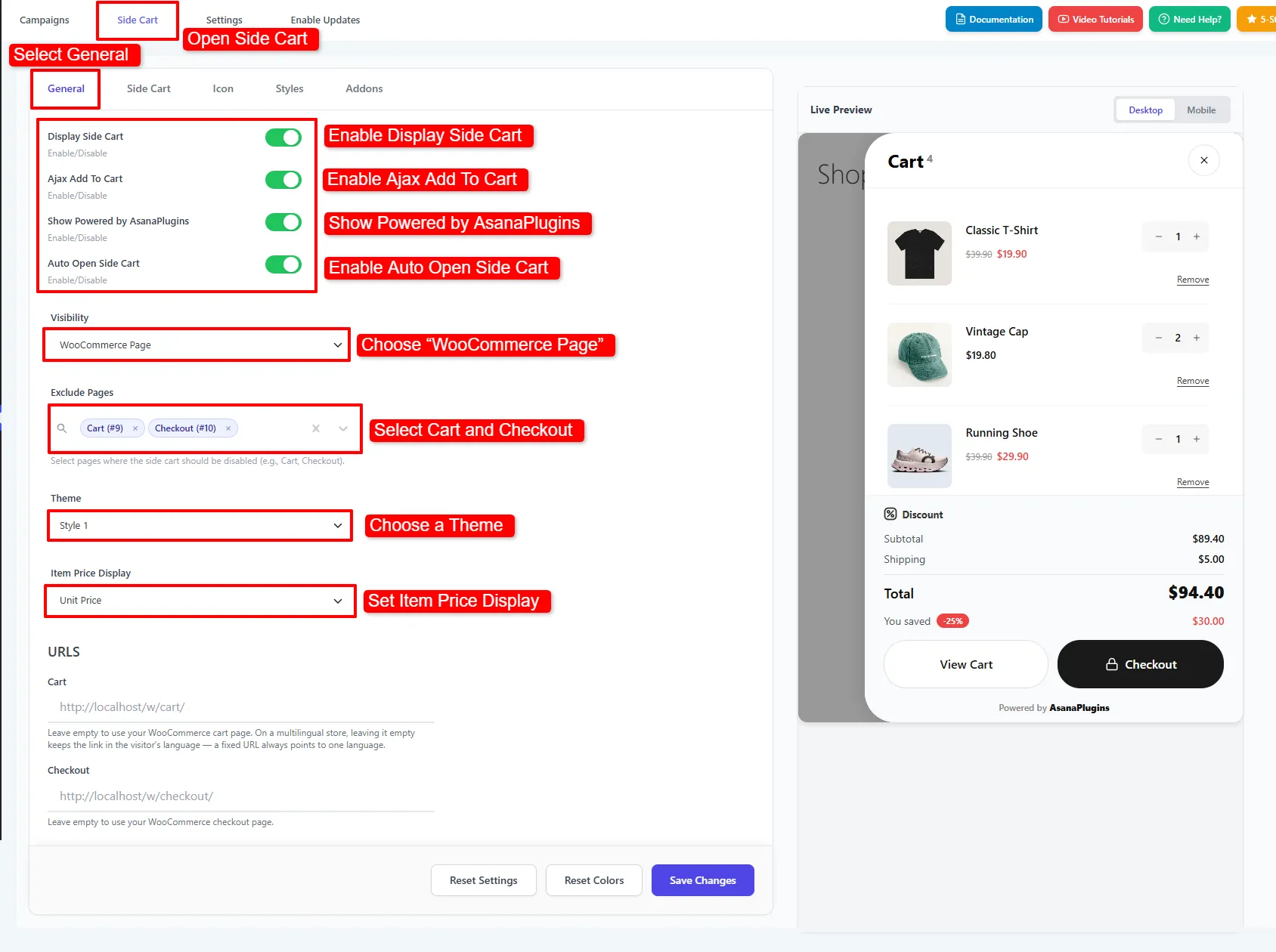
Start in the General tab. When learning how to add a side cart to WooCommerce without code, the first switch to check is Display Side Cart. Turn it on to enable the drawer. Then enable Ajax Add To Cart so supported Add to cart actions update the basket without a full page reload.

Also enable Auto Open Side Cart if the drawer should appear after a customer adds an item. Alternatively, leave automatic opening off and let customers open it through a cart icon.

WooCommerce side cart General settings with drawer, AJAX, automatic opening, visibility, and exclusions highlighted.
Enable the drawer and AJAX updates, then choose where the cart appears.

For the setup shown above, choose WooCommerce Page under Visibility. Then add the Cart and Checkout pages under Exclude Pages if you want those pages to handle their own flow. Choose Entire Website instead if shoppers should access the drawer from other pages too.

Select Style 1 for the free drawer and Unit Price for the item price display. The screenshot also shows the Powered by AsanaPlugins control; changing that setting requires Pro. You can leave it at its default while following this tutorial.

Leave the Cart and Checkout URL fields empty to use WooCommerce’s assigned pages. This also avoids hard-coding a language-specific link on a multilingual store. Finally, click Save Changes.

3. Set up the WooCommerce side cart layout

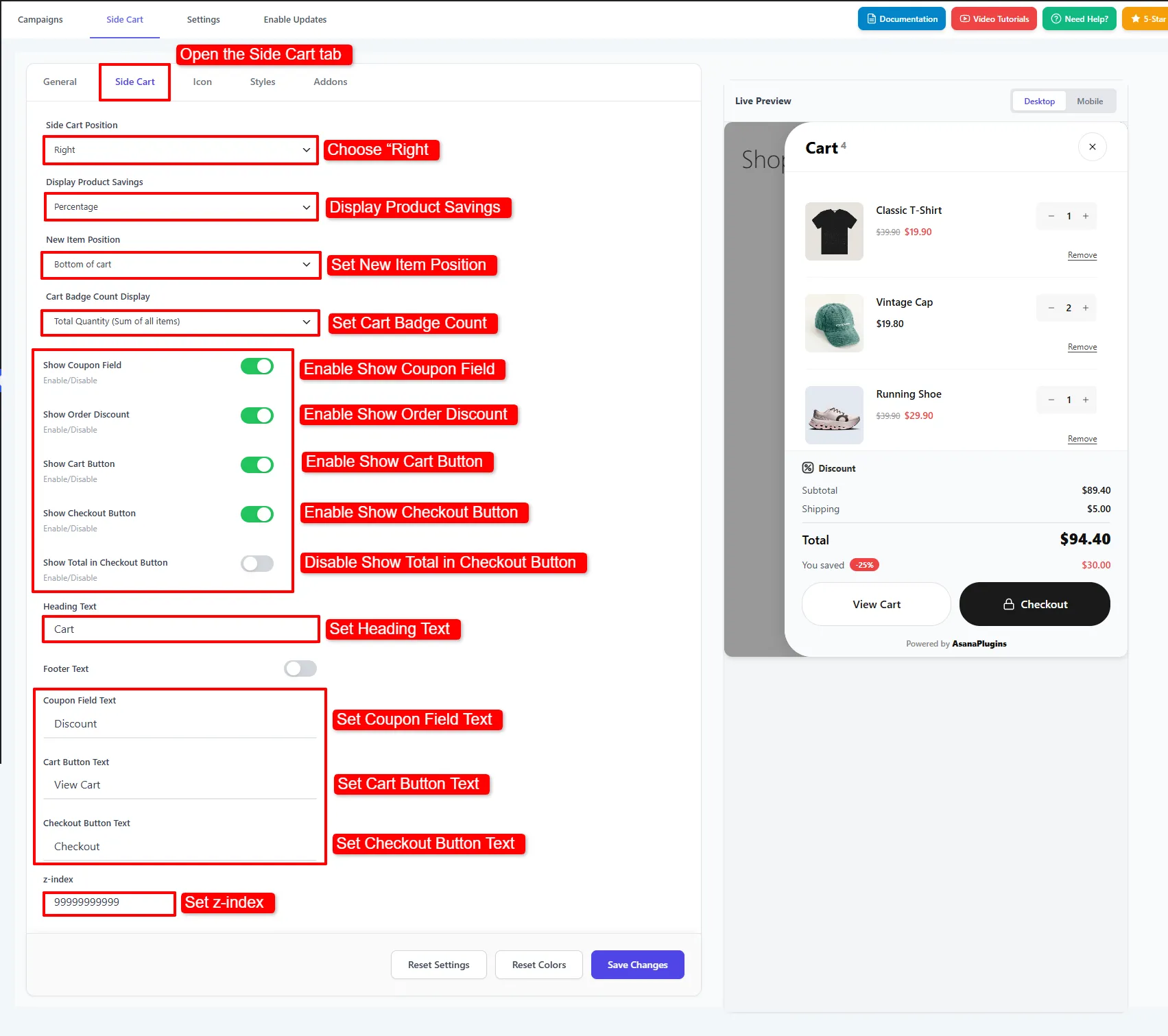
Open the inner Side Cart tab to choose what the drawer contains. For example, set Side Cart Position to Right and New Item Position to Bottom of cart to follow the screenshot.

Drawer layout settings for position, quantities, coupons, labels, and checkout buttons.
Choose the drawer contents and labels in the Side Cart tab.

Choose whether the cart badge shows total quantity or unique line items. With total quantity, two units of one product count as two. In contrast, a line-item count treats that product row as one.

Enable Show Cart Button and Show Checkout Button so shoppers can reach both pages. You can also show the coupon field and order discount. However, displaying a coupon field does not create a coupon; you still need a valid WooCommerce coupon.

Next, use clear labels such as Cart, View Cart, and Checkout. The screenshot leaves Show Total in Checkout Button off, but that choice is optional. Keep the default z-index unless another element covers the drawer; the large sample value is not a requirement.

Save the layout, then reopen the storefront. If you are learning how to add a side cart to WooCommerce without code, test both buttons now so you catch a wrong destination before styling the rest of the drawer.

4. Add a WooCommerce side cart icon

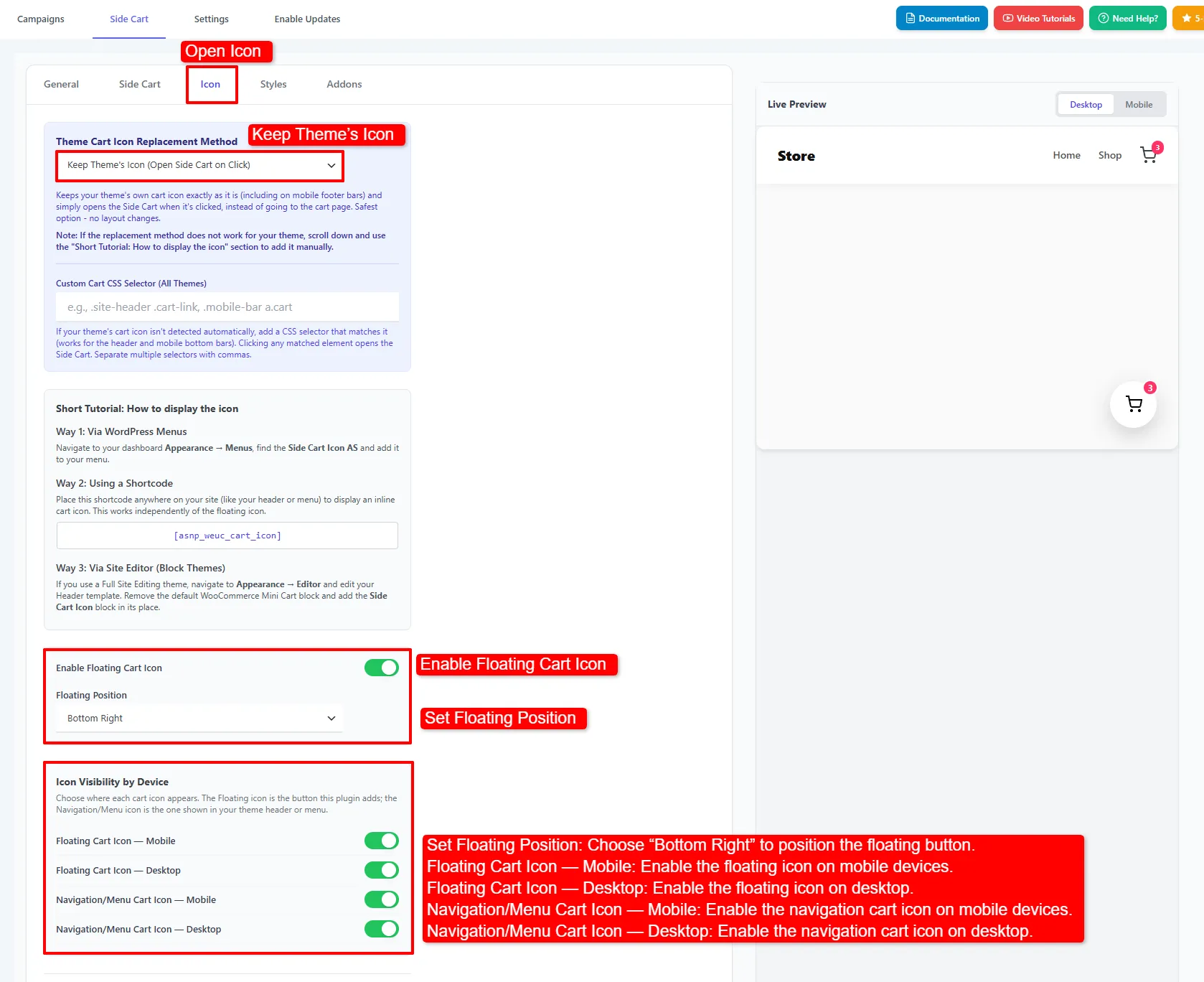
The Icon tab controls how shoppers reopen a closed drawer. For the simplest setup, enable Enable Floating Cart Icon and choose a position such as Bottom Right. Then check that it does not cover a chat widget or mobile navigation.

Icon tab showing the existing theme icon, floating cart position, and Pro device controls.
Use a floating icon or keep your theme icon. The separate device visibility controls shown here are Pro.

If your theme already has a cart icon, try Keep Theme’s Icon (Open Side Cart on Click). This preserves the theme’s icon while changing what happens when shoppers click it. However, a custom theme trigger may need additional configuration. You can use the floating icon to complete this no-code tutorial without entering a CSS selector.

Pro control in this screenshot: separate mobile and desktop visibility switches for floating and navigation icons require Pro. They are optional; the basic floating icon is available in the free plugin.

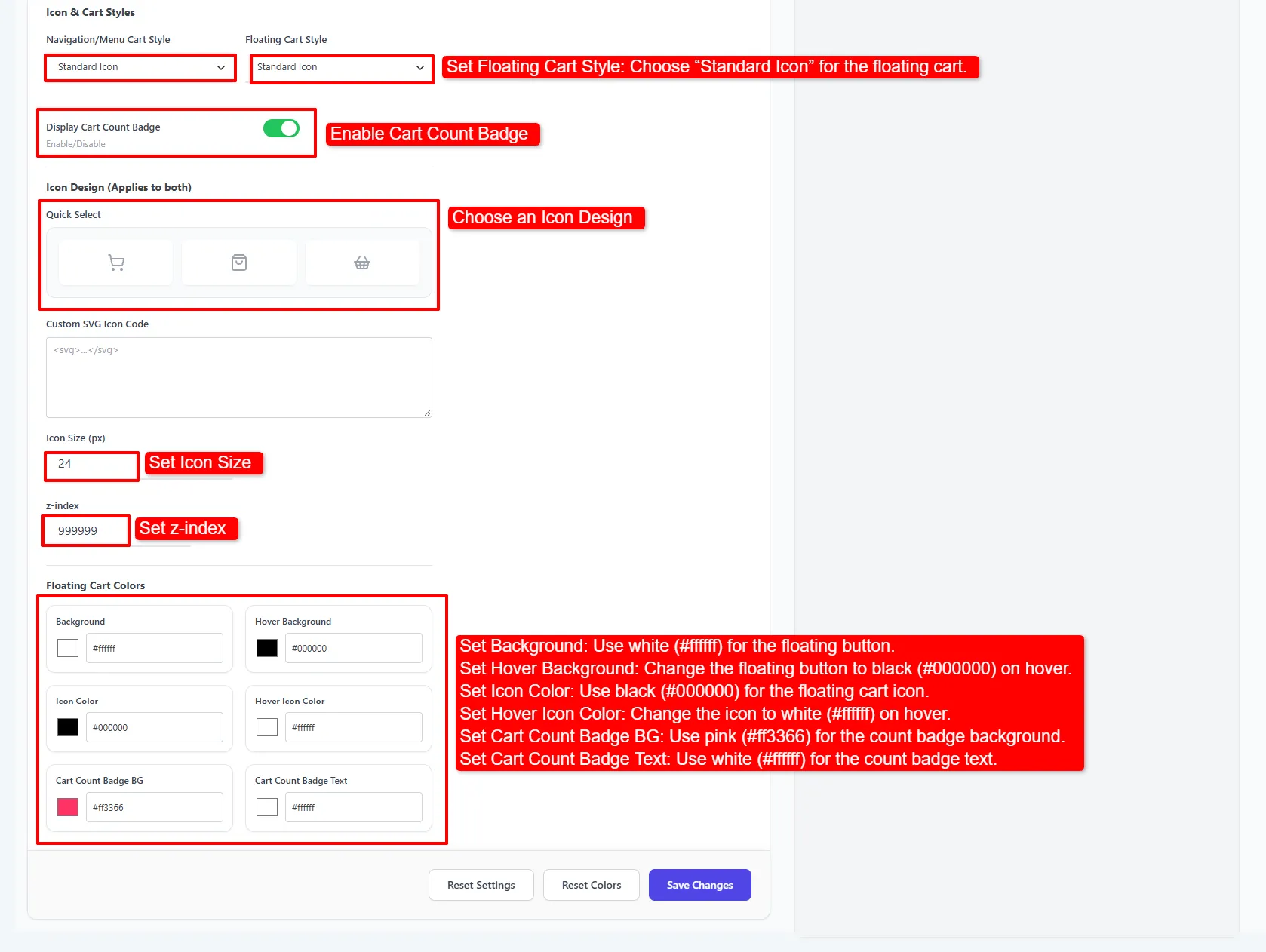
Next, choose Standard Icon, turn on Display Cart Count Badge, and select a preset under Quick Select. Because presets are built in, you can leave the Custom SVG Icon Code field empty.

Icon presets, count badge, size, and floating button colors.
Choose a preset icon and readable colors without entering custom SVG code.

For example, the screenshot pairs a white icon background with a black cart symbol and a pink count badge. You can choose your own colors instead. Also check the hover colors so the icon stays visible when a customer points at it. Click Save Changes after adjusting the size and colors.

5. Style the WooCommerce side cart without code

Open Styles to change the drawer background, heading, prices, and buttons. Start with your store’s normal text and background colors. Then give Checkout enough contrast to stand out from View Cart.

Drawer Styles tab with background, text, price, and checkout button color controls.
Match the drawer and button colors to your storefront.

Use the color pickers or enter hex values in the settings; neither method requires editing a theme file. Also review the hover states and close icon. Finally, compare Desktop and Mobile in the live preview, then save your changes.

At this point, you have learned how to add a side cart to WooCommerce without code and style the basic drawer. The next section is optional. You can skip ahead to testing if you only need the cart panel.

6. Add optional WooCommerce side cart upsells

Once you know how to add a side cart to WooCommerce without code, product offers are an optional next step. Open Addons → Upsells and switch on Enable Upsells. The free edition supports up to three side-cart upsell rules. Therefore, start with one clear recommendation before adding more conditions.

Create an offer from a product category

In General, choose All matched rules (Combine applicable products) to combine offers from eligible rules. Alternatively, choose First match wins when you want one matching rule to take priority.

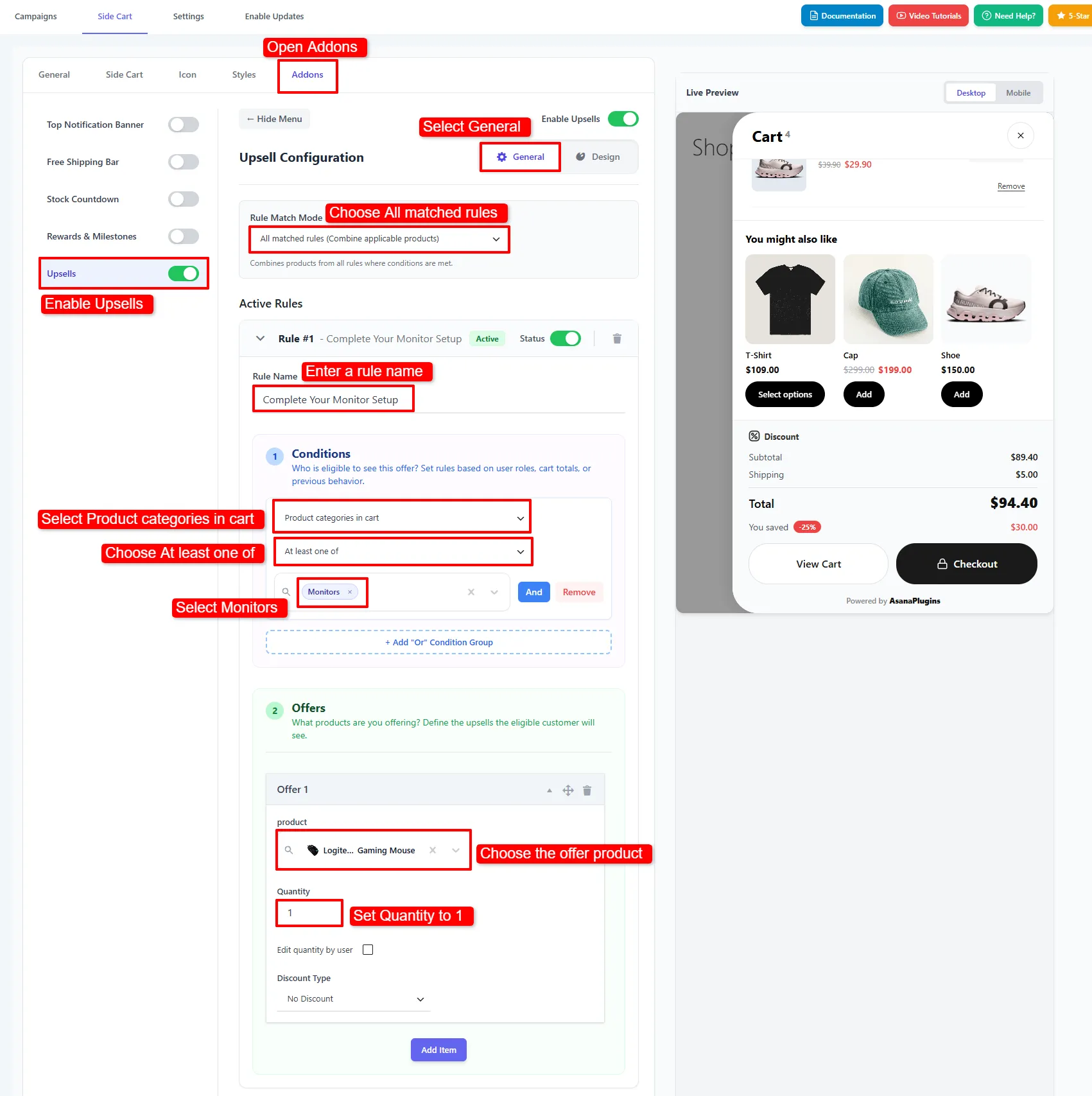
WooCommerce side cart upsell rule targeting the Monitors category and offering a mouse with no discount.
Create a category-based offer and choose the product, quantity, and optional discount.

Name your first rule Complete Your Monitor Setup. Then choose Product categories in cart → At least one of → Monitors. Under Offers, select a mouse, set Quantity to 1, and keep No Discount if you want to charge its normal price.

The mouse is a complementary product, so this is a cross-sell even though the settings group it under Upsells. Replace Monitors and the example mouse with a category and product from your own store. Also leave the rule’s Status switch enabled.

Use cart totals for more offers

The next screenshots show two more examples. First, the $100 Cart Bonus – Headset rule uses Subtotal excluding tax → Greater equal to → 100. It offers two headsets at 10% off and a controller at 3% off.

In contrast, Premium Monitor Setup requires a Monitors item and a subtotal greater than 150. Its keyboard offer has a 5% discount. Because these are example thresholds, adjust them to your store currency and margins.

Use the gallery arrows to compare the rules, or open the subtotal rule screenshot and combined-conditions screenshot at full size.

Keep the difference between the operators in mind: Greater equal to includes the threshold itself, while Greater than does not. Also use the subtotal excluding tax when testing these examples; the final checkout total may include shipping and tax.

Choose fallback products and style offers

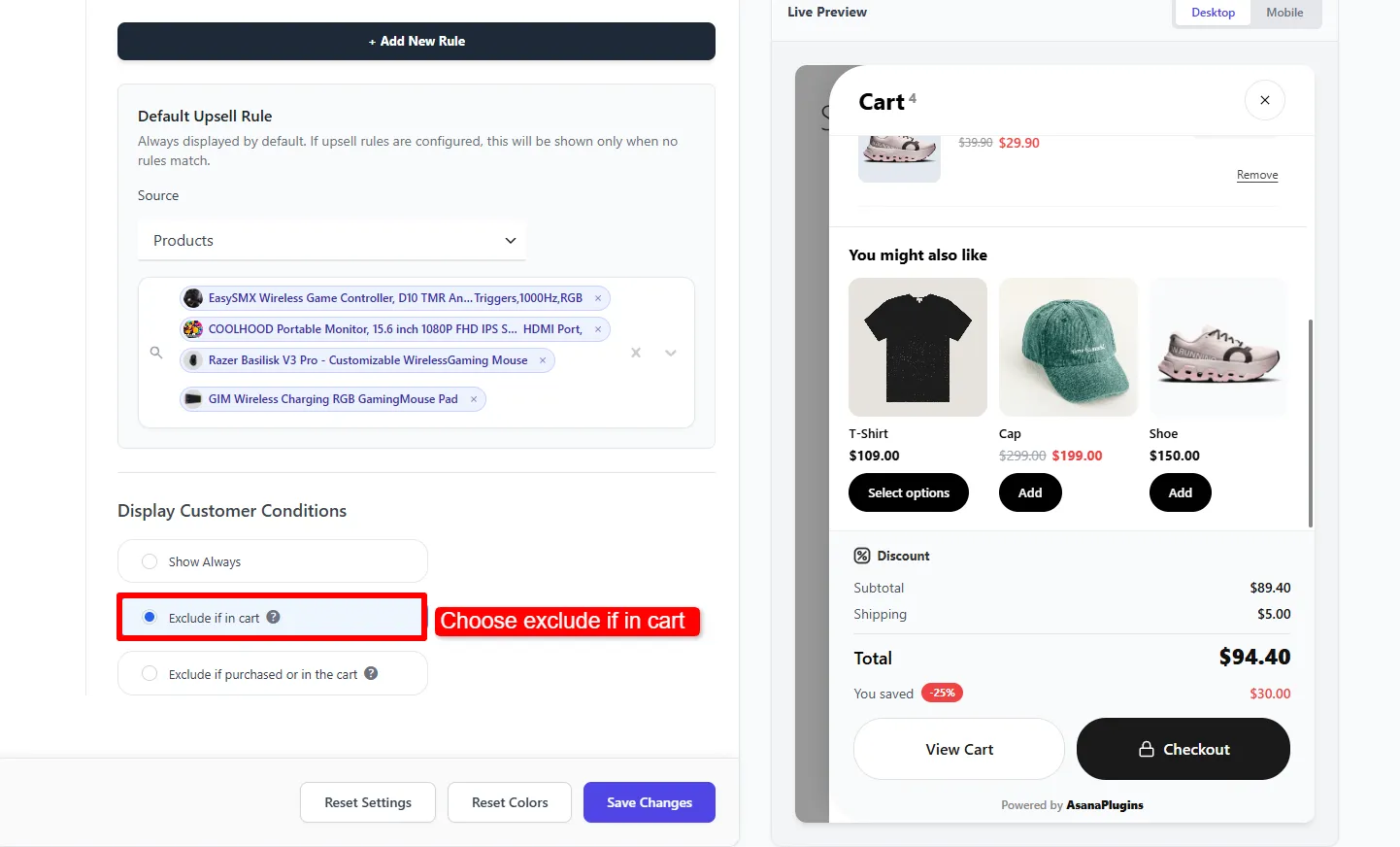
Under Default Upsell Rule, select Products and choose fallback items. These appear when no active rule matches. However, they are still optional, so leave the selection empty if you want recommendations only for matched rules.

Default product selection and the Pro Exclude if in cart control.
Choose fallback products. The highlighted Exclude if in cart option requires Pro.

Pro control in this screenshot: Display Customer Conditions, including Exclude if in cart, requires Pro. You can configure the free rules without enabling that control. For the exact rule limits, see the side-cart upsell documentation.

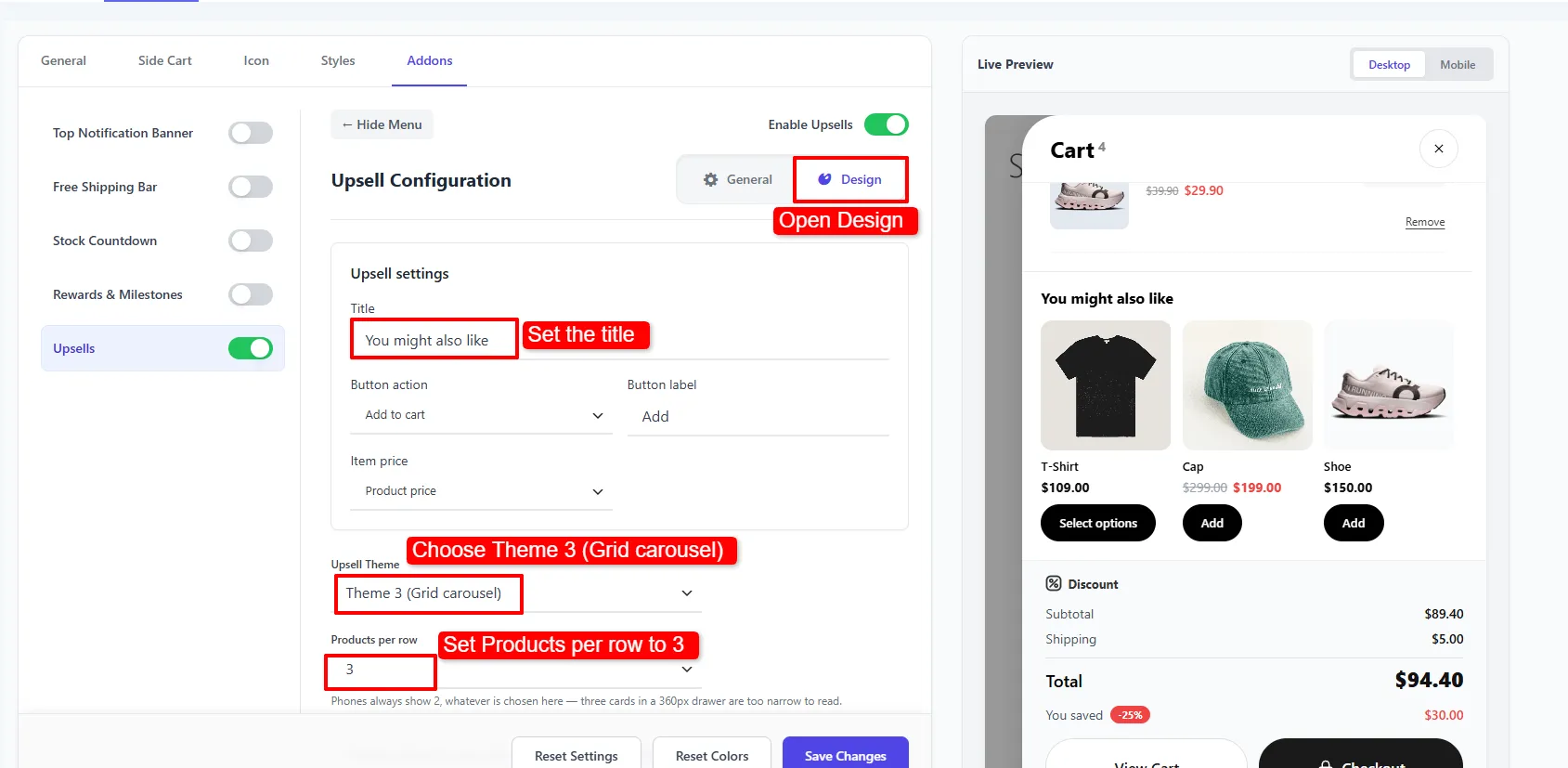
Next, open Design. Use a clear title such as You might also like, set Button action to Add to cart, and choose a short label such as Add. The screenshot uses Theme 3 (Grid carousel) with three products per row; phones show two.

WooCommerce side cart upsell Design tab with the recommendation title, Add button, and Theme 3 grid carousel.
The offer grid uses its own theme and products-per-row setting.

Finally, match the offer colors to the drawer and click Save Changes. These recommendation layouts are separate from the main drawer’s Style 1 and Style 2 choices. The premium drawer theme, free-shipping progress bar, rewards, banner, and countdown are not required for this setup. You can return to offer styling later if you only need to know how to add a side cart to WooCommerce.

Offer color controls and highlighted Save Changes button.
Set offer colors and save the completed upsell configuration.

7. Test the side cart on your storefront

Open your store in a logged-out or private browsing window. First, add a simple product and check that the drawer opens. Then change its quantity, remove it, and add it again. The item count and totals should follow each action.

WooCommerce side cart open over a gaming shop with cart items, product offers, totals, and checkout buttons.
Storefront example after setup: shoppers can review the basket and optional offers in one drawer.

Next, test a variable product after choosing its options. Also try a valid coupon if you enabled the coupon field. Finally, follow View Cart and Checkout to confirm that the drawer leads to your assigned pages.

If you added offers, test a matching category and a cart that does not match. Then test values below, at, and above each subtotal threshold. Because the rule uses the subtotal excluding tax, compare the same amount when checking eligibility.

Repeat the checks at phone width. In particular, confirm that you can scroll the drawer, close it, and reach Checkout. The admin preview is useful, but your live theme, products, and other plugins determine the final result.

Fix common setup problems

Why does the side cart not open?

First, check Display Side Cart and Auto Open Side Cart. Then check Visibility and Exclude Pages. If the floating icon works but the theme icon does not, revisit the Icon tab or keep using the floating trigger.

Why does the drawer show old items?

Confirm that AJAX updates are enabled, then clear any site and browser caches. Next, retest with script delay or combination temporarily disabled on a staging copy. If that resolves the issue, narrow down the conflicting optimization before changing your live settings.

Why are offers missing?

Check Enable Upsells, the rule Status, and whether the basket meets every condition in the group. Also confirm that the offer product is available to buy. Finally, check the fallback products if no rule should match.

Common questions

Can I add a side cart to WooCommerce for free?

Yes. The free plugin includes the basic drawer, floating cart icon, and up to three side-cart upsell rules. However, the premium drawer theme and several extra controls shown in the screenshots require Pro.

Does this replace the Cart page?

No. It adds a quick basket view while leaving the normal Cart page available. Therefore, keep your Cart and Checkout pages assigned and test their links after setup.

Do I need to edit my theme or add code?

No code is needed for the floating-icon setup in this guide. Use the preset icon, color controls, and built-in buttons. If your custom header icon needs a selector, you can use the floating icon instead.

Your next step

You now know how to add a side cart to WooCommerce without code, from enabling the drawer to checking checkout links. Start with the basic cart and then add one relevant offer. For more settings, use the complete side-cart setup documentation, or revisit our free plugin comparison before choosing your preferred tool.
Posted on — Leave a comment

How to Add Product Badges in WooCommerce: Free + Pro Methods (2026)

Learning how to add product badges in WooCommerce helps you make important product information visible before a shopper opens a product page. A simple “30% Off,” “New Arrival,” “Low Stock,” or “Free Shipping” label can help visitors understand an offer while they scan a WooCommerce shop or category page.

In this guide, you’ll learn how to add product badges in WooCommerce without custom theme code. We’ll start with the free version of Sale Badges and Product Labels for WooCommerce, then cover the Pro features that help when you need image badges, advanced targeting, countdown timers, notification bars, or store-feature tools.

Quick answer: install and activate the plugin, open Sale Booster in WordPress, create a badge, choose its design, assign a product condition, and save. The badge then appears on matching products in your shop or product pages.

How to Add Product Badges in WooCommerce: What You Need

A WooCommerce product badge is a visual label displayed on a product image or product card. It can communicate a promotion, product status, availability, or a useful buying detail without changing the product title.

Common examples include:

  • Promotion: Sale, 20% Off, Black Friday, or Clearance.
  • Availability: Sold Out, Back in Stock, Limited Stock, or Pre-Order.
  • Merchandising: New Arrival, Best Seller, Featured, or Staff Pick.
  • Service information: Free Shipping, Handmade, or Secure Payment.
  • Urgency: a countdown timer for a genuine limited-time offer.
WooCommerce includes a default “Sale!” indicator for sale-priced products, but it does not provide a complete visual badge system for every use case. A badge plugin adds reusable designs, targeting rules, placement controls, and—depending on the version—timers and campaign bars.

How to Add Product Badges in WooCommerce: Choose a Method

MethodBest forWhat you get
Custom codeDevelopers with a very specific theme workflowMaximum control, but you maintain the PHP/CSS and compatibility yourself
Free pluginMost stores adding text, CSS, or basic automatic labelsVisual badge creation, live preview, product/category/tag rules, sale and stock conditions, scheduling, and shortcode support
Pro pluginCampaigns and advanced merchandisingImage and modern badge libraries, advanced customer/product rules, countdowns, notification bars, popups, embeds, Quick View, and Sticky Add to Cart

For most store owners, the free plugin is the simplest way to learn how to add product badges in WooCommerce and replace a plain sale indicator with a consistent badge system. You can upgrade later when your campaigns need features that are not part of the free version.

How to Add Product Badges in WooCommerce: Install the Free Plugin

Before you begin, make sure WooCommerce is installed and active. The plugin requires WooCommerce because its display rules read product, sale, stock, category, and tag data from your store.

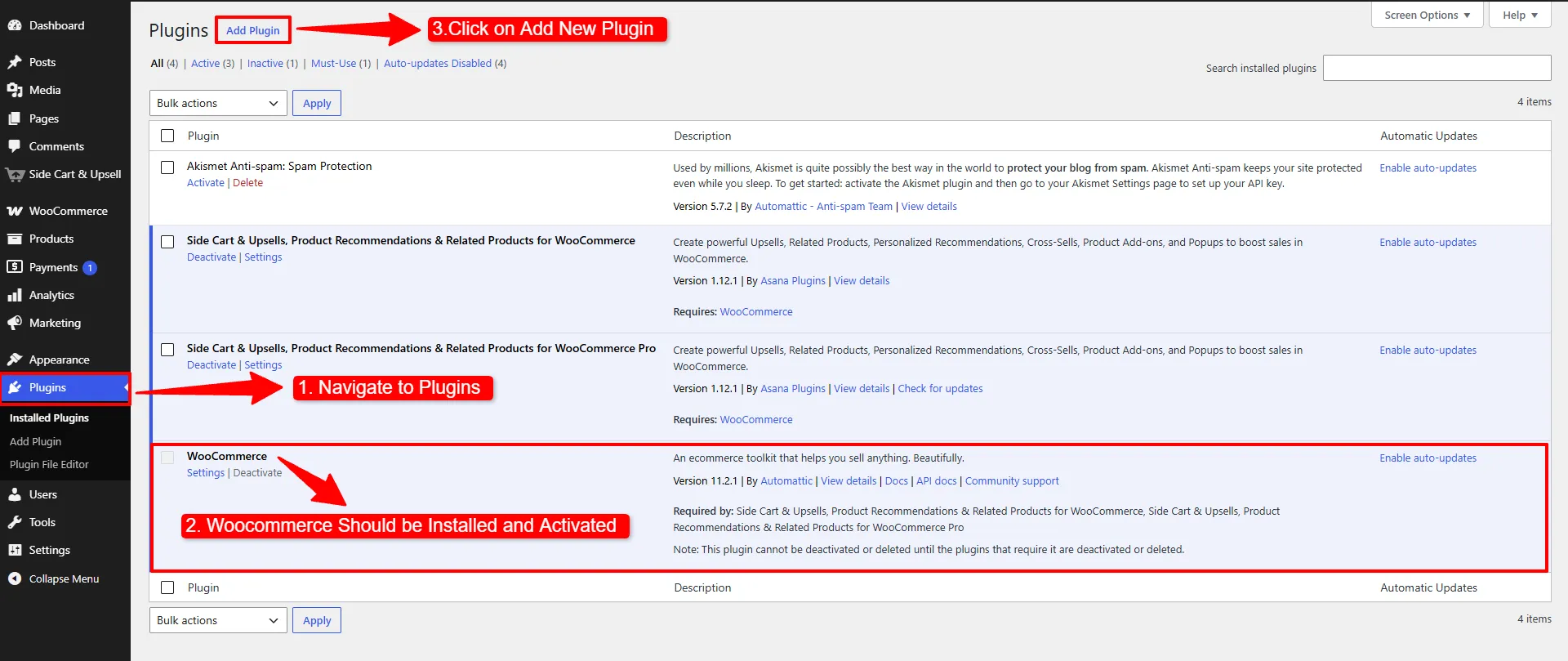
  1. In WordPress, go to Plugins → Add New.
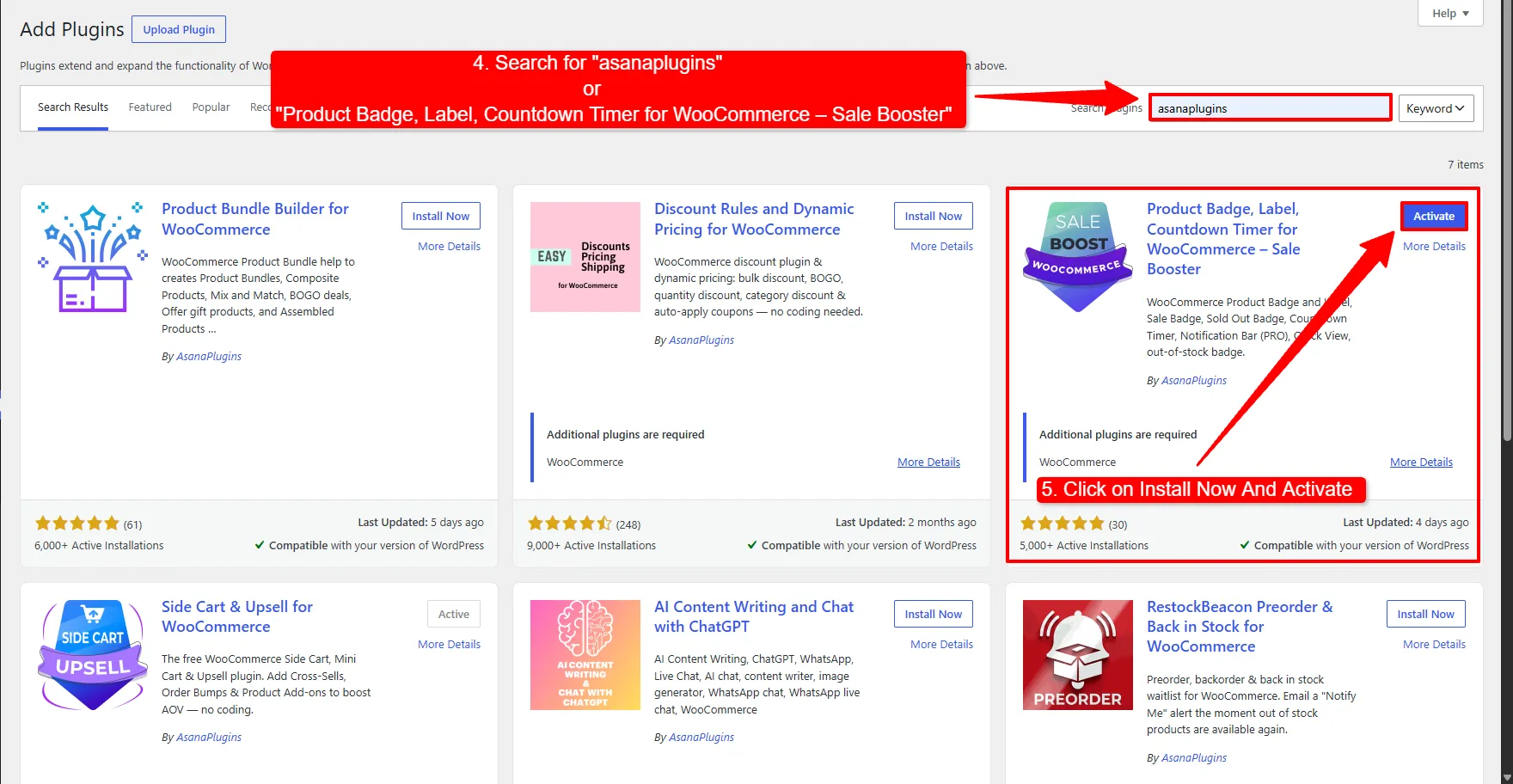
  2. Search for Sale Badges and Product Labels for WooCommerce.
  3. Click Install Now, then Activate.
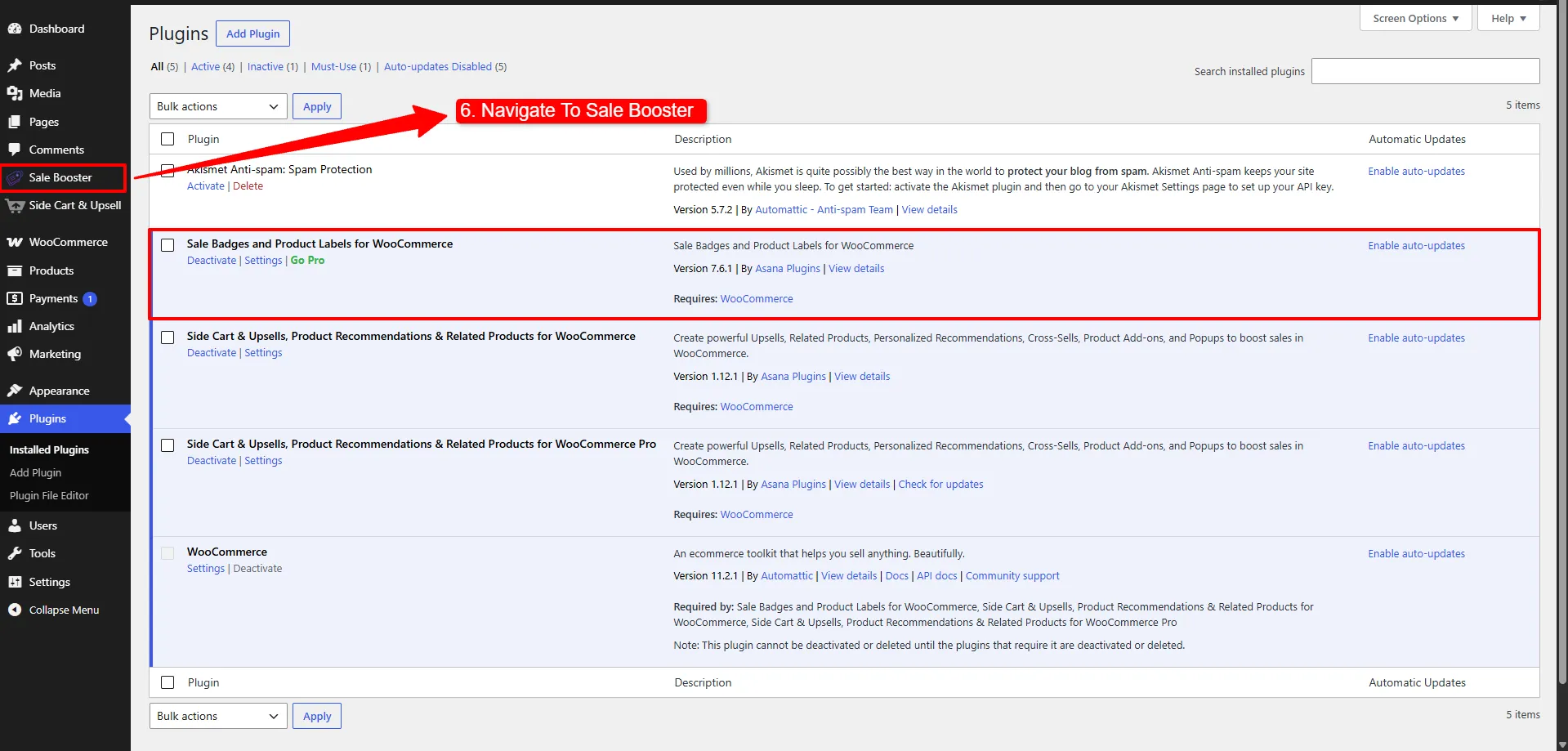
  4. Open Sale Booster from the WordPress admin menu.

You can also download the plugin from the WordPress.org plugin directory. Keep WooCommerce active while configuring the badges so the product selector and conditions can load correctly.

WordPress Plugins screen with WooCommerce active and Add New Plugin highlighted
First, check that WooCommerce is active, then click Add New Plugin.
Search results showing the Sale Booster plugin and its Activate button
Search for the plugin, click Install Now, and then Activate.
Activated Sale Booster plugin and its WordPress admin menu entry
After activation, open Sale Booster from the WordPress menu.

How to Add Product Badges in WooCommerce: Create Your Badge

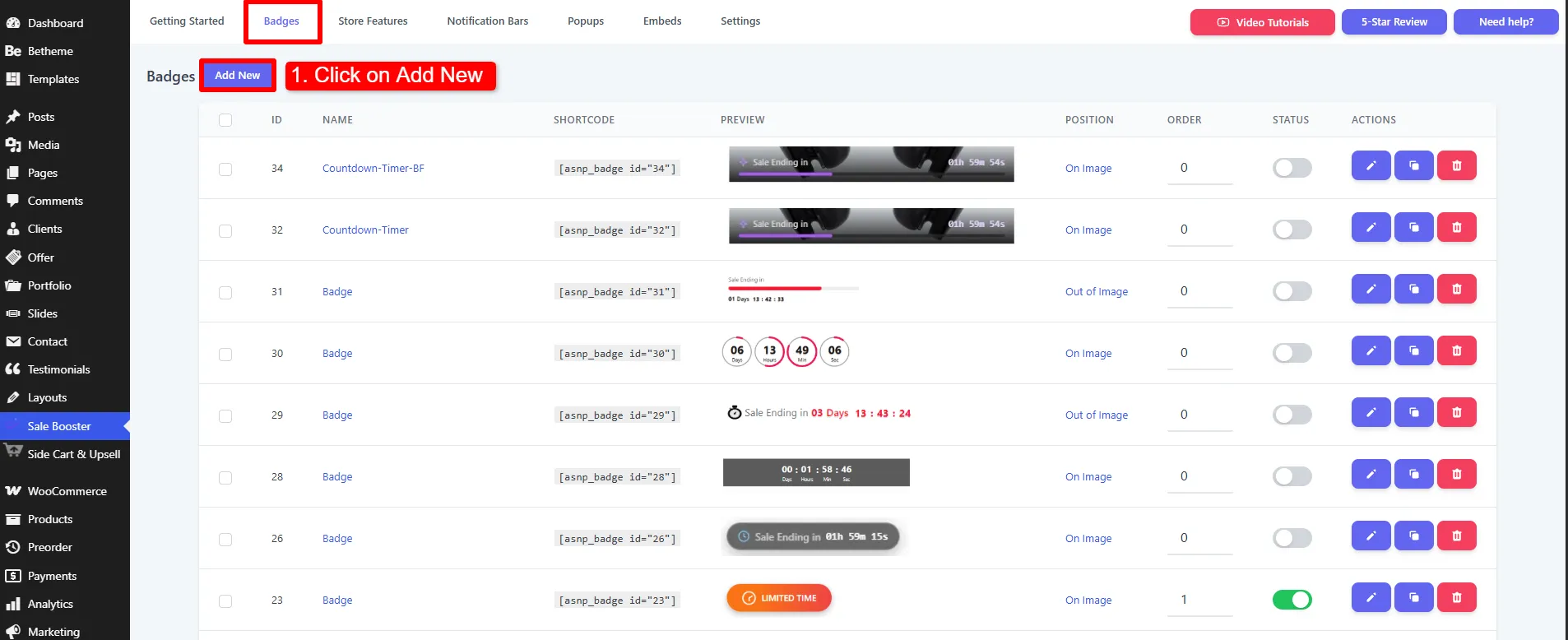
From Sale Booster, open the badges screen and choose Add New. Give the badge an internal name that describes its purpose, such as “Summer Sale,” “New Arrival,” or “Free Shipping.” Turn on its status when you are ready to preview it.

Add product badges in WooCommerce using the Sale Booster Badges tab and Add New button
Go to Sale Booster → Badges → Add New.

Use a name that will still make sense when your badge library grows. The internal name is for administration; the customer-facing label is configured in the badge design settings.

Choose a badge type

The free version includes flexible CSS labels and a basic fixed-date countdown. Start with a CSS label when you want short text that adapts cleanly to your theme. The screenshots also show Pro options; use the feature labels below to choose the right method.

  • CSS label: a text-based badge with selectable shapes, colors, typography, position, and effects.
  • Image label: an uploaded or library image, available in Pro.
  • Modern or advanced label: preset visual treatments and deeper style controls, available in Pro.
  • Countdown timer: a basic fixed-date timer is included in Free; additional designs and evergreen timers are available in Pro.

Enter customer-facing text such as New, Best Seller, or {saved_percent} OFF when the dynamic discount placeholder is available in your editor. Dynamic placeholders are useful because the displayed discount can follow the product’s current pricing instead of requiring a separate badge for every percentage.

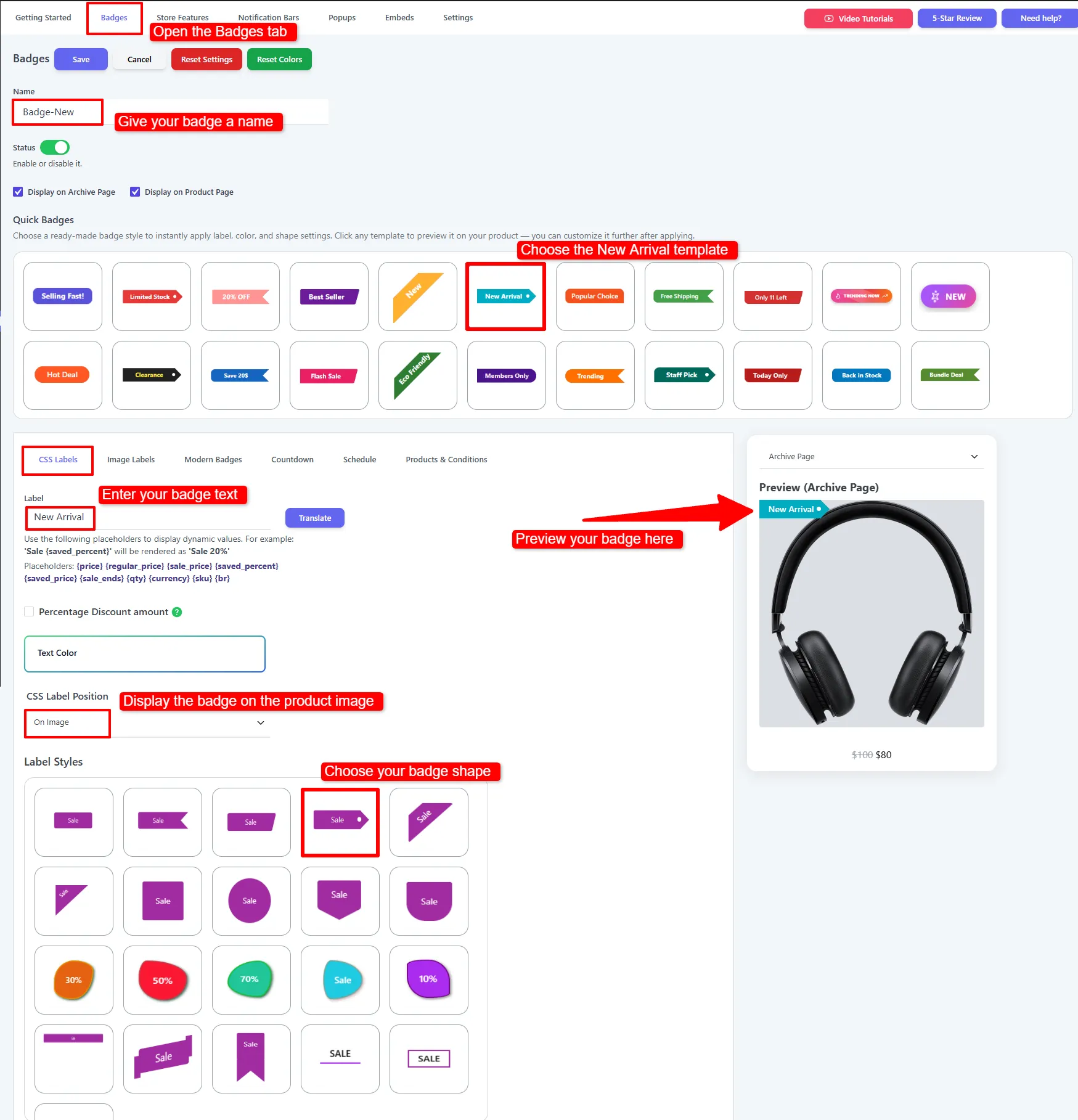
For the example below, name the badge Badge-New and choose New Arrival under Quick Badges. In CSS Labels, keep the label text short, select On Image, and choose a tag shape. Enable Display on Archive Page and Display on Product Page if you want both locations.

Design New Arrival product badges in WooCommerce with a CSS label and tag shape
Choose the New Arrival template, edit the label, and preview its shape on the product image.

Style and position your product badge

Use the live preview while you choose the shape, color, font size, weight, opacity, rotation, and position. The goal is to make the badge noticeable without hiding the product image, price, or product title.

Useful placement choices include top-left, top-right, bottom-left, and bottom-right. If the label overlaps a theme’s sale indicator, either move the new label or enable the option to hide the default WooCommerce on-sale badge. You can also adjust the hook or display position when a theme places product images in an unusual markup structure.

Keep the text short. “30% Off” is easier to scan than a sentence, while “Free Shipping” is usually clearer than a small icon with no explanation. On mobile, test the smallest product card in your grid; a badge that looks balanced on desktop can cover too much of the image on a narrow screen.

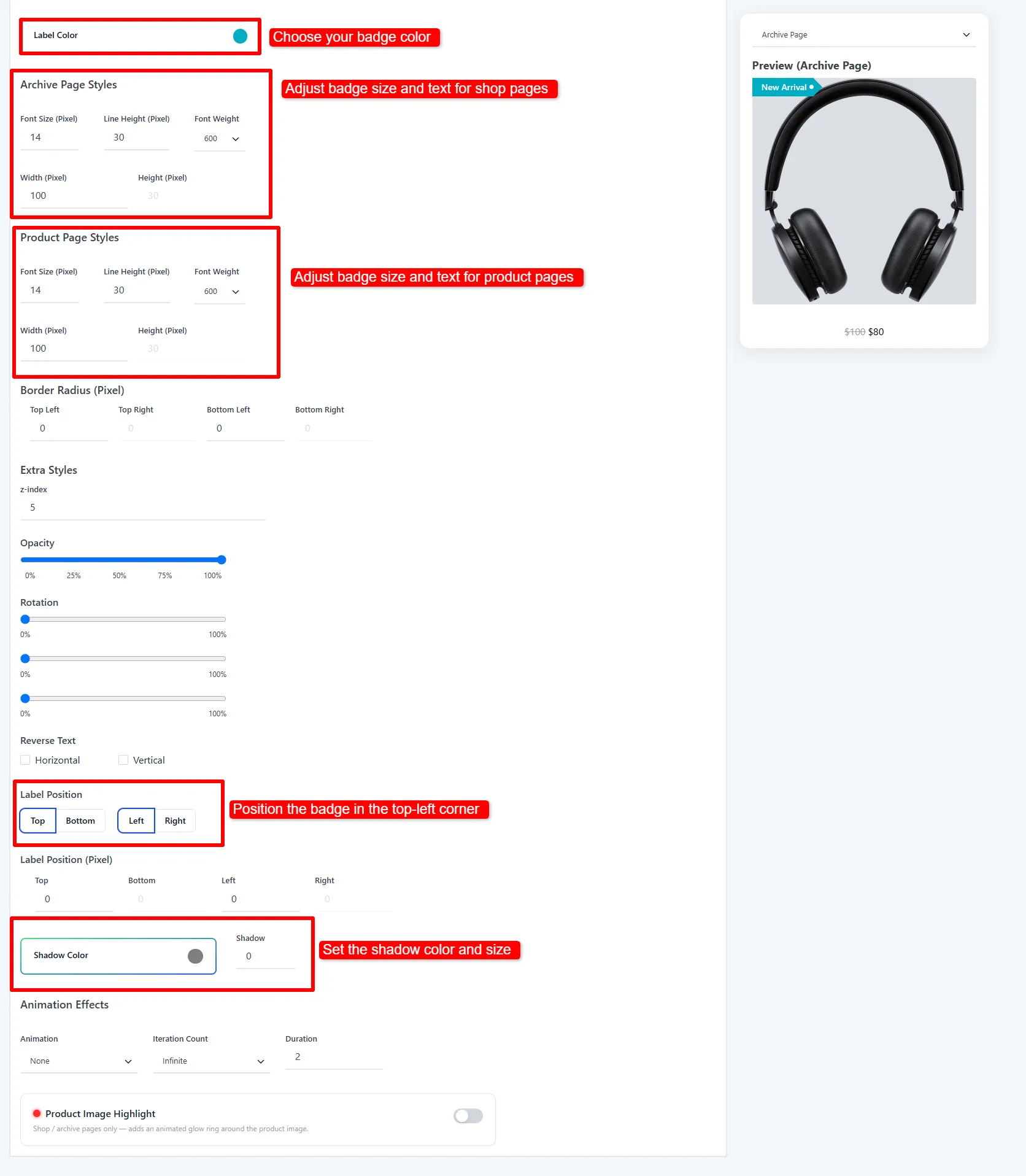
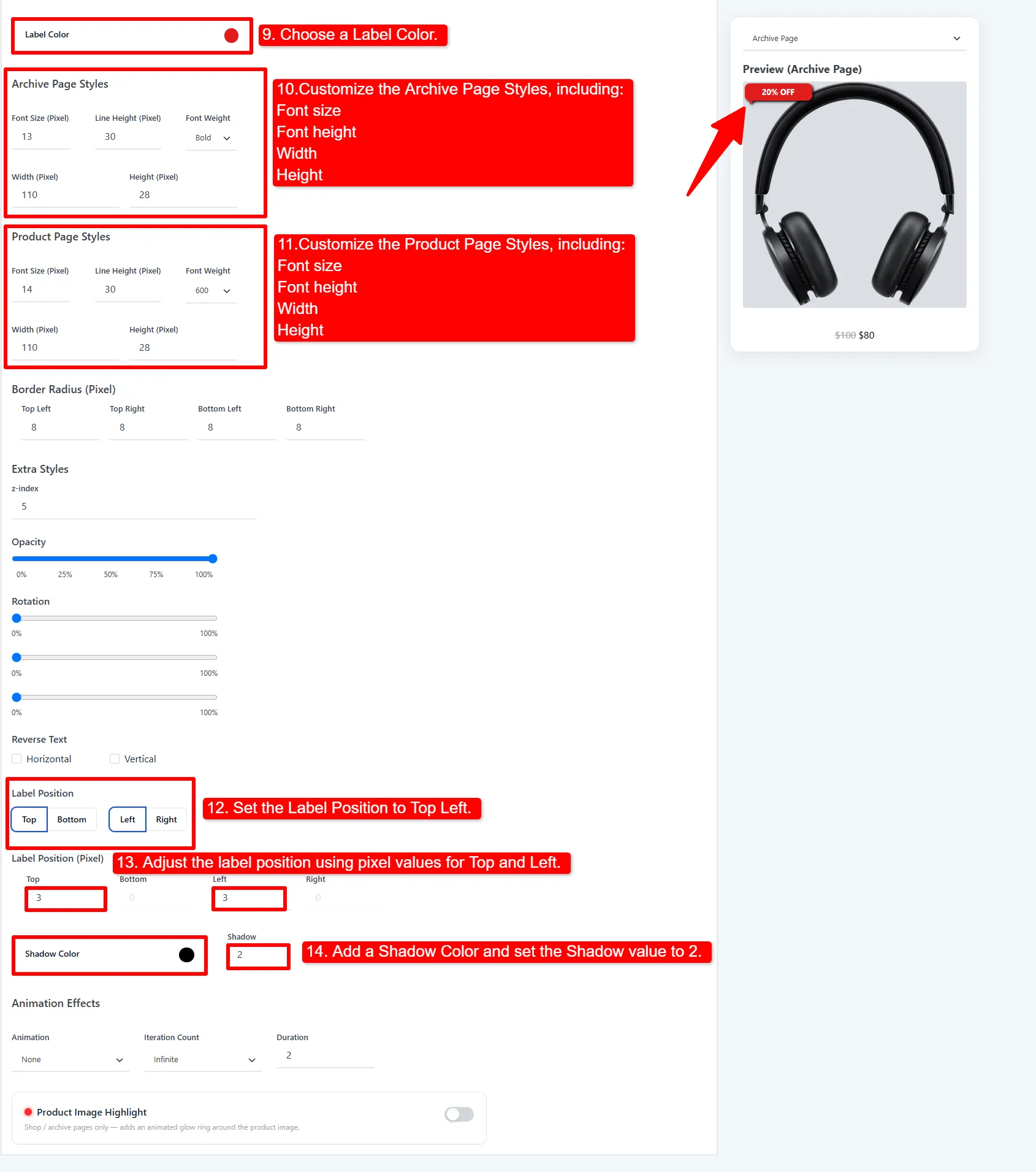
The screenshot uses a 14-pixel font, 30-pixel line height, font weight 600, and a 100-by-30-pixel badge. Treat these as a starting point: adjust the archive and product page styles separately, then check that the full label fits. Select Top and Left to place it in the upper-left corner.

Style controls for product badges in WooCommerce, including color, size, and top-left placement
Adjust the color and dimensions for both page types, then choose the badge position.

How to Add Product Badges in WooCommerce: Target Products

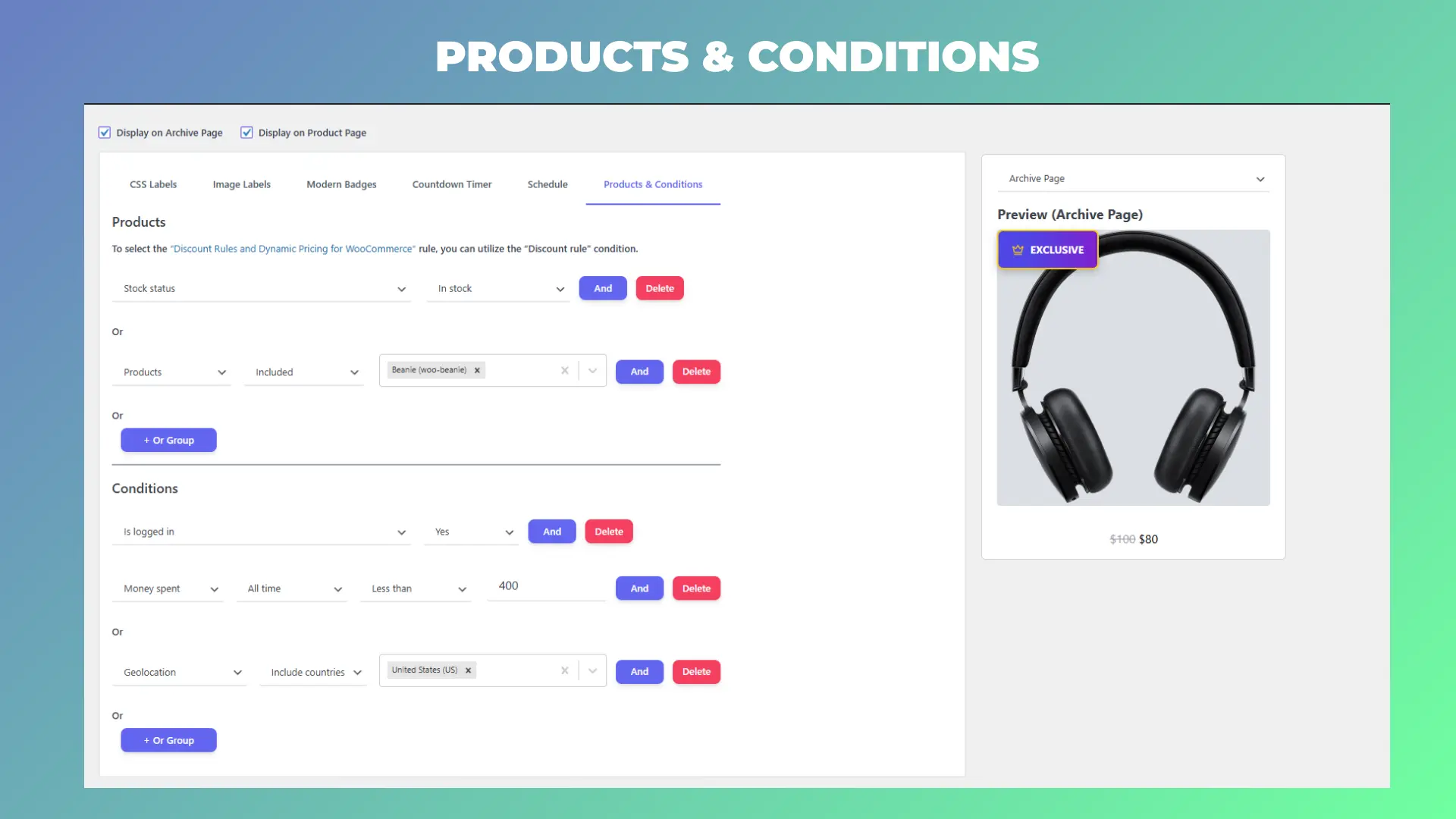
A badge becomes useful when it appears on the right products automatically. In the Products & Conditions area, choose the condition that matches your campaign.

  • Specific products: show the badge on a hand-picked set of products.
  • Category: target every product in a category such as Shoes or Summer Collection.
  • Tag: target products marked with a WooCommerce tag.
  • On sale: apply a sale label to products with an active sale price.
  • Stock status: show In Stock, Out of Stock, or Backorder labels.
  • All products: use a store-wide message when the same label belongs everywhere.

Use the narrowest condition that fits the message. A “Clearance” badge should not appear on every product just because the store has one clearance category. If you combine multiple rules, review the result on both a shop archive and a single product page.

Example: automatically label new arrivals (Pro)

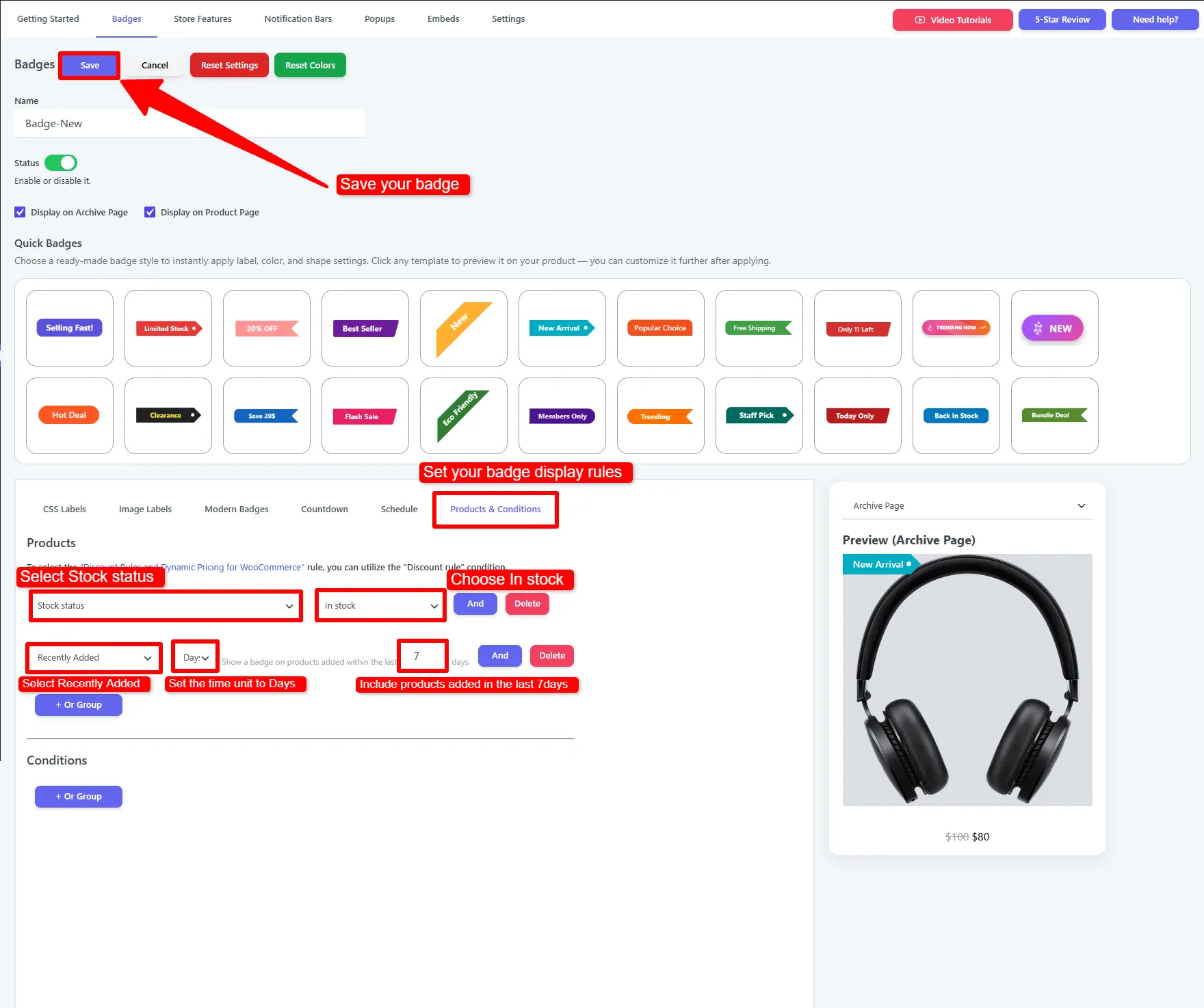
For a New Arrival badge, set Stock status → In stock. Click And in the same group, then choose Recently Added → Days → 7. This Pro rule shows the badge only when both conditions match. Click Save.

Keep these rules in one AND group. Putting them in separate OR groups would also label older products simply because they are in stock. In the free version, select your new products manually or use a dedicated product tag instead.

Rules for product badges in WooCommerce combining In stock AND Recently Added within 7 days
Pro example: show New Arrival only on in-stock products added within the last seven days.

For more examples, see the WooCommerce badge conditions documentation.

Add a dynamic percentage discount badge

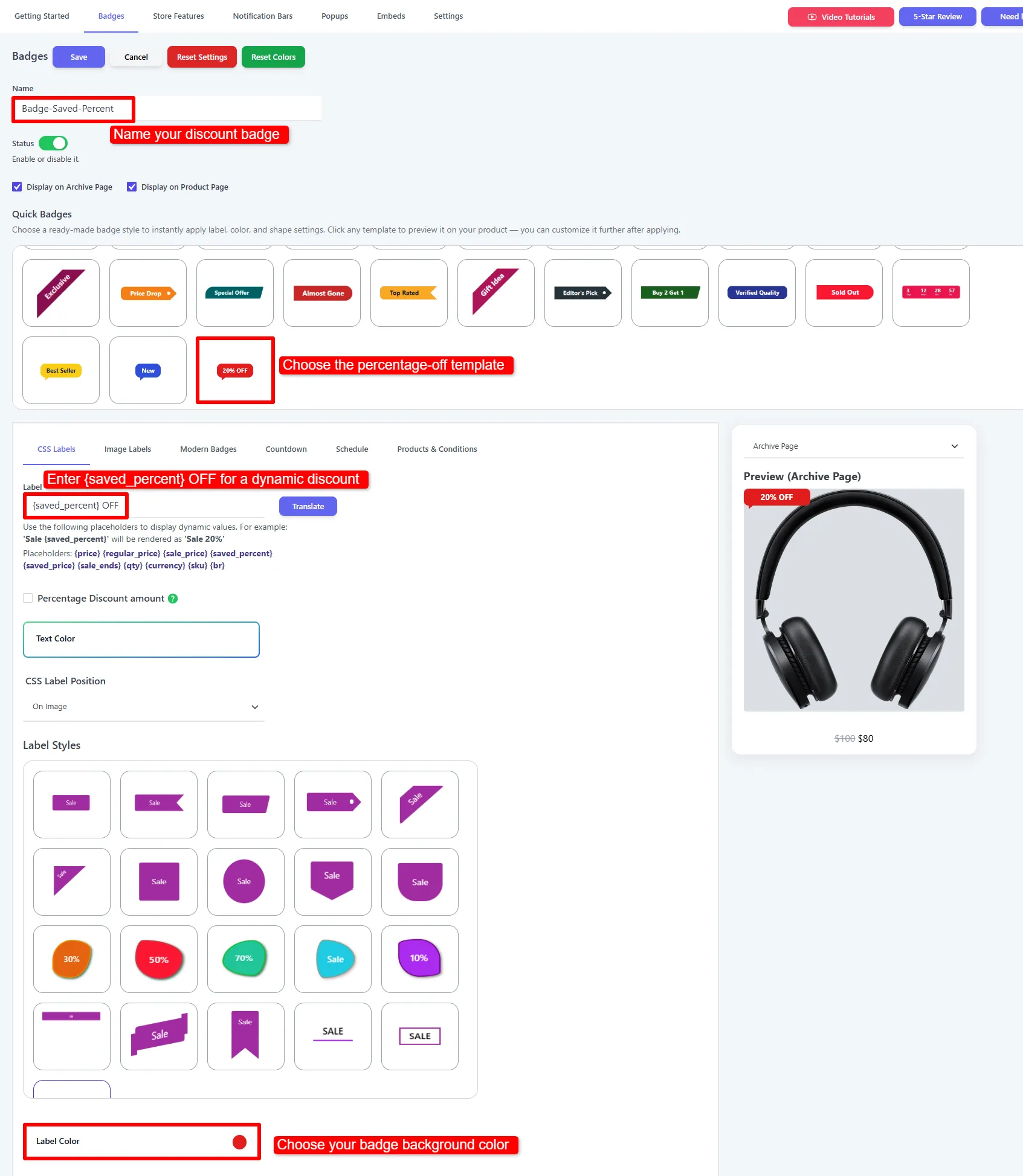
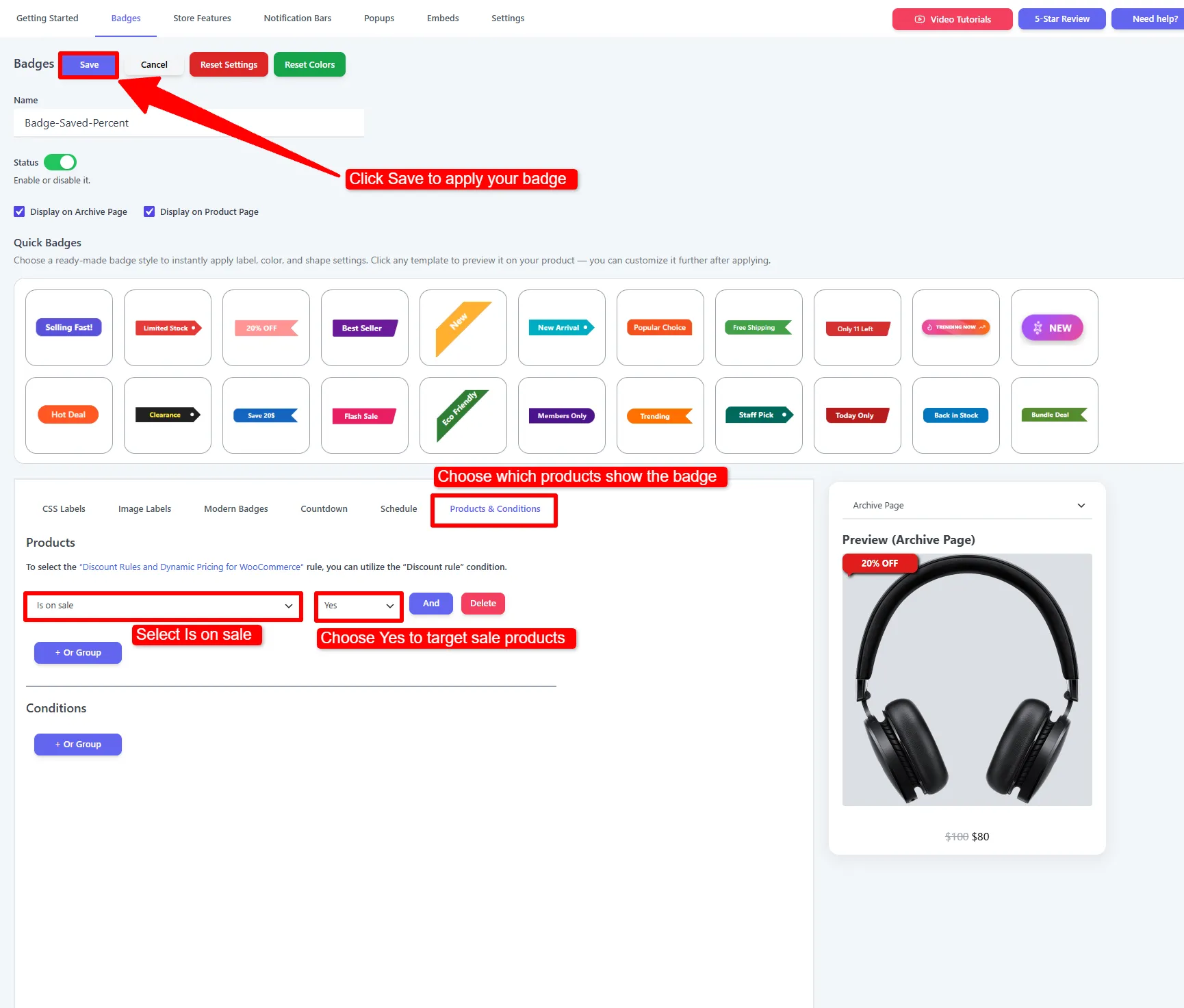
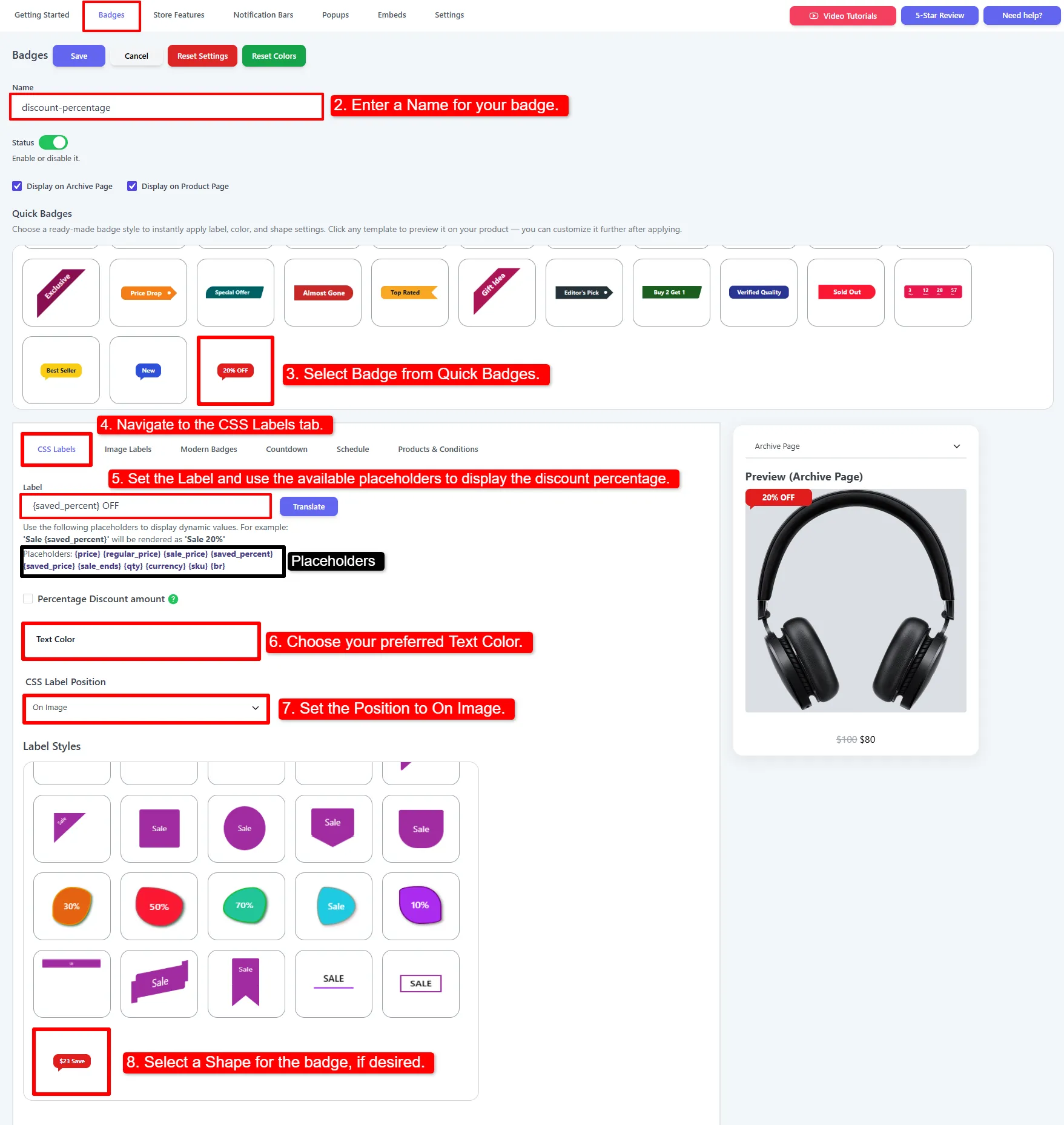
Create a second badge named Badge-Saved-Percent. Choose a percentage-off template, open CSS Labels, and enter {saved_percent} OFF in the Label field. The placeholder includes the percent sign, so you do not need to add another one. For example, a product reduced from $100 to $80 displays 20% OFF.

Add percentage-off product badges in WooCommerce using the saved_percent label placeholder
Enter {saved_percent} OFF so the discount text follows each product’s pricing.

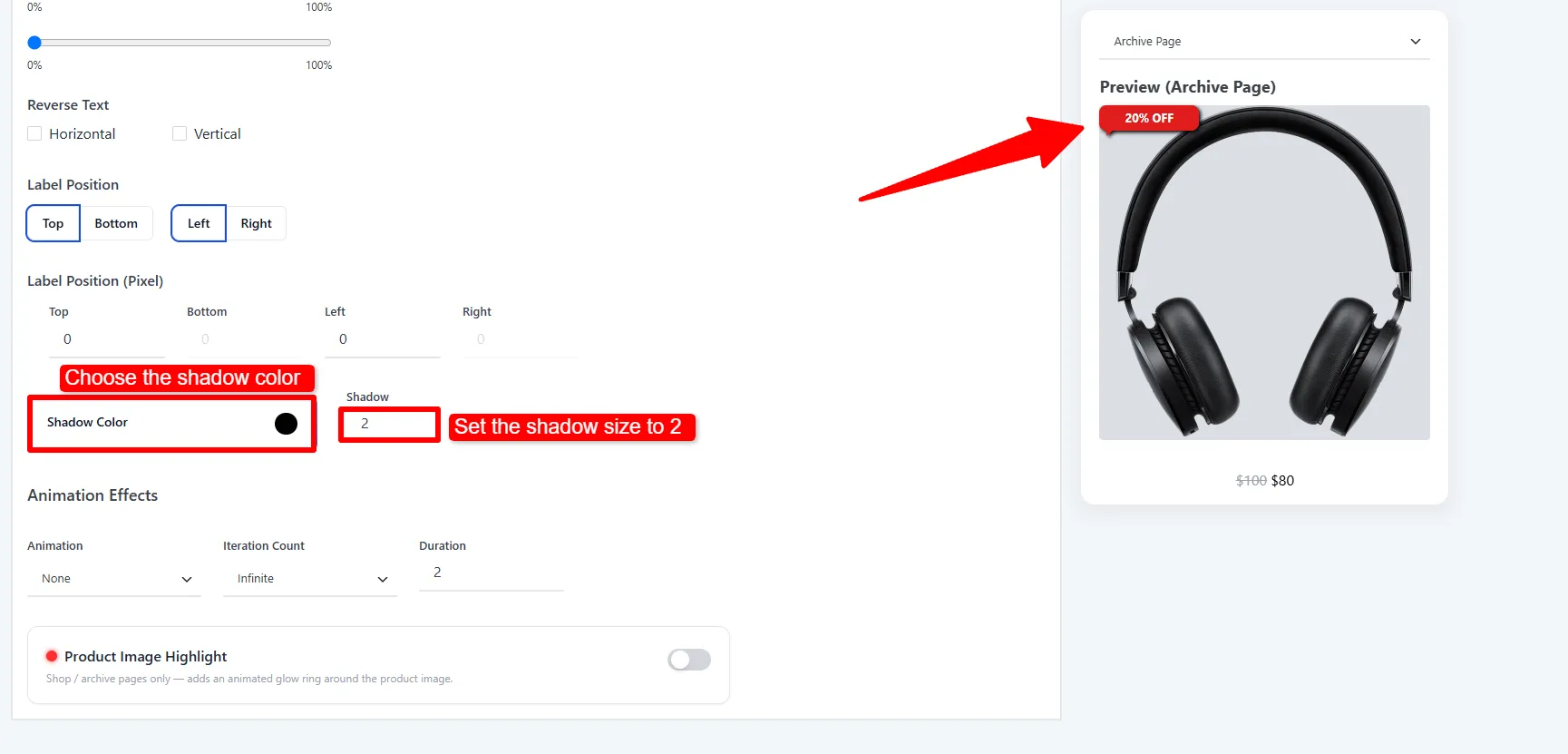
Choose a clear background and text color. If the label needs more separation from the product photo, set Shadow Color to black and Shadow to 2. Keep animation off when a static badge communicates the offer clearly.

Percentage discount badge preview with black Shadow Color and Shadow set to 2
Optional: use a black shadow with a value of 2 to separate the badge from the product image.

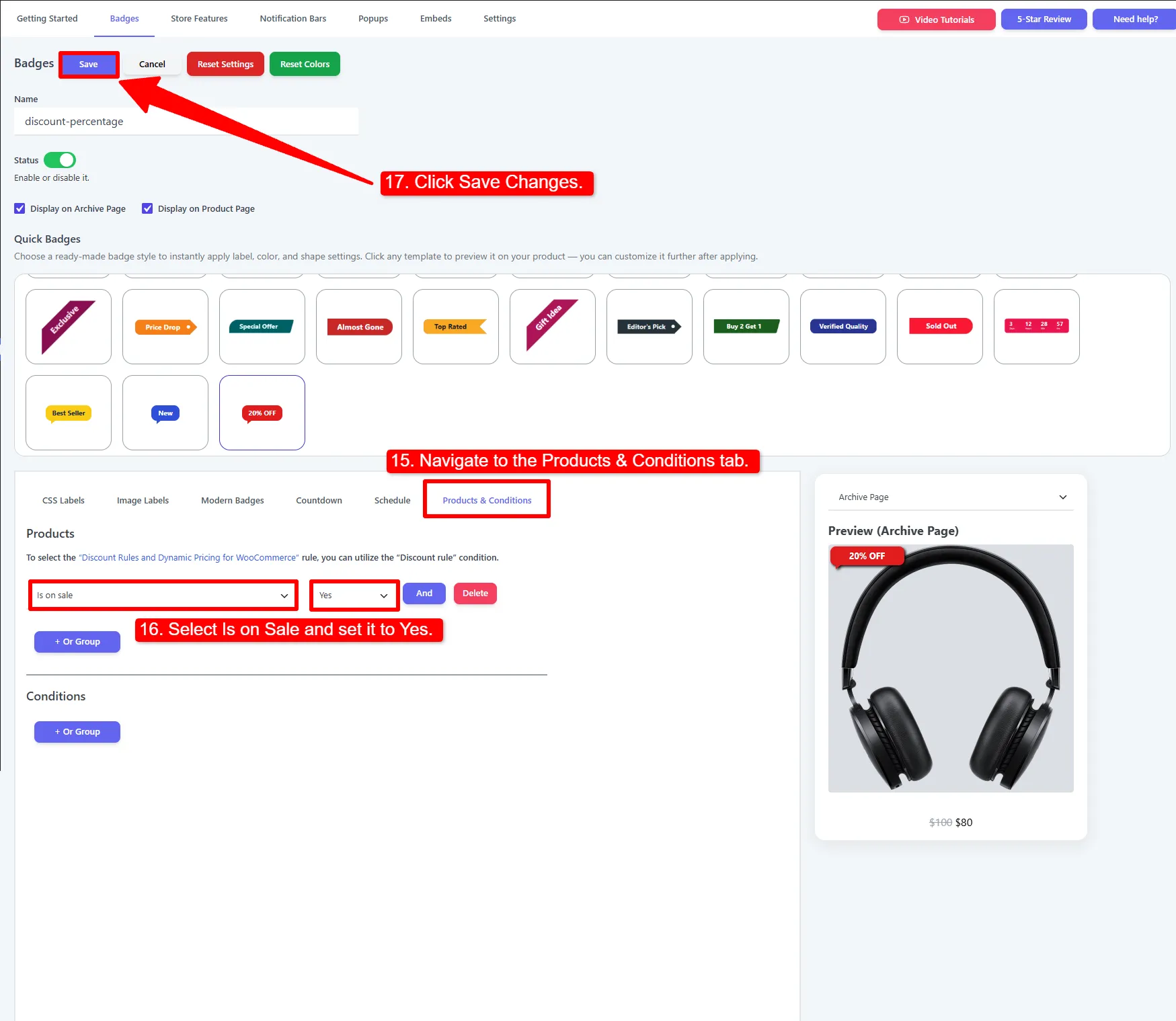
Next, open Products & Conditions and select Is on sale → Yes. Click Save. This targets discounted products instead of applying a discount claim to your entire catalog. Check products with different discounts and at least one product that is not on sale.

Apply product badges in WooCommerce to sale products with Is on sale set to Yes
Set Is on sale to Yes, then save the percentage discount badge.

How to Add Product Badges in WooCommerce: Verify the Result

Save the badge, then open a shop or category page that contains a matching product. Check the result at desktop and mobile widths. Also open a single product page if you want the badge there too.

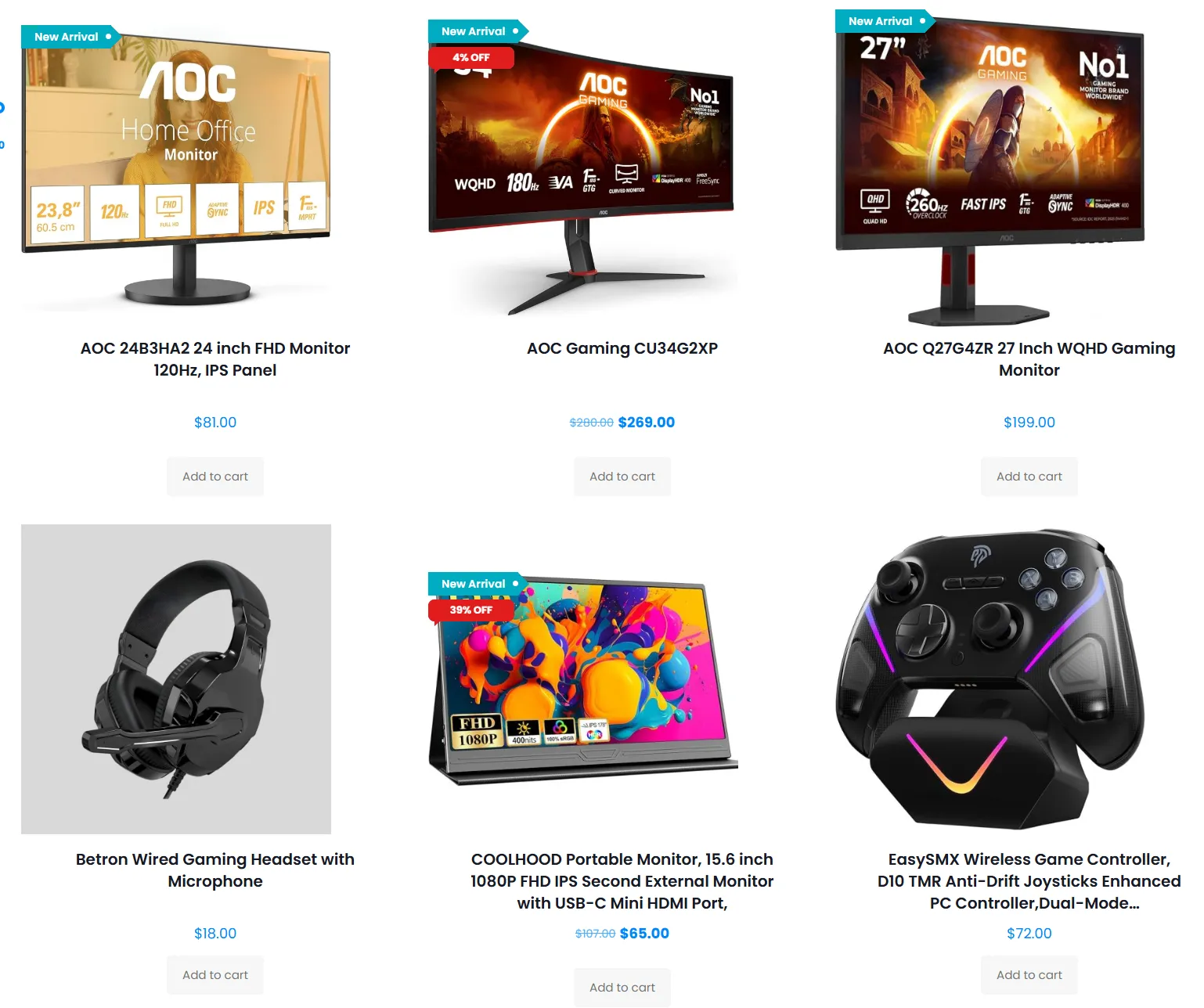
How to add product badges in WooCommerce: storefront showing New Arrival and percentage-off labels
Storefront result: New Arrival and dynamic discount badges appear on matching products.

If the badge does not appear, check these items first:

  1. The badge status is enabled.
  2. The product actually matches the selected condition.
  3. The badge is configured to show in the location you are viewing.
  4. Your theme has not moved or replaced the WooCommerce product-image hook.
  5. A cache or optimization plugin is serving an older page.
  6. The badge is not hidden by the global settings or a mobile-only rule.

How to Add Product Badges in WooCommerce with Pro

The Pro version is useful when a text label is not enough for your promotion. It adds a library of image labels, modern badge presets, advanced conditions, and campaign elements that work across product pages and the wider store.

Use image and modern badges

Choose from more than 200 image-label designs, upload your own artwork, or use modern gradient and preset badge styles. Image labels are a good fit for seasonal campaigns, “Black Friday,” “Pre-Order,” and other messages where the visual treatment matters as much as the words.

Target by customer or product data

Pro conditions can target user login status, user roles, total customer spend, quantity, regular price, sale price, total price, shipping class, best sellers, recently added products, and other product attributes. These rules let you show a VIP message to logged-in customers, a volume message to products above a quantity threshold, or a best-seller label without maintaining a manual product list.

Add a product countdown badge

A countdown badge can show the remaining time for a genuine limited-time offer. Free includes a basic fixed-date timer. Pro adds more timer designs and evergreen modes; the progress-bar design shown below is a Pro example.
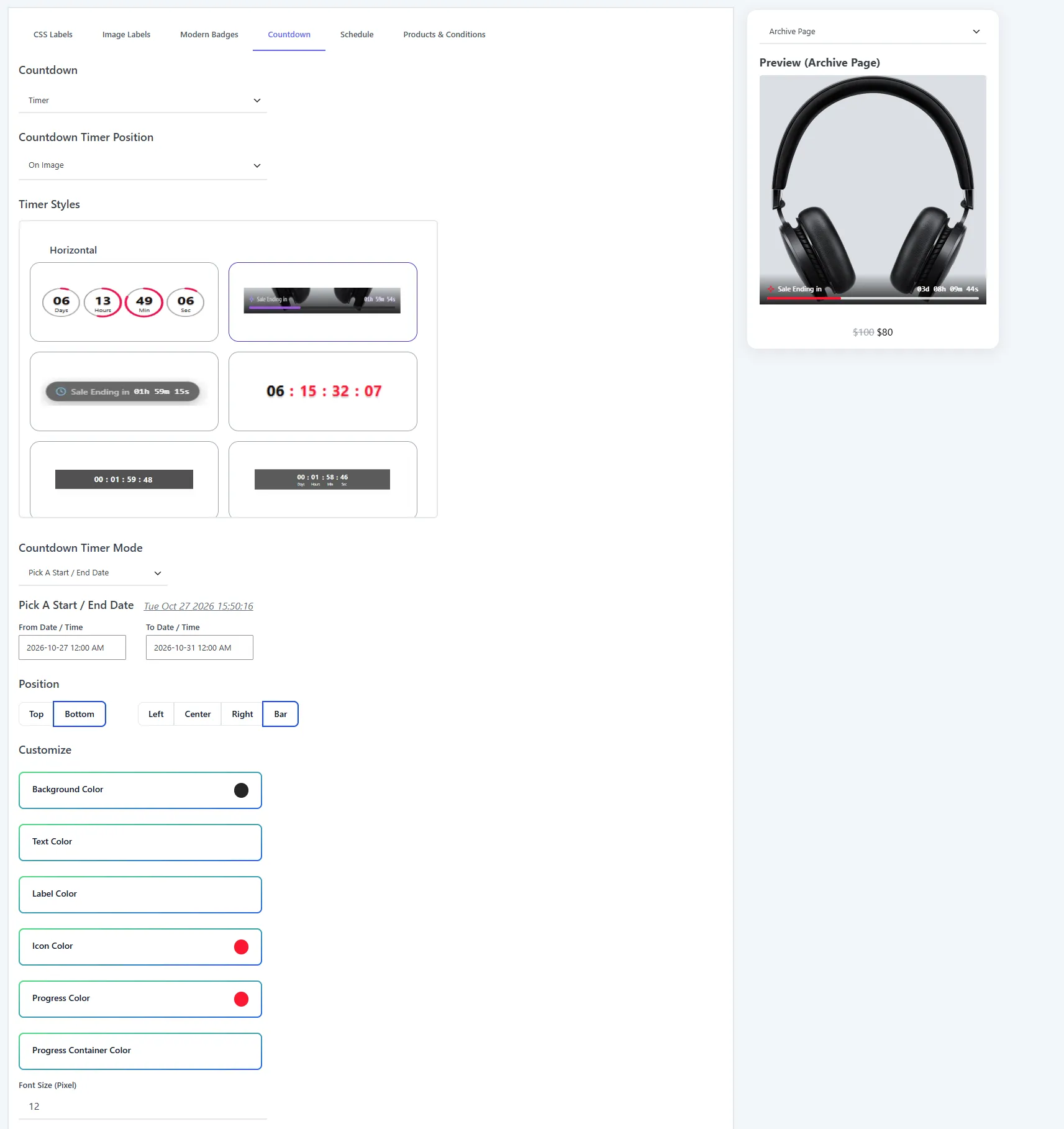
Open the badge’s Countdown tab, choose On Image, and select a timer style. Set Countdown Timer Mode to Pick A Start / End Date, then enter your own campaign’s start and end times. The dates in this screenshot are examples.

To reproduce the layout, choose Bottom and Bar, then adjust the background, text, and progress colors. Set matching product rules and save the badge. A timer communicates the deadline; also schedule the actual WooCommerce sale to end when promised.

Countdown badge editor with a fixed start and end date and a bottom-bar timer preview
Pro example: choose a progress timer, enter your campaign dates, and position it as a bottom bar.

Use notification bars for store-wide campaigns

Pro also includes notification bars for announcements, actions, countdowns, free shipping, and other campaign messages. These are separate from the product countdown badge shown above. Open Sale Booster → Notification Bars to create a store-wide message, then choose its content, timing, and display rules.

For more examples, see the WooCommerce sales countdown timer guide.

Optional: add a badge with a shortcode

If your theme or page builder needs a manual placement, the plugin provides the [asnp_badge] shortcode. Use [asnp_badge] for the current product context, or use [asnp_badge product_id="7"] when you need to render the badge for a specific product. The hide="1" option can be used for product-page placement.

Shortcodes are best used when you understand the page layout. For normal shop grids and product templates, automatic placement is usually easier to maintain because the badge follows your WooCommerce product output.

Best Practices When You Add Product Badges in WooCommerce

  • Use one clear message per badge. Do not combine “New,” “Sale,” “Limited,” and “Free Shipping” into one tiny label.
  • Match the rule to the claim. Only show scarcity or deadline language when the offer or inventory really is limited.
  • Keep a consistent color system. Reserve one accent for discounts, one for availability, and one for shipping or service information.
  • Test product-image contrast. A white badge can disappear on light product photography; use the live preview with representative products.
  • Check mobile layouts. Make sure the label does not hide the product image or cover a variation selector.
  • Schedule campaign badges. Add start and end dates for seasonal promotions so expired labels do not remain visible.
  • Pair badges with a useful landing page. A “Summer Sale” badge should lead to a page where shoppers can browse the matching products.

Free vs Pro: which version do you need?

Choose the free version if you need custom CSS labels, basic product/category/tag/sale/stock rules, scheduling, positioning controls, and a no-code way to improve your WooCommerce product cards.

Choose Pro if you need image-label libraries, modern presets, advanced user and price conditions, product image highlights, countdown timer templates, notification bars, sales popups, embeds, Quick View, or Sticky Add to Cart. The free plugin and Pro extension are designed to work together, so you can begin with a small badge system and add campaign features as your store grows.

See the Pro features and upgrade options →

Frequently asked questions

Can I add product badges in WooCommerce without coding?

Yes. Install Sale Badges and Product Labels for WooCommerce, create a badge in Sale Booster, choose a condition, and save. The plugin handles the front-end placement for standard WooCommerce layouts.

Can I show a badge only on sale products?

Yes. Choose the on-sale condition so the label is applied to products with an active sale price. The badge can be removed automatically when the product no longer matches the rule.

Can I replace the default WooCommerce “Sale!” badge?

Yes. Create a custom sale label and use the plugin setting that hides the default WooCommerce on-sale badge. Check the result in both the shop loop and the single product layout.

Can I show different badges by category?

Yes. Create separate badges or rules and target each WooCommerce category. This is useful for messages such as “New Season,” “Clearance,” or “Free Shipping” that apply to different product groups.

Why is my badge not showing?

Confirm that the badge is active, the product matches its condition, the display location is enabled, and caching is cleared. If the theme changes the standard WooCommerce product-image markup, use the plugin’s hook or compatibility settings and test again.

Related tutorials: WooCommerce sale badge guide, product labels guide, and sales countdown timer guide.

Next steps

You now have a complete no-code workflow for how to add product badges in WooCommerce: install the plugin, create a reusable design, target the right products, verify the storefront, and add Pro campaign features only when you need them.

Start with one focused badge—such as a percentage-off label for sale products—then add category rules, scheduling, and a countdown bar for your next real promotion. For deeper setup details, continue with the badge installation documentation and the badge management guide.

Posted on — Leave a comment

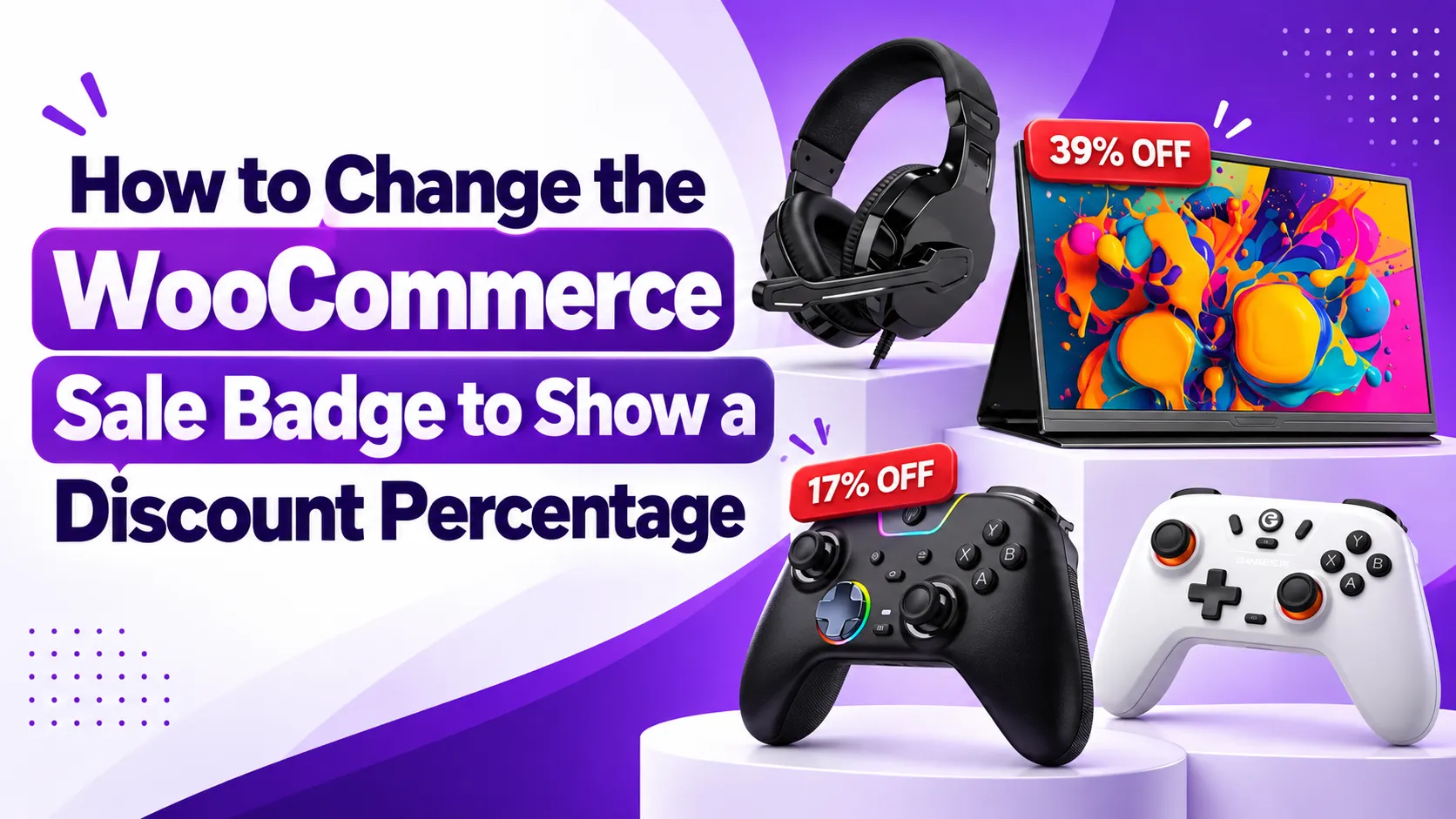
WooCommerce Sale Badge Percentage

The default WooCommerce sale badge percentage tells shoppers that a product is discounted—but not how much they can save. A percentage-based badge makes the value clear at a glance.

How to Show a Discount Percentage on a WooCommerce Sale Badge

Learn how to replace the generic “Sale!” label with a dynamic discount percentage that updates automatically with your product’s live WooCommerce pricing.

Reading time: 8 minutes

The WooCommerce sale badge tells shoppers that a product is discounted, but it doesn’t tell them how much they can save. Replacing that generic label with a live percentage—such as 20% OFF—makes the value easier to understand while customers scan a shop or category page.

The quickest method is to use Product Badge, Label, Countdown Timer for WooCommerce – Sale Booster. Create a CSS label, enter the {saved_percent} placeholder, target products that are on sale, and hide the default WooCommerce badge if you want one clean label. The percentage updates from the product’s current pricing instead of requiring a separate badge for every discount level.

Key takeaways

  • Use a dynamic percentage instead of a hard-coded discount label.
  • Hide the default Sale badge when it would create duplicate messaging.
  • Test the result on archive pages, product pages, mobile layouts, and variable products.

Key Takeaways
– Use {saved_percent} OFF to show each product’s live discount percentage.
– Target the badge to on-sale products so it doesn’t appear on full-price items.
– Disable the default WooCommerce Sale badge if you want to avoid duplicate labels.
– Test variable products, mobile layouts, and cached pages before publishing the change.

For related setup, see the complete guide to adding WooCommerce product badges.

How to customize a WooCommerce sale badge percentage

A percentage badge gives shoppers a faster comparison point than the word “Sale” alone. It can also make a product grid easier to scan when multiple products have different sale prices.

Use a percentage badge when the discount is the main reason to buy. Use a different message—such as NEW, BEST SELLER, or FREE SHIPPING—when the product’s strongest selling point is not price.

The important rule is accuracy: the percentage should match the current regular and sale prices. Don’t use a hard-coded 30% OFF label on products whose discounts may change.

Method 1: Show the discount percentage with Sale Booster

1. Open the badge editor

Sale Booster badge settings with the Add New button for a WooCommerce sale badge

In WordPress, go to Sale Booster → Badges → Add New. Give the badge an internal name such as Automatic Percentage Sale Badge, enable its status, and choose whether it should display on the archive/shop page, the product page, or both.

2. Enter the dynamic percentage placeholder

WooCommerce sale badge style settings with a dynamic discount percentage placeholder
Set the dynamic discount percentage placeholder.

Open the CSS Labels tab and enter this in the Label field:

Sale Booster replaces {saved_percent} with the product’s actual discount percentage. A product discounted from $100 to $80 can show 20% OFF, while a product discounted from $50 to $35 can show 30% OFF using the same badge.

You can also use the plugin’s percentage-discount option when you want the label to contain only the percentage. Add OFF when the context needs to be clearer for shoppers.

3. Choose a readable shape and color

WooCommerce sale badge design controls with a product preview
Fine-tune the badge styling and product preview.

Pick a CSS label shape from the gallery, then set the badge color and text color. A strong contrast—such as white text on a red or dark background—helps the percentage stay readable over product photography.

Keep the badge short. {saved_percent} OFF is usually more legible than a sentence such as You save {saved_percent} on this product today.

4. Target on-sale products

Sale Booster targeting rules for showing badges on on-sale products
Target the percentage badge only to products that are on sale.

Open Products & Conditions and add the Is On Sale product rule. This keeps the percentage badge connected to products that have an active sale price.

If you want a campaign-specific label, use an Include → Category, Include → Tag, or specific-product rule as well. For example, you can target on-sale products in the Summer category without showing the badge on every discounted product in the catalog.

5. Hide the default “Sale!” label

WooCommerce sale badge setting to hide the default Sale label
Hide the default WooCommerce Sale badge to avoid duplicates.

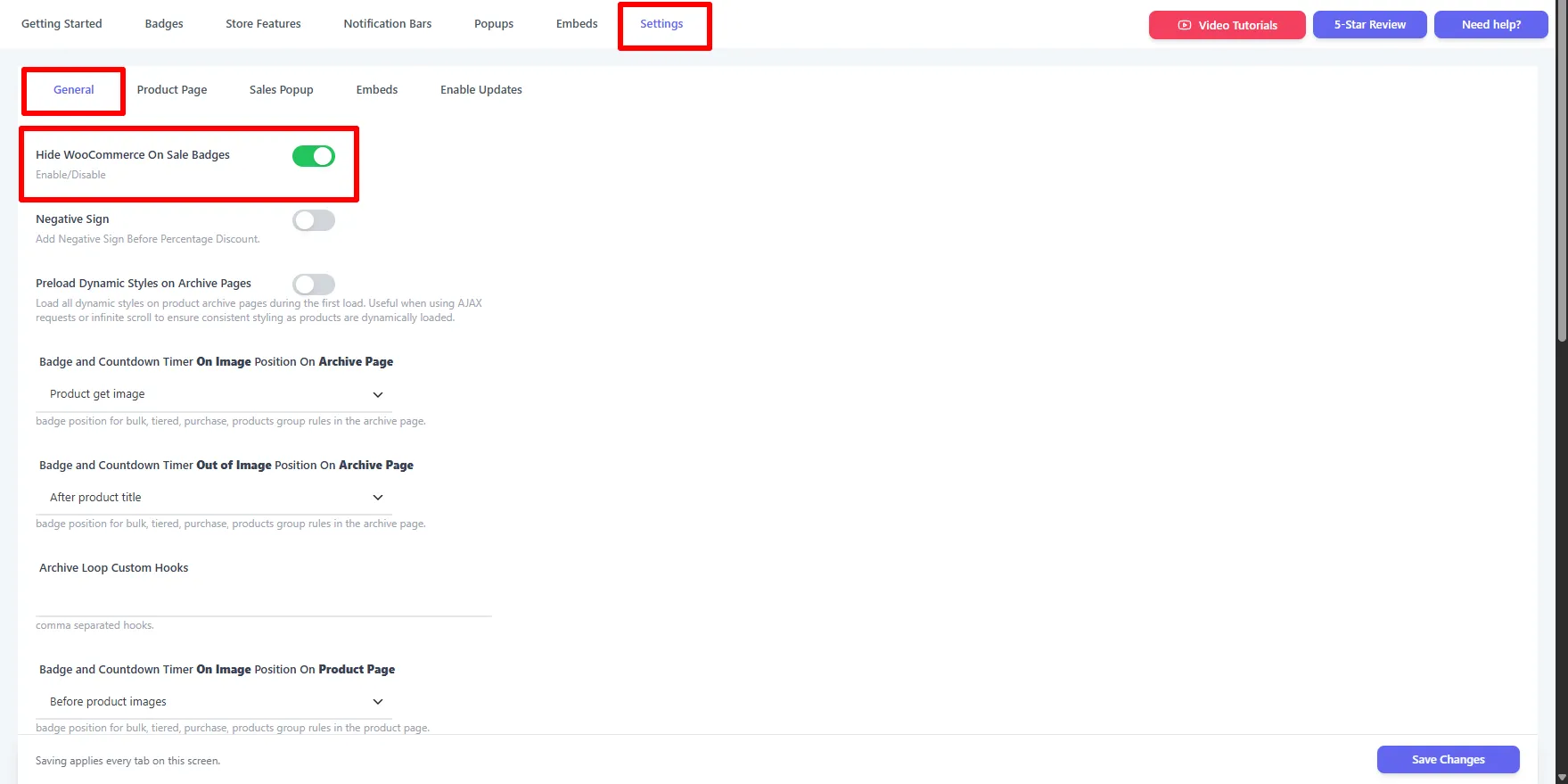
If both labels appear, open Sale Booster → Settings → General and enable the option to hide WooCommerce’s default on-sale badge. Save the setting and clear your page cache before checking the storefront again.

Whether you hide the default depends on your design. A custom percentage badge usually works best by itself; a theme-specific sale marker may still be useful if it appears in a different location.

Click Save, then test a product with a known regular price and sale price. Check the shop grid and the single product page if both display locations are enabled.

What if the percentage is wrong?

First, verify the product’s regular price and sale price in WooCommerce. The displayed percentage depends on that underlying product data. Then check whether a variable product is showing a parent price or a selected variation price in the template you’re testing.

Also check caching. A full-page cache may continue serving the previous badge text after the product price changes. Clear the page cache, object cache, and CDN cache where applicable, then test in a private browser window.

If the badge is correct in the editor preview but missing on the storefront, follow the WooCommerce sale badge troubleshooting guide.

Alternative: use a fixed percentage label

A fixed label such as 20% OFF is appropriate when every product in the rule has the same discount and the promotion is controlled elsewhere. It is not appropriate when sale prices vary or may change during the campaign.

Dynamic text is safer for mixed catalogs because the message follows each product’s actual discount. If you use fixed text, schedule the badge and remove or update it when the promotion changes.

Best practices for percentage sale badges

  • Use {saved_percent} OFF for mixed-discount catalogs.
  • Keep the badge to one short message.
  • Use a clear color reserved for discounts.
  • Don’t show a discount badge on full-price products.
  • Check that the percentage is readable on light and dark product images.
  • Test a simple product and a variable product.
  • Check the archive, category, search, related-product, and single-product layouts.
  • Clear caches after changing price rules or badge settings.
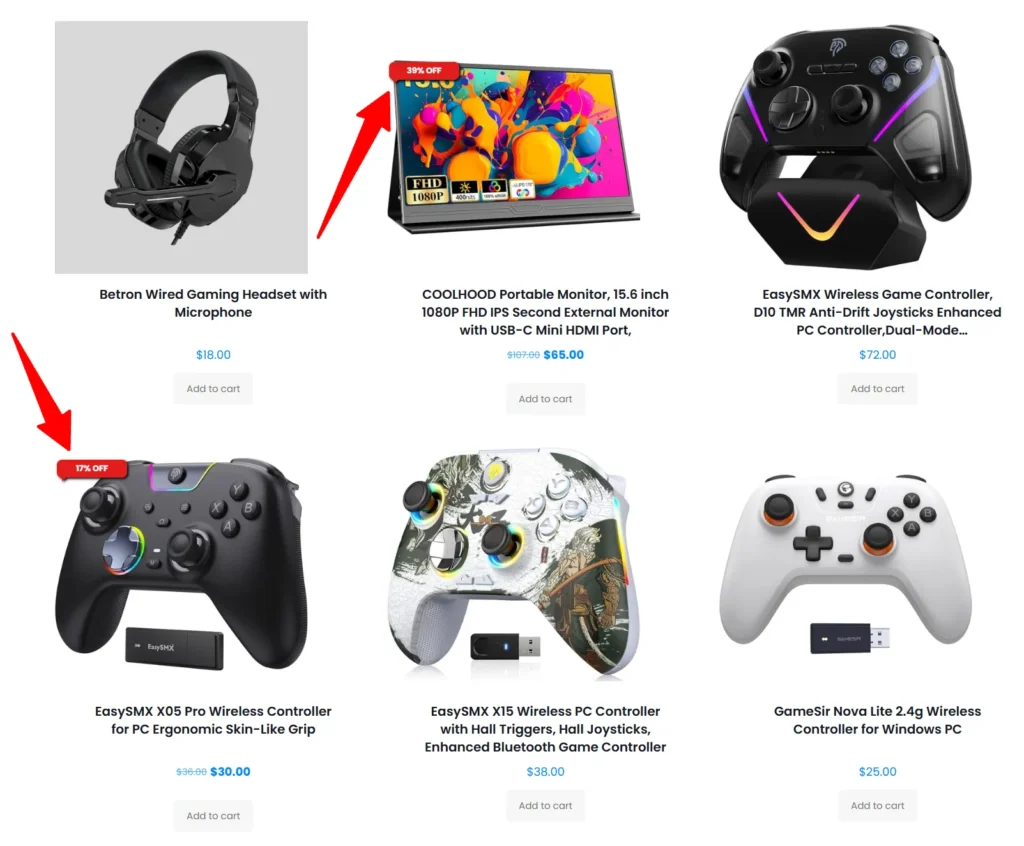
WooCommerce product grid showing sale badges with discount percentages
Percentage badges displayed on the WooCommerce product grid.

How to Test a WooCommerce Sale Badge percentage

Before publishing, test the WooCommerce sale badge on simple and variable products with different sale prices. Confirm that the discount percentage is accurate, the text is readable on mobile screens, and the badge does not appear on full-price products. Clear your cache after making changes so shoppers see the latest version.

Where Should a WooCommerce Sale Badge Appear?

A WooCommerce sale badge can appear on shop pages, category pages, search results, and individual product pages. Display it where shoppers compare products, but avoid showing duplicate badges in multiple locations. A consistent position makes the discount easier to notice without distracting from the product image.

Frequently Asked Questions

How do I show a discount percentage instead of “Sale!” in WooCommerce?

Create a badge in Sale Booster → Badges, open CSS Labels, and enter {saved_percent} OFF in the Label field. Target the badge to on-sale products and disable the default WooCommerce on-sale badge if both labels appear.

What placeholder shows the WooCommerce discount percentage?

Use {saved_percent}. Add text around it, such as {saved_percent} OFF, to create a complete customer-facing label.

Can I show different discount percentages on different products?

Yes. The same dynamic badge can render the current percentage for each matching product, provided the product’s regular and sale prices are configured correctly.

Why does my WooCommerce sale badge still say “Sale!”?

The default WooCommerce badge may still be enabled, your custom badge may not be active, or the product may not match its rule. Check the badge status, the on-sale condition, display location, and the setting that hides the default badge.

Conclusion

To change the WooCommerce sale badge to show a discount percentage, use a dynamic label instead of hard-coded text. In Sale Booster, create a CSS label with {saved_percent} OFF, target on-sale products, choose a readable style, and hide the default badge when necessary.

Posted on — Leave a comment

WooCommerce Upsell Free Plugin

The WooCommerce Upsell Free Plugin is a powerful tool designed to help you boost sales by displaying targeted upsell offers across your product, cart, and checkout pages. By recommending complementary or higher-value products at the perfect moment, this plugin enhances the customer experience while increasing your store’s average order value. Whether you’re promoting beauty items, accessories, or bundled discounts, the WooCommerce Upsell Free Plugin makes it easy to create personalized shopping journeys that convert. For more details or to download the plugin, visit the official WordPress plugin page.

What Is the WooCommerce Upsell Free Plugin?

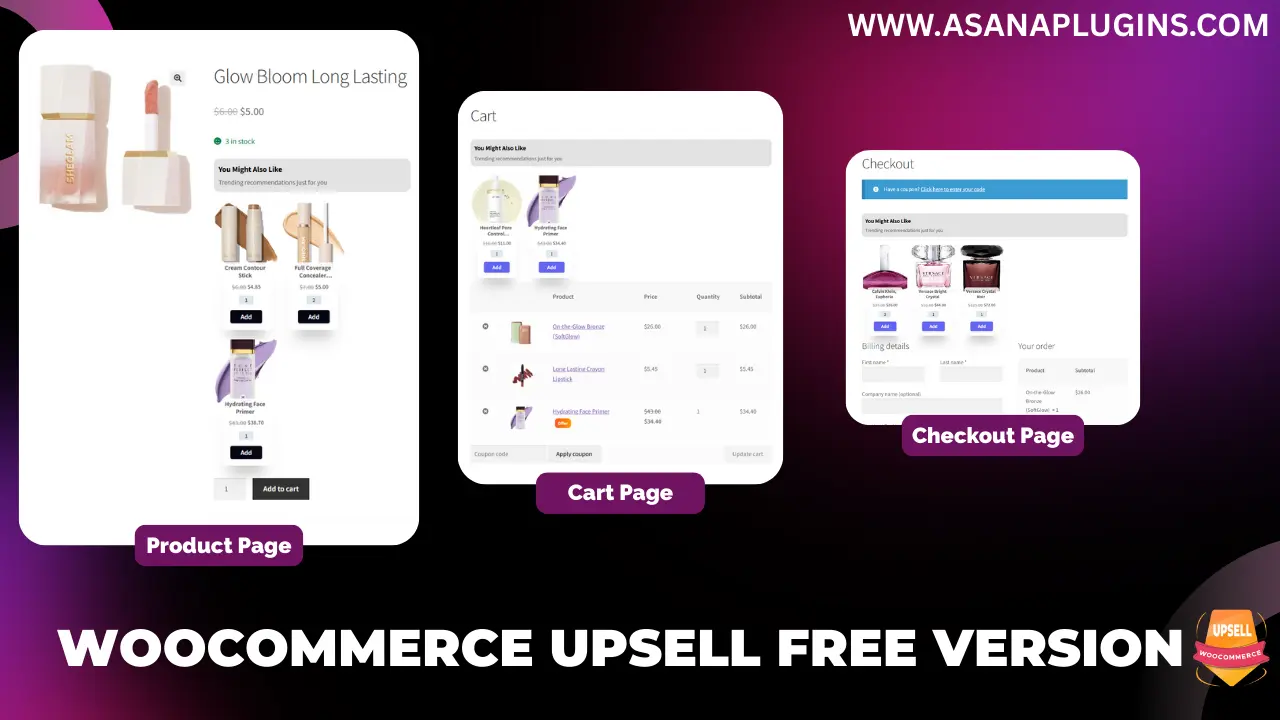
The WooCommerce Upsell Free Plugin allows you to showcase complementary or higher-value products directly on product, cart, and checkout pages. With targeted recommendations, you can increase customer engagement, boost conversions, and maximize average order value without any complex setup.


Why Use Product Upsells in WooCommerce?

The Product Upsell feature helps you promote add-on or premium products where customers are most likely to buy—right on the product page. By displaying relevant items, you encourage buyers to upgrade or purchase additional items.

Example:
If a shopper is viewing Glow Bloom Long Lasting, you can promote upsell items like:

  • Cream Contour Stick
  • Full Coverage Concealer Matte Finish Concealer
  • Hydrating Face Primer

This personalized experience inspires customers to complete their look with complementary products.


Scenario: Smart Upsells in Action

Imagine a customer browsing Glow Bloom Long Lasting. Just below the main product, an upsell section appears showing perfectly matched items such as a contour stick, concealer, and primer. Customers can review product details, choose quantities, and even enjoy discounts.
This seamless recommendation system helps increase revenue while improving the shopping experience.

How to Create a Product Upsell Using the WooCommerce Upsell Free Plugin

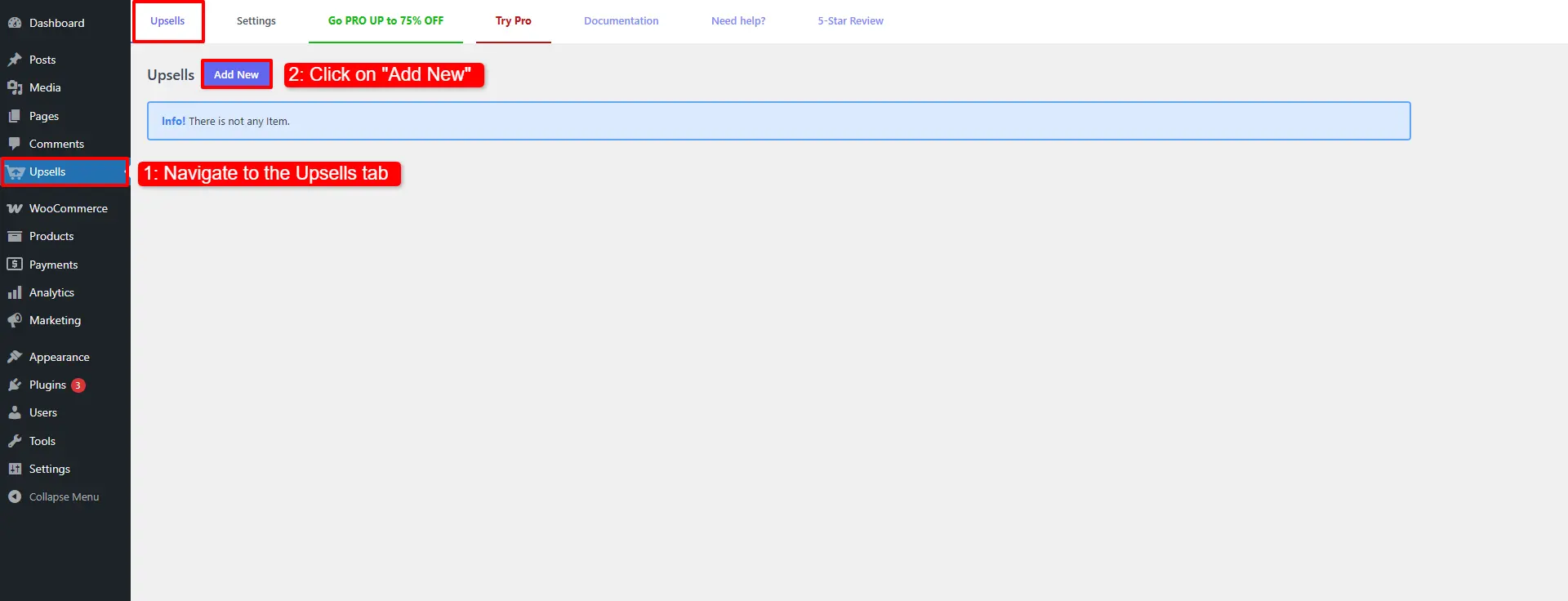
  • Navigate to Upsells.
  • Click on Add New.
Navigate to Upsells
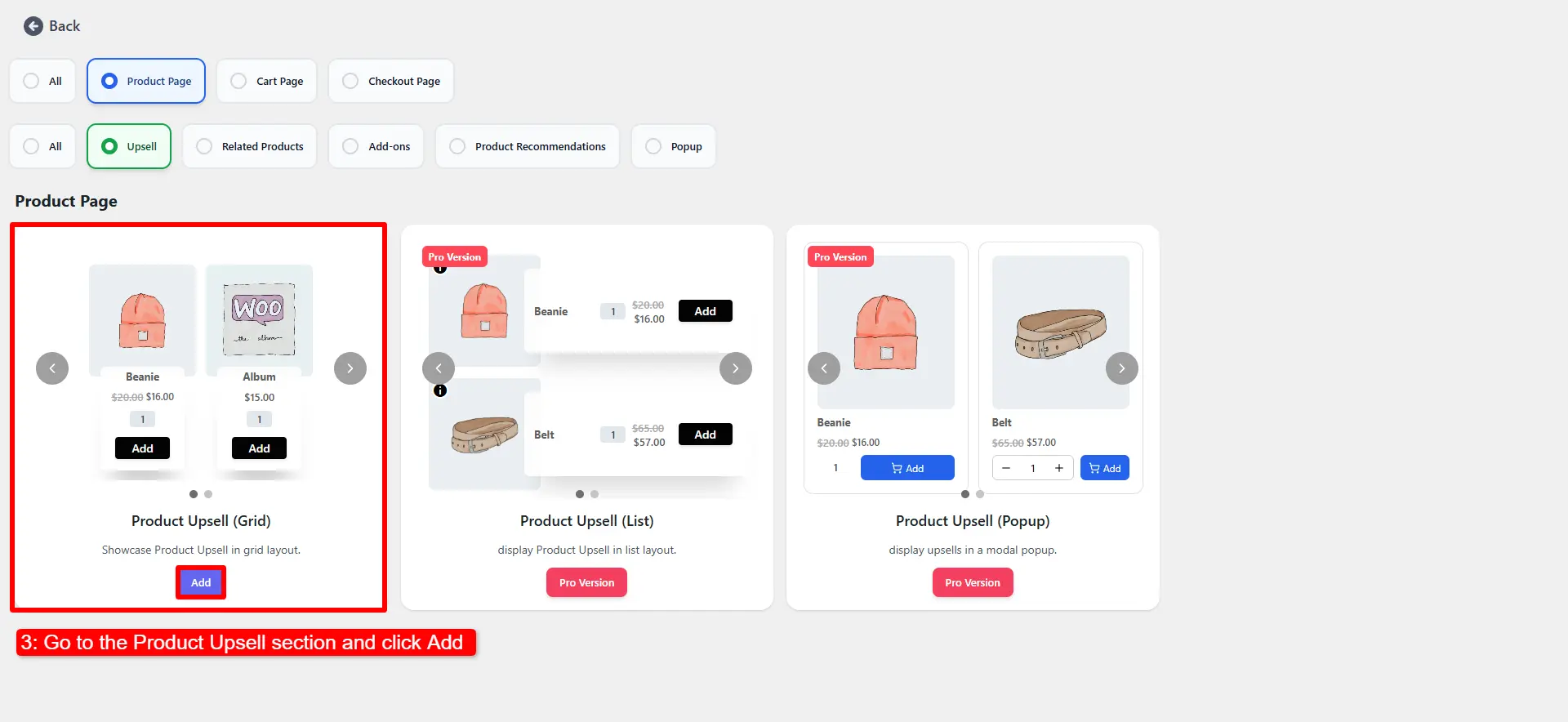
  • Go to the Product Upsell section and click Add.
Go to the Product Upsell section and click Add.
  • Open the Offers tab.
  • Add Offer 1 and select the product you want to promote.
  • Add Offer 2, then select a product.
  • Set the Quantity for the offer.
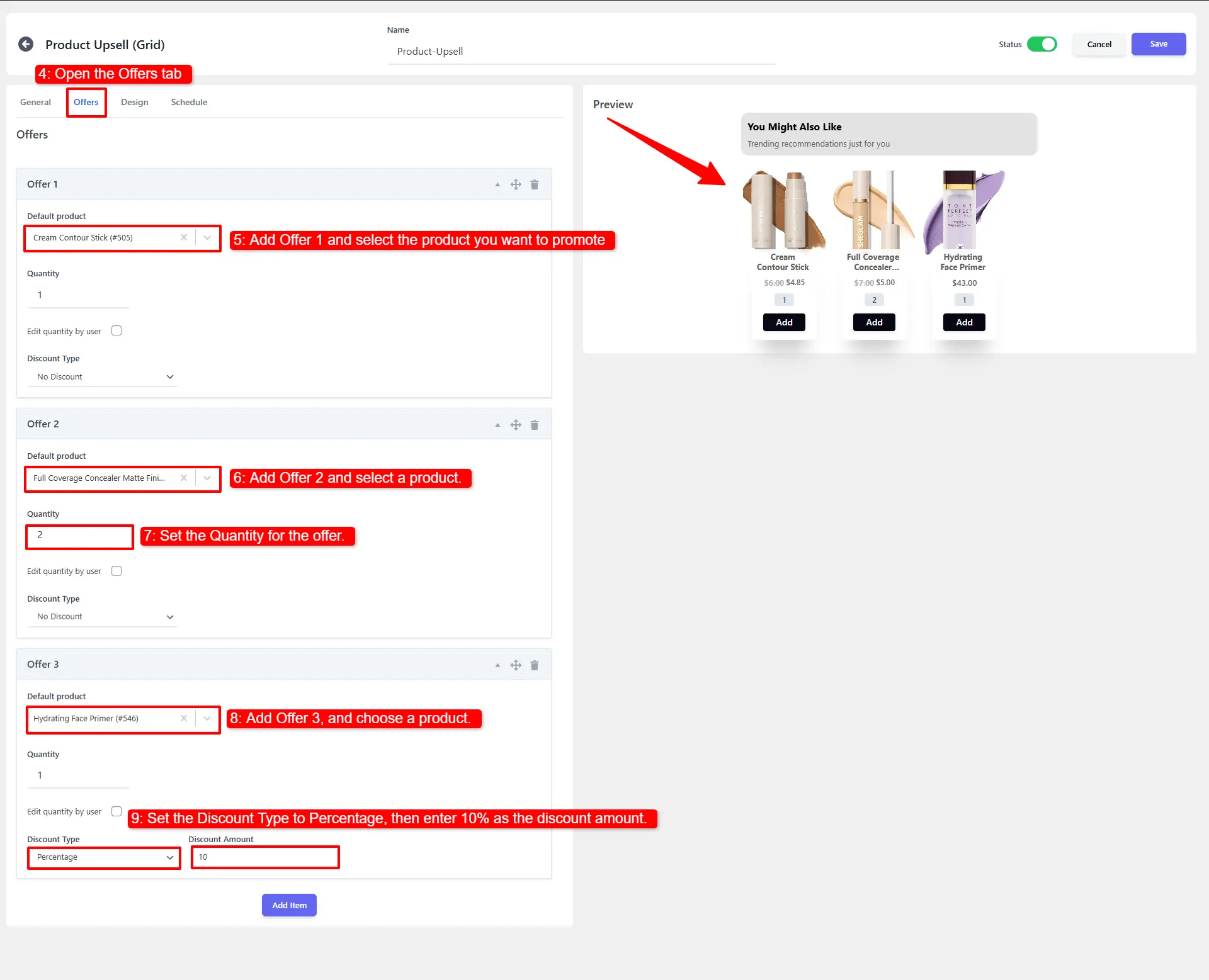
  • Add Offer 3, and choose a product.
  • For Offer 3, set the Discount Type to Percentage and enter 10% as the discount amount.
Configure Offers in the WooCommerce Upsell Free Plugin
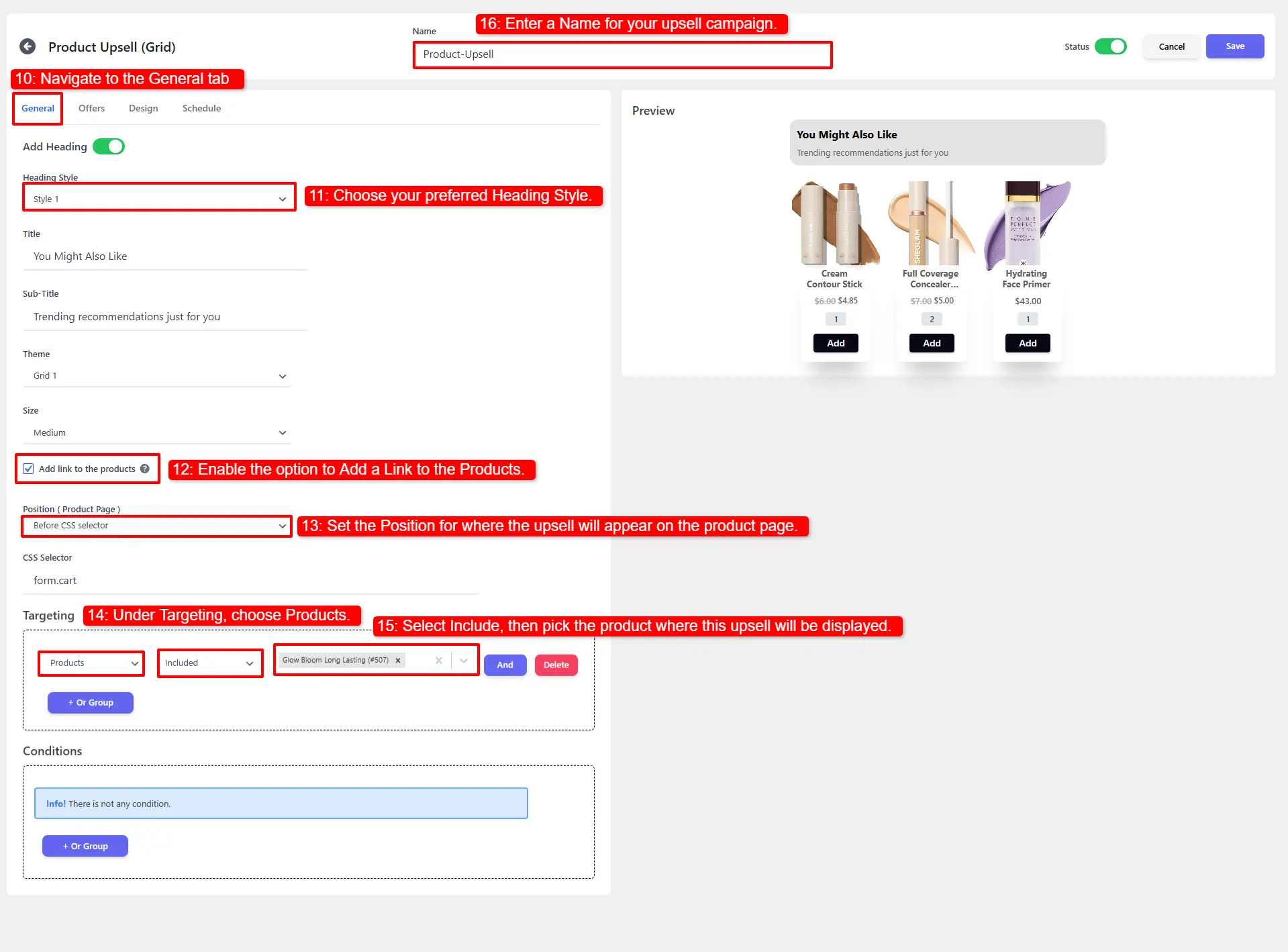
  • Navigate to the General tab.
  • Choose your preferred Heading Style.
  • Enable the option to Add a Link to the Products.
  • Set the Position for where the upsell will appear on the product page.
  • Under Targeting, choose Products.
  • Select Include, then pick the product where this upsell will be displayed.
  • Enter a Name for your upsell campaign.
Adjust General Settings
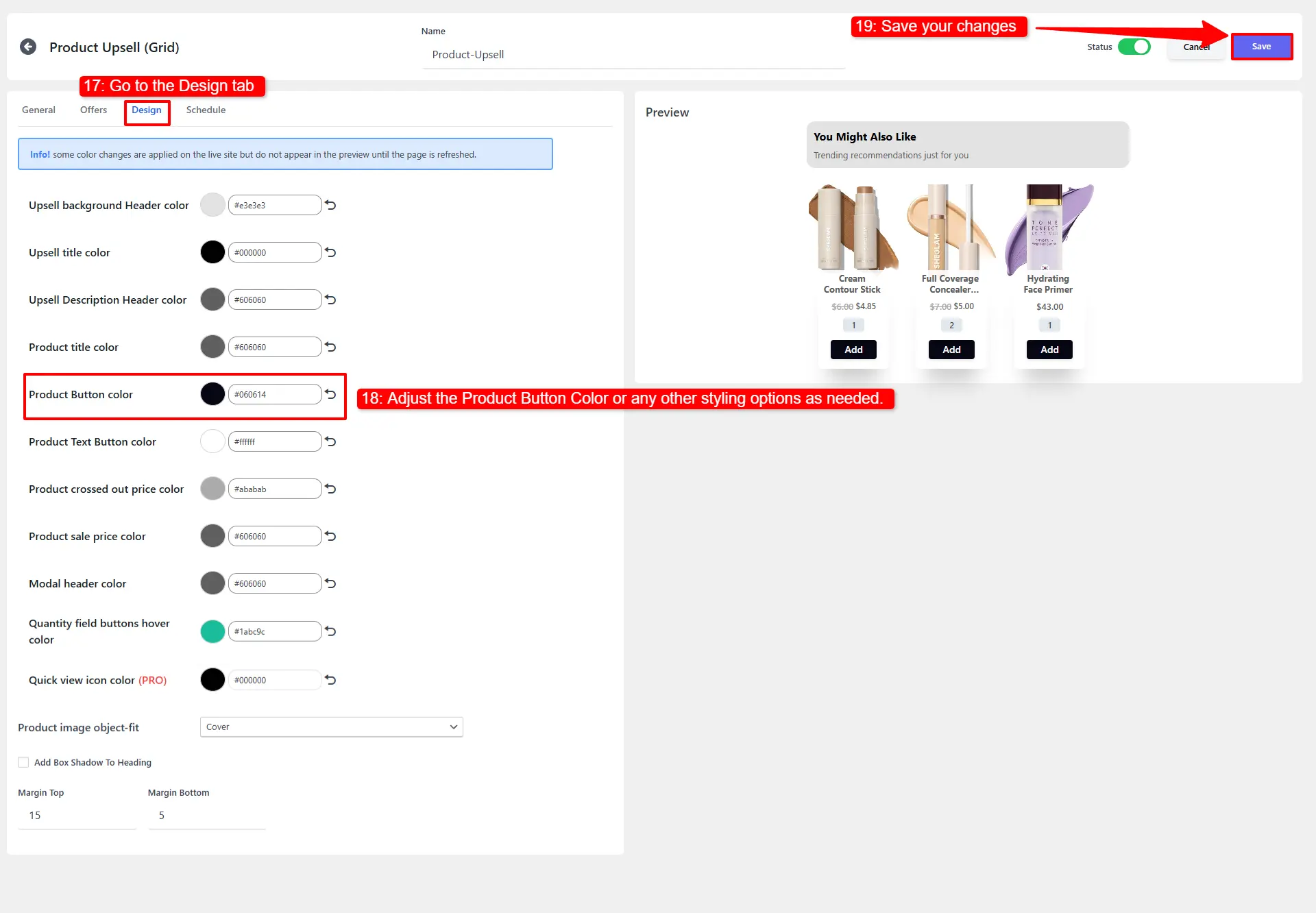
  • Go to the Design tab.
  • Adjust the Product Button Color or any other styling options as needed.
  • Save your changes.
Customize Design

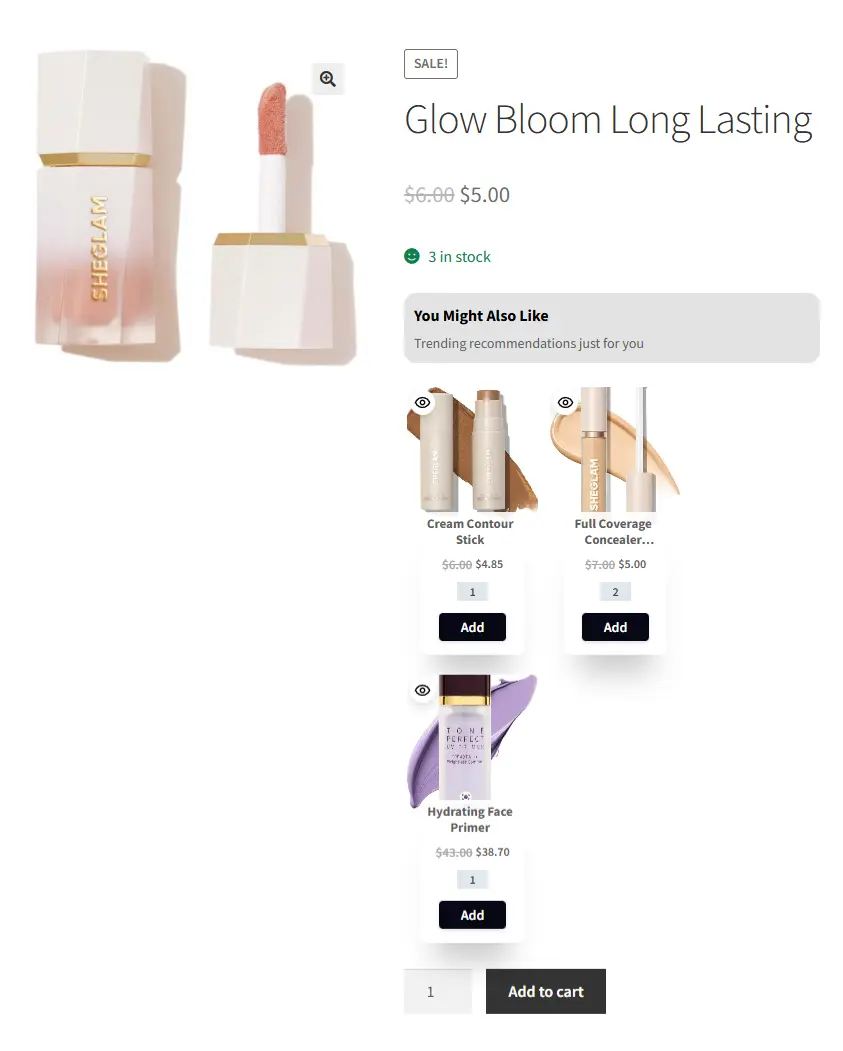
Once everything is set up, your Product Upsell section will automatically appear on the Glow Bloom Long Lasting product page. The offers you added will display according to your chosen theme and layout.

Product Upsell section will automatically appear on the Glow Bloom Long Lasting product page

How to Create a Cart Upsell (WooCommerce Upsell Free Plugin)

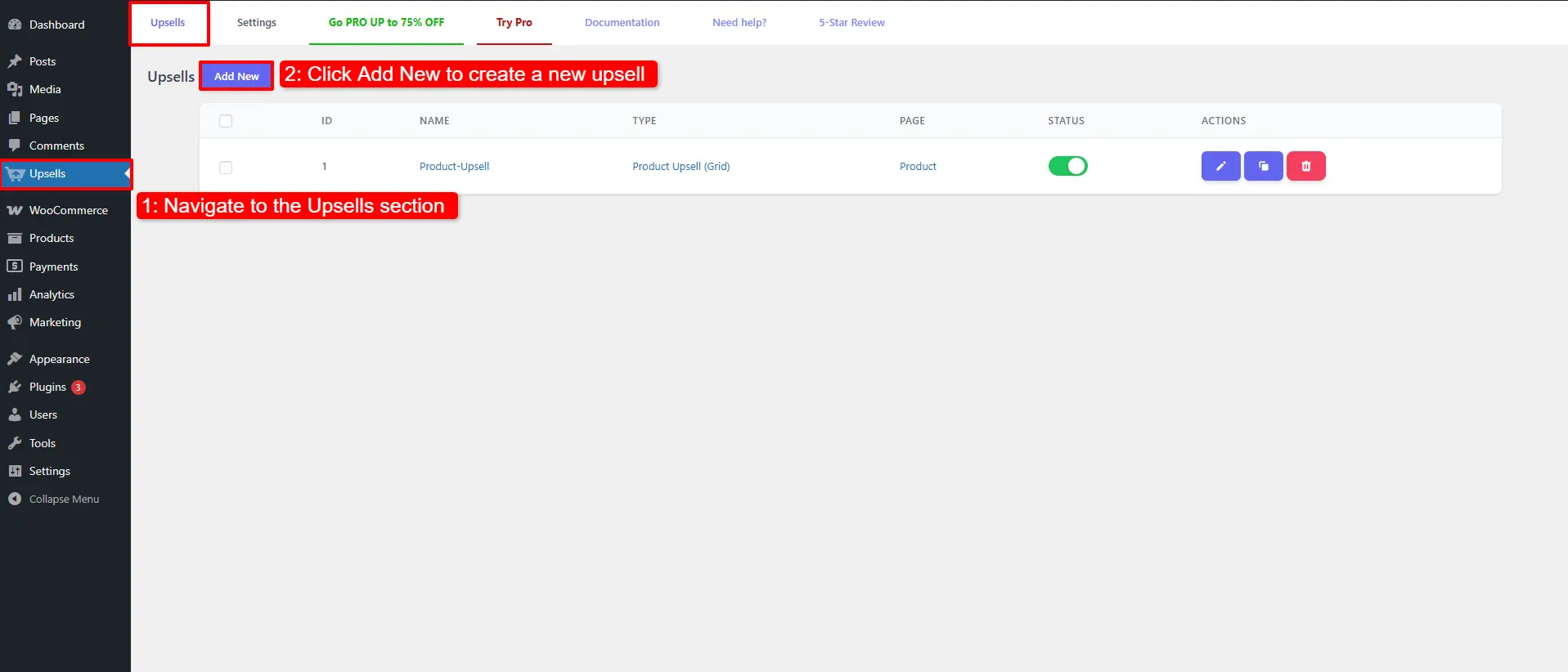
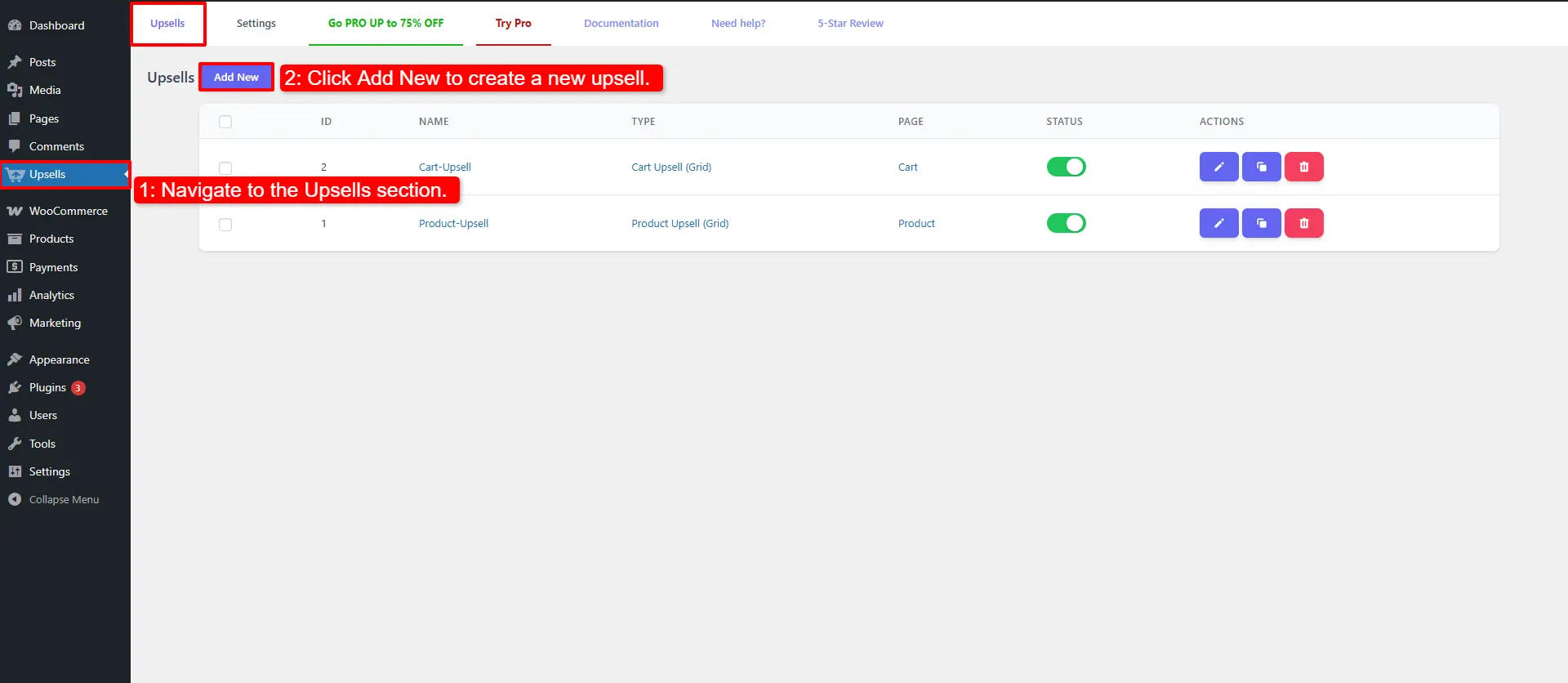
  • Navigate to Upsells
  • Click Add New to create a new upsell
Create Cart Upsell
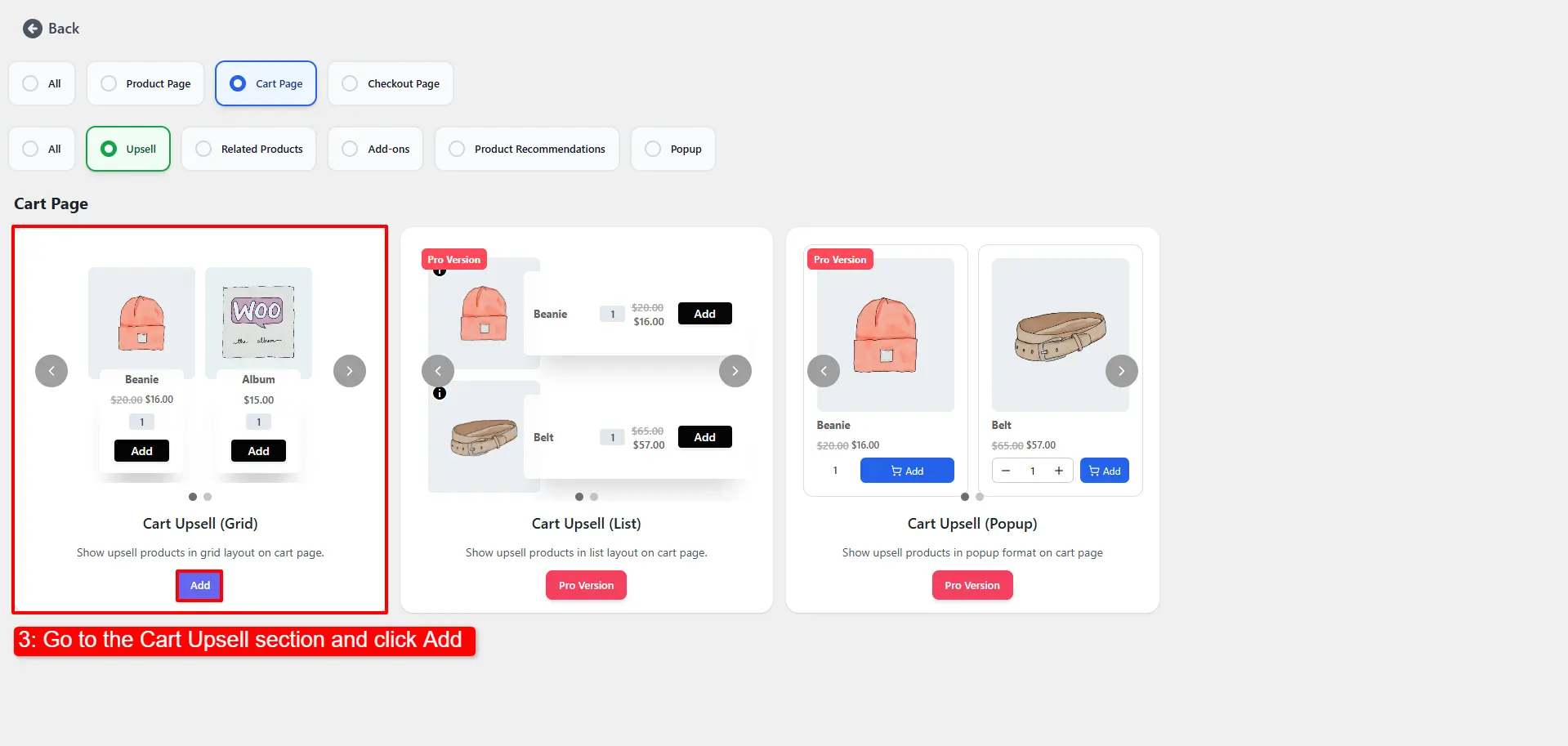
  • Go to the Cart Upsell section and click Add
Go to the Cart Upsell section and click Add
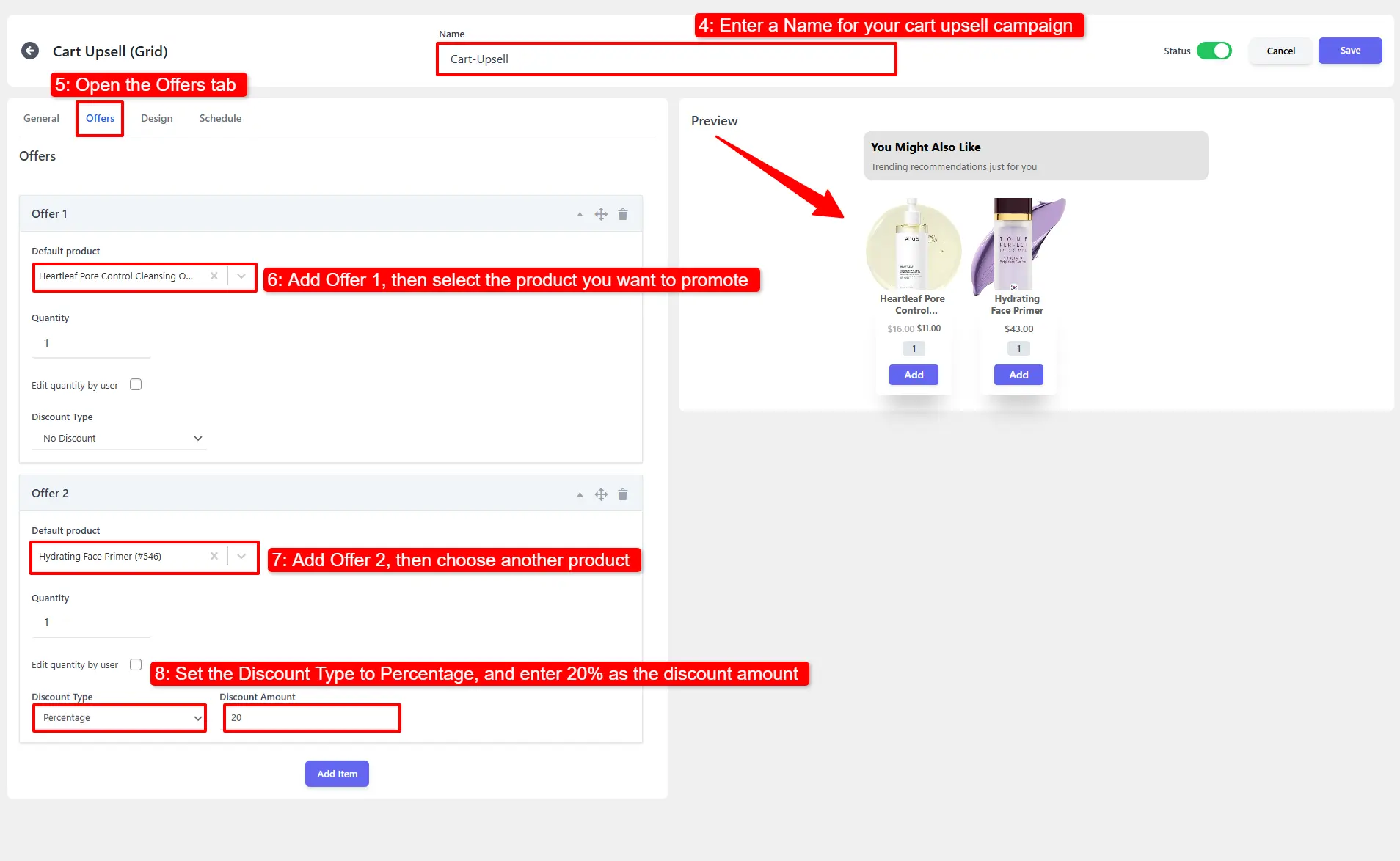
  • Enter a Name for your cart upsell campaign.
  • Open the Offers tab.
  • Add Offer 1 and select the product you want to promote.
  • Add Offer 2, then select a product.
  • For Offer 2, set the Discount Type to Percentage and enter 20% as the discount amount.
Add Cart Offers
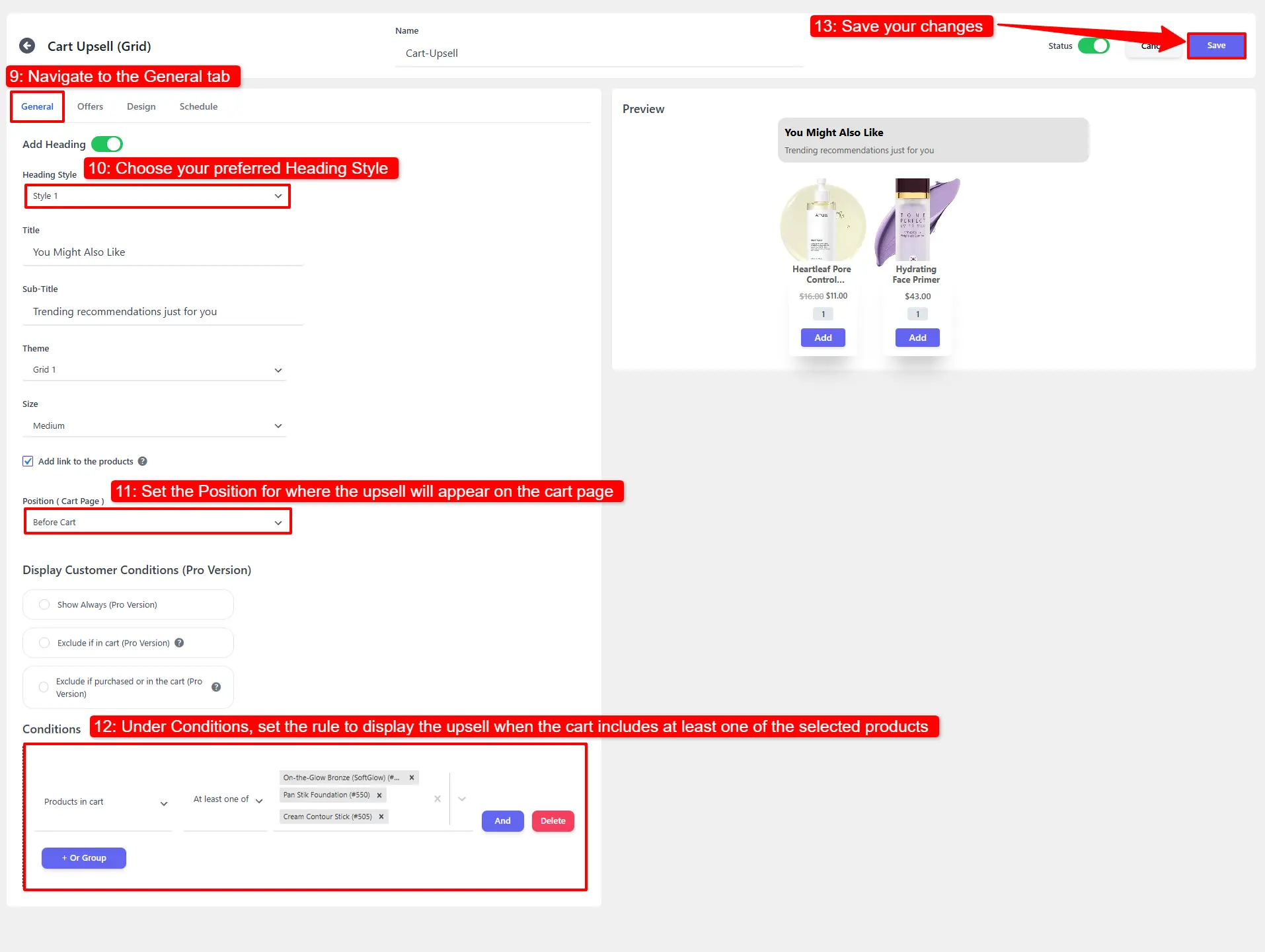
  • Navigate to the General tab.
  • Choose your preferred Heading Style.
  • Set the Position for where the upsell will appear on the cart page..
  • Under Conditions, set the rule to display the upsell when the cart includes at least one of the selected products.
  • Save your changes.
Apply General Settings

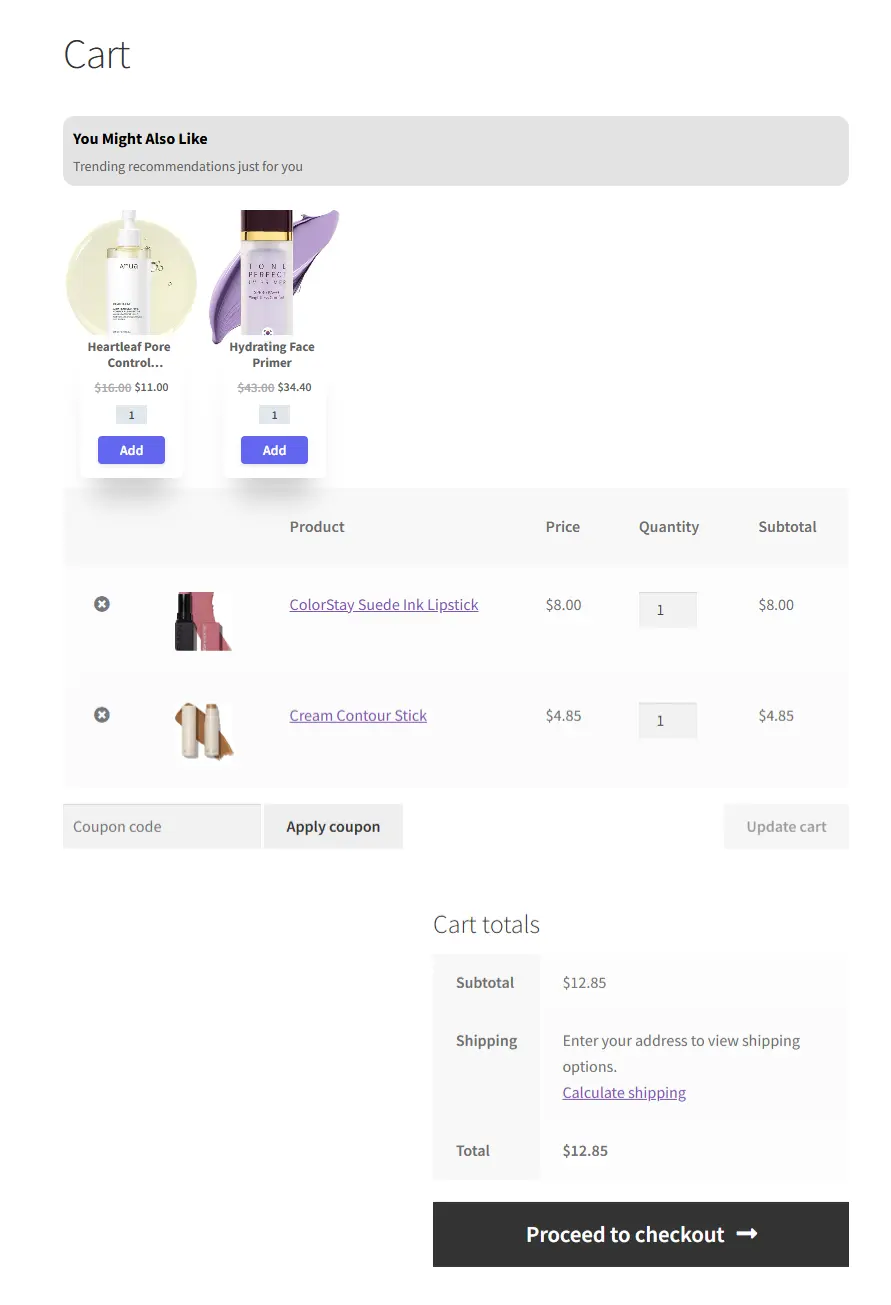
Once everything is configured, the cart upsell will automatically appear at the top of the Cart page whenever a customer has at least one of the selected products in their cart.

the cart upsell will automatically appear at the top of the Cart page

How to Create a Checkout Upsell (WooCommerce Upsell Free Plugin)

  • Navigate to Upsells
  • Click Add New to create a new upsell
Create Checkout Upsell
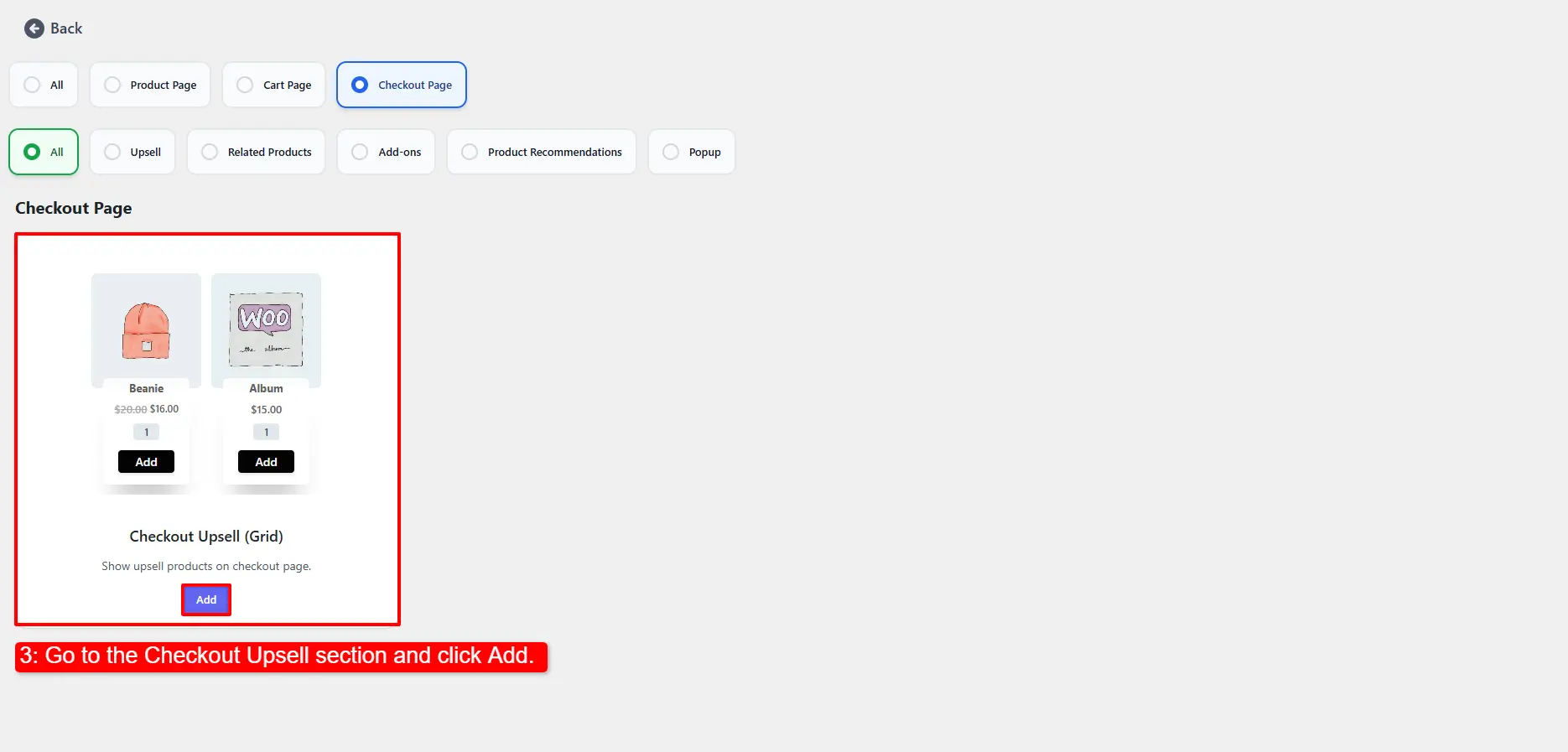
  • Go to the Checkout Upsell section and click Add.
Go to the Checkout Upsell section and click Add.
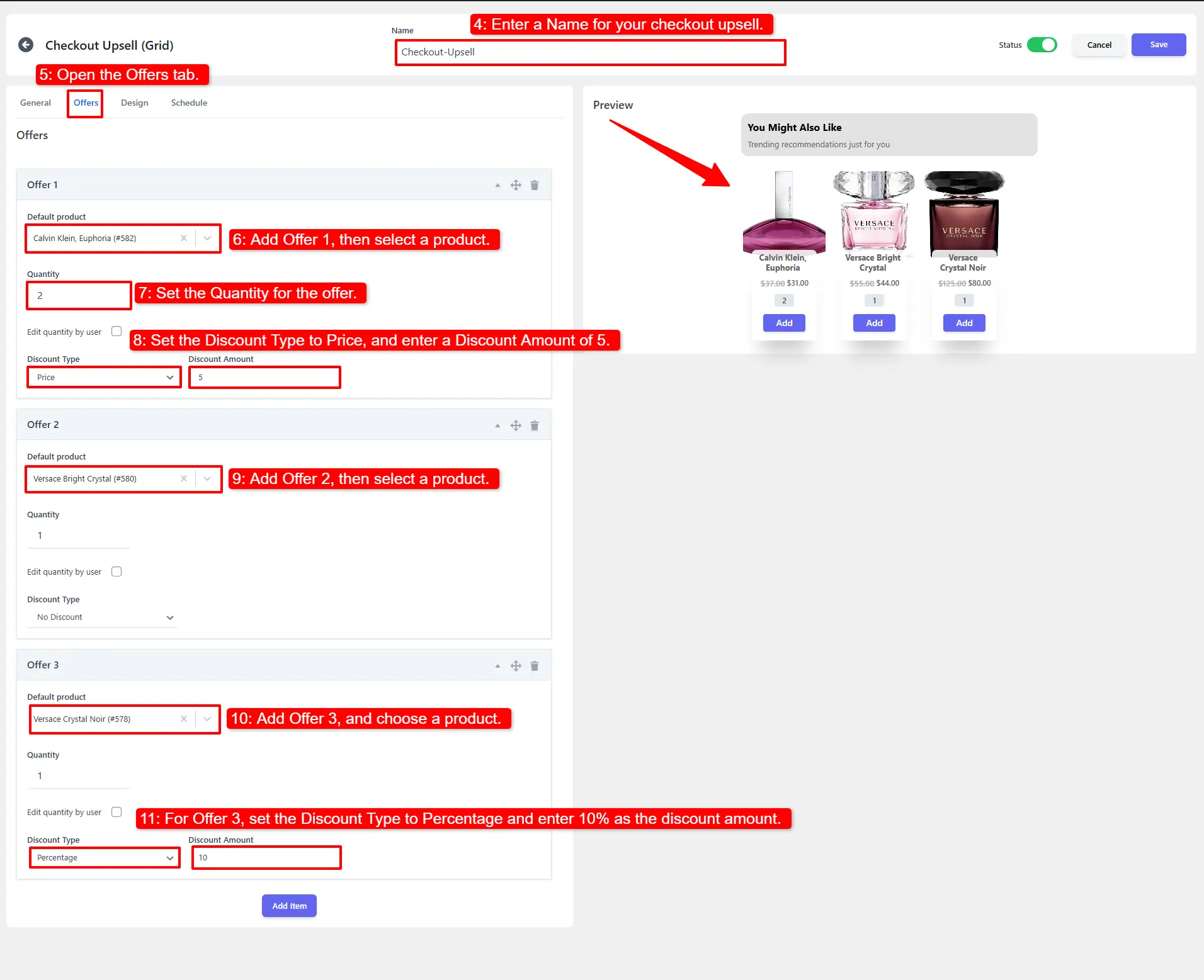
  • Enter a Name for your checkout upsell.
  • Open the Offers tab.
  • Add Offer 1, then select a product.
  • Set the Quantity for the offer.
  • Set the Discount Type to Price, and enter a Discount Amount of 5.
  • Add Offer 2, then select a product.
  • Add Offer 3, and choose a product.
  • For Offer 3, set the Discount Type to Percentage and enter 10% as the discount amount.
Add Checkout Offers
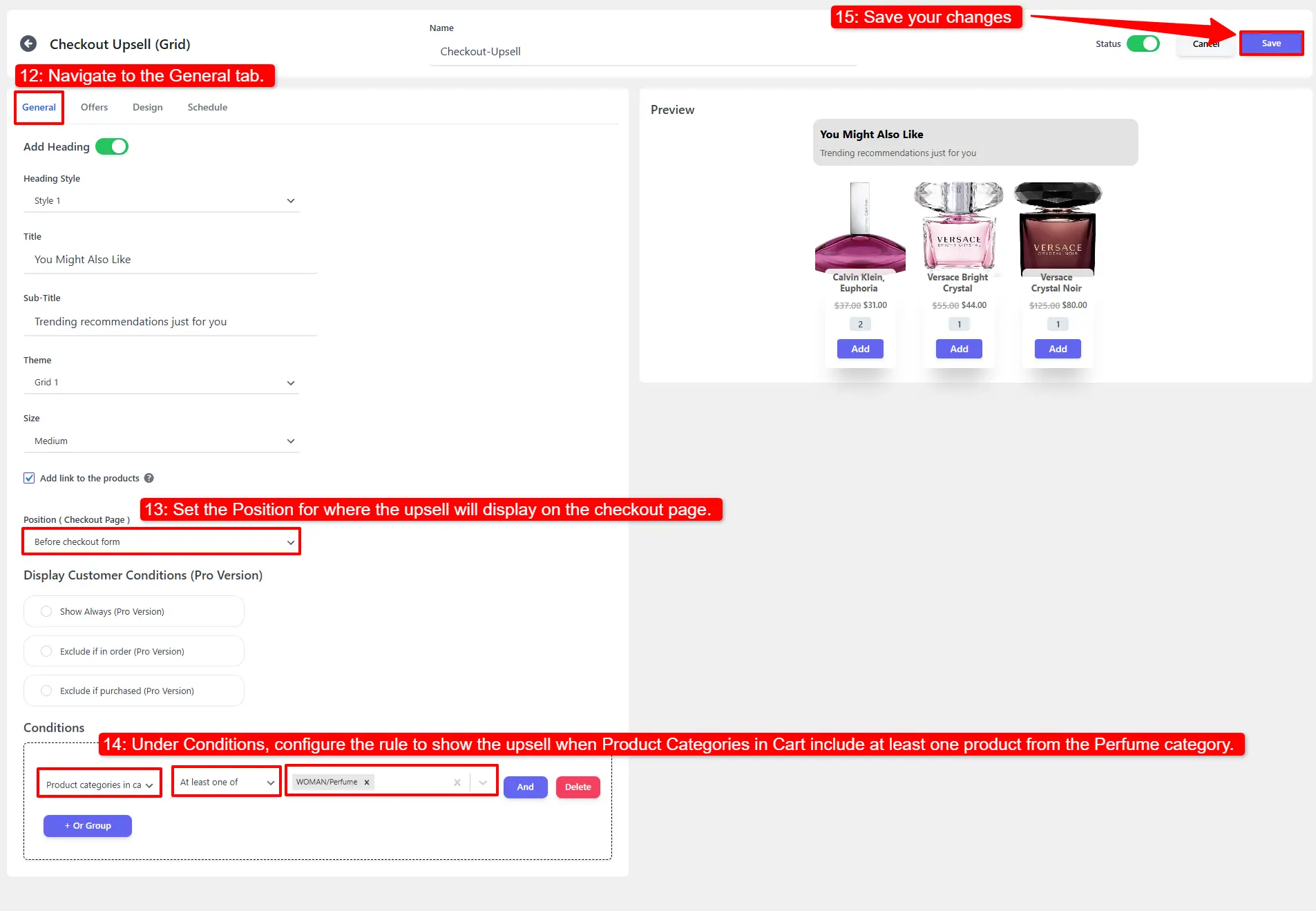
  • Navigate to the General tab.
  • Set the Position for where the upsell will display on the checkout page.
  • Under Conditions, configure the rule to show the upsell when Product Categories in Cart include at least one product from the Perfume category.
  • Save your changes.
General Settings

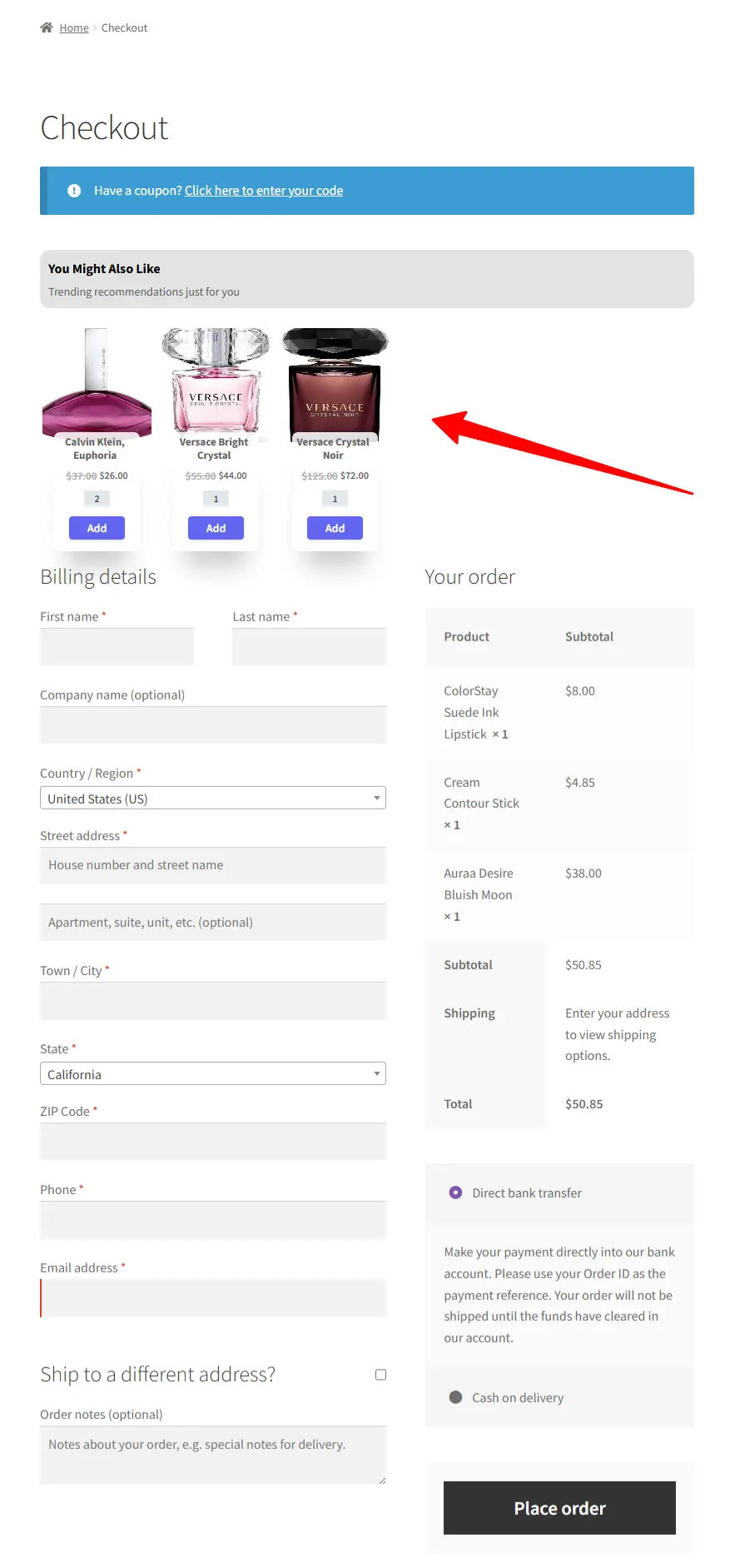
Once everything is set, the checkout upsell will automatically appear at the top of the Checkout page whenever a customer’s cart contains at least one product from the Perfume category.

the checkout upsell will automatically appear at the top of the Checkout page

Final Thoughts on the WooCommerce Upsell Free Plugin

The WooCommerce Upsell Free Plugin is a powerful tool for boosting your store’s average order value. With flexible display rules, smart targeting, and customizable designs, you can create highly effective upsells throughout your store.
If you want to explore additional options and view more detailed guides, you can visit the plugin Documentation.

Updated on — Leave a comment

5 Best WooCommerce Badge Plugins in 2026

Looking for the best WooCommerce badge plugins to make your products stand out? Picture two nearly identical WooCommerce product pages. One is just a photo and a price. The other has a bold “Best Seller” badge, a bright “Only 3 Left in Stock” sticker, and a clean “New Arrival” flash. Which one earns the click?

That small visual nudge is why choosing the best WooCommerce badge plugins matters more than most store owners realize. Badges do more than decorate a product image. They guide attention, create urgency, and reassure shoppers they’re making the right choice. Done well, the best WooCommerce badge plugins can help improve click-through and add-to-cart rates without changing a single price.

The right plugin turns that psychology into a five-minute setup instead of custom code. In this guide, updated for 2026, we’ve researched and compared five of the best WooCommerce badge plugins, covering free and premium options, conditional logic, and design flexibility. Whether you need simple sale labels or advanced product rules, you’ll find a WooCommerce badge plugin that fits your store.

1. Product Badge, Label, Countdown Timer For WooCommerce – Sale Booster

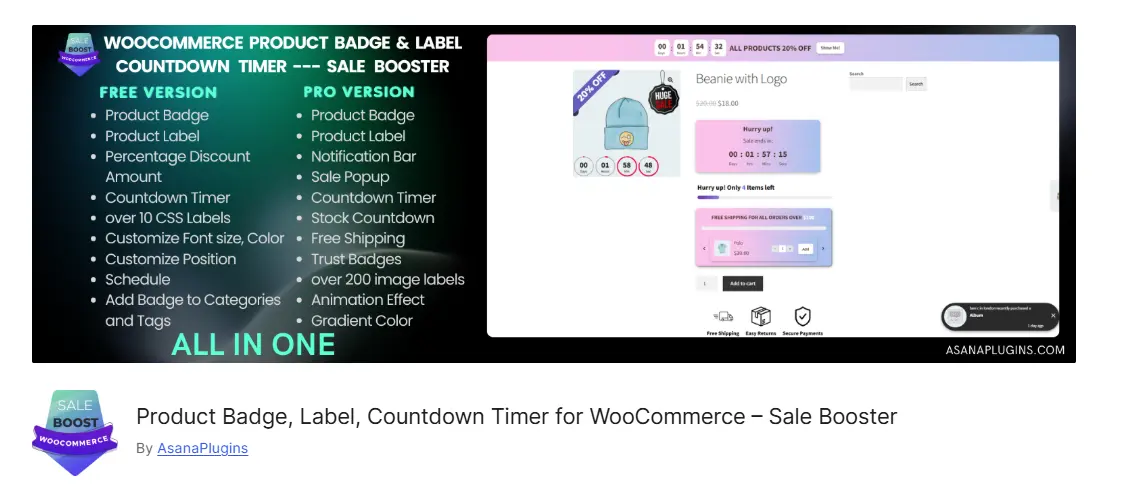
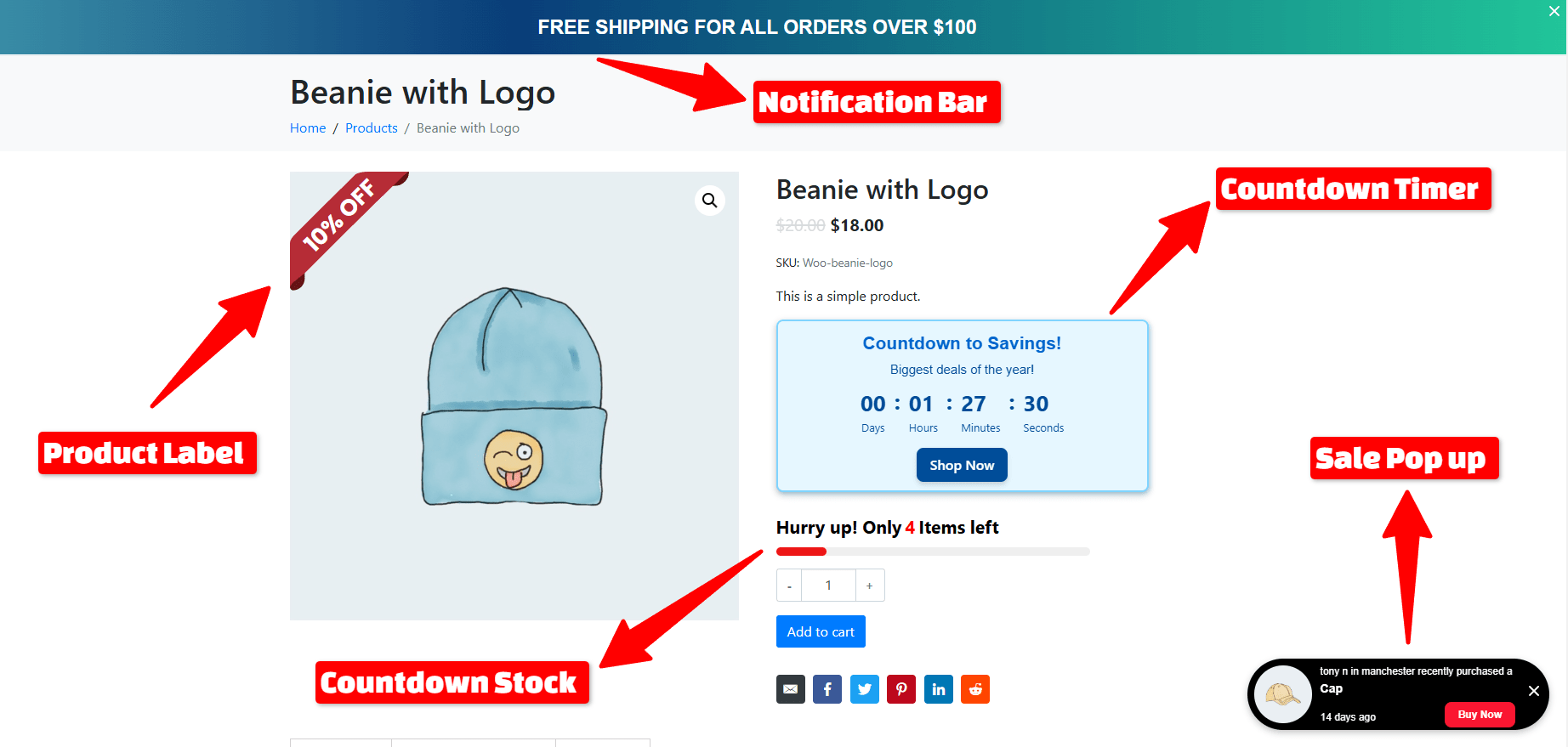
Product Badge, Label, Countdown Timer for WooCommerce – Sale Booster. Elevate your store’s appeal with customized badges and countdown timers (PRO Version). Enhance your store with one of the most versatile WooCommerce badge plugins, along with product labels and countdown timers to drive sales. This all-in-one plugin empowers you to create eye-catching labels and scheduled badges for products, categories, and tags. Highlighting discount values, product quantities, stock status, and sale status, these labels provide valuable information to your customers. Plus, leverage the power of countdown timers to create urgency and drive conversions. With an intuitive interface, easily customize labels and replace default on-sale badges. Take your WooCommerce store to new heights with visually appealing badges, labels, and countdown timers tailored to your unique offerings.
🚀FEATURES

Let’s take a brief look at some of the cool features of this plugin:

  • Over 10 Modern Badges
  • Add Free Shipping on Product Page
  • Add Discount Popup
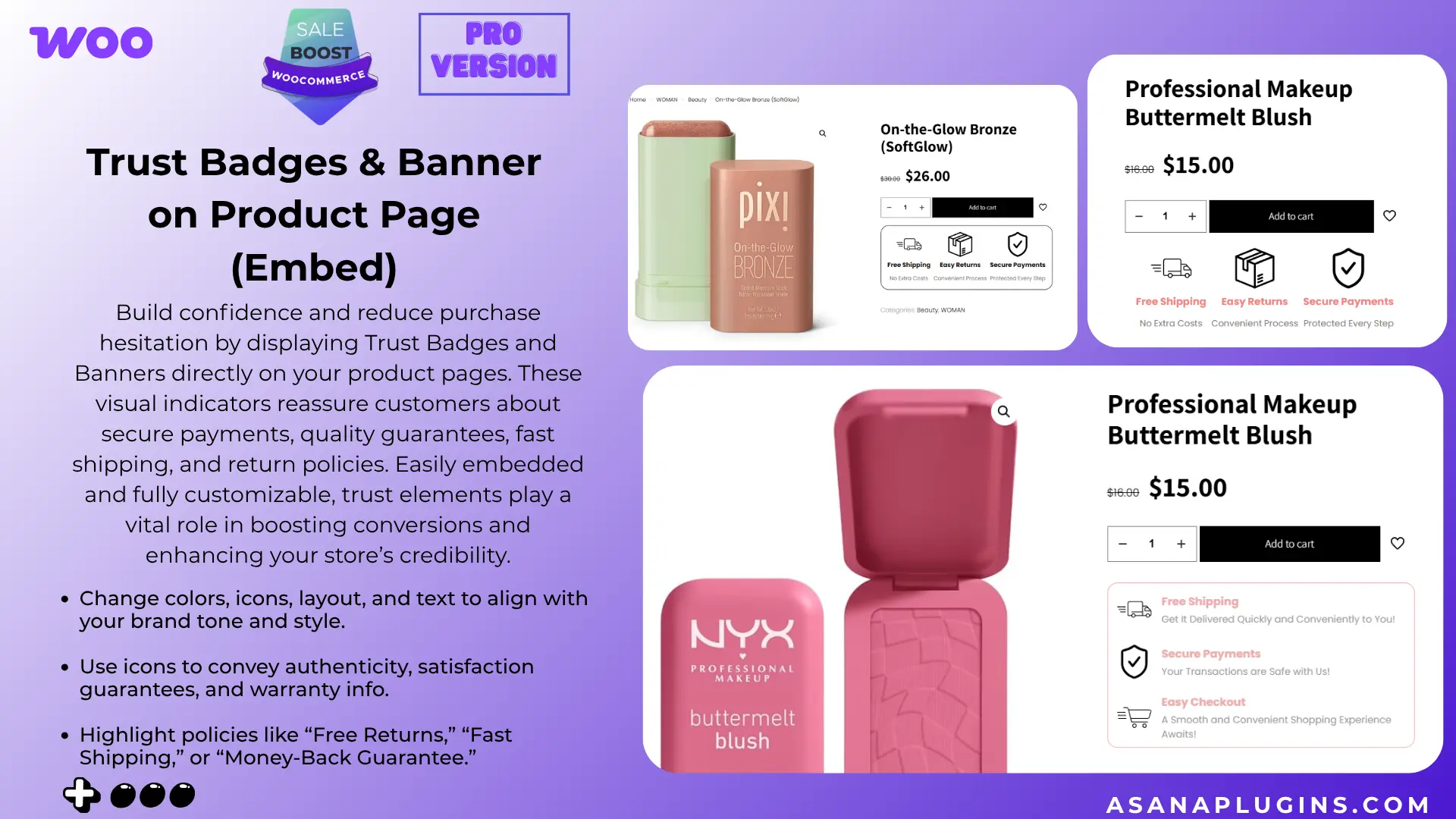
  • Add Trust Badges for embeds
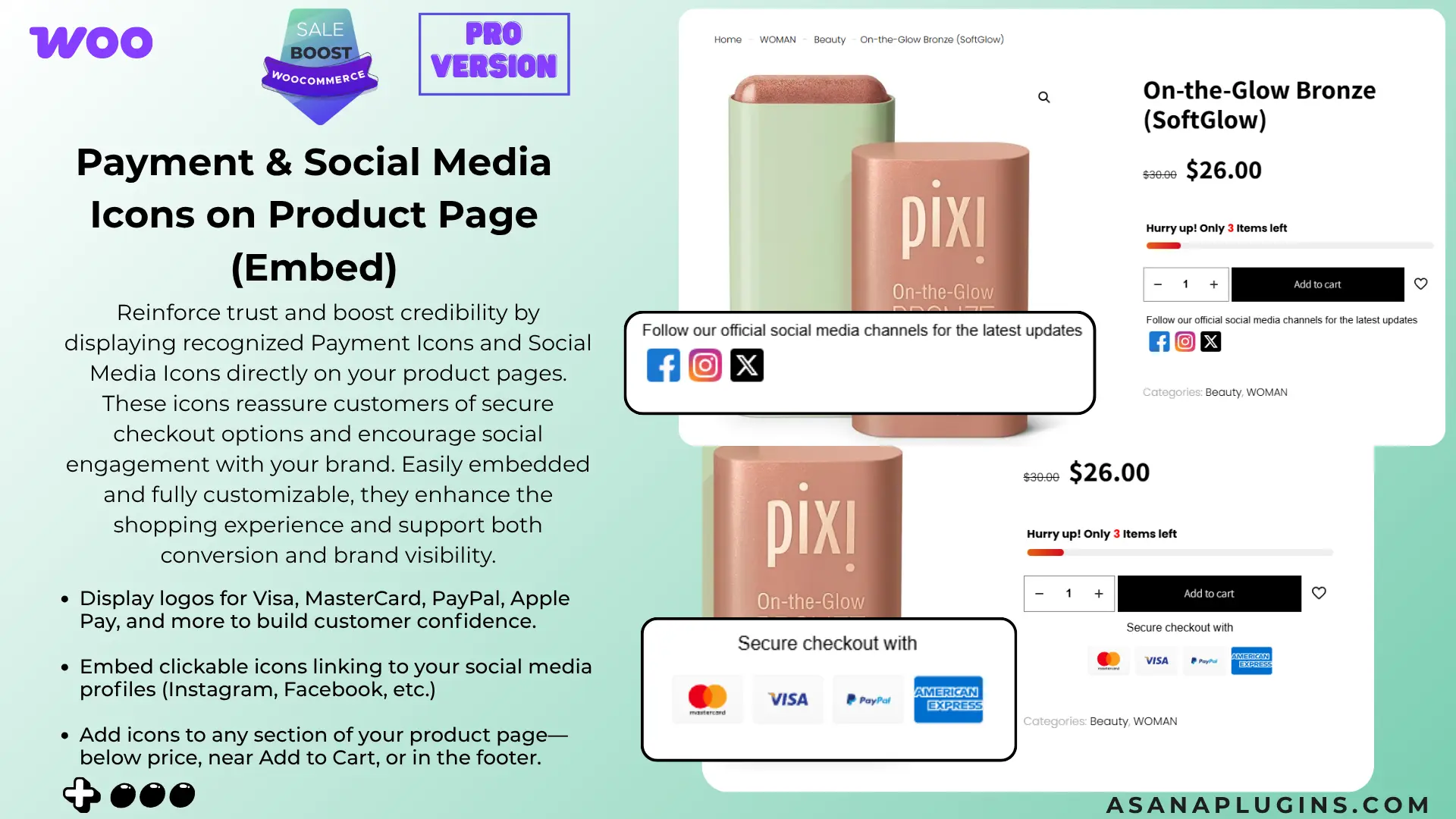
  • Add Social Media Icons for embeds
  • Add Payment Icons for embeds
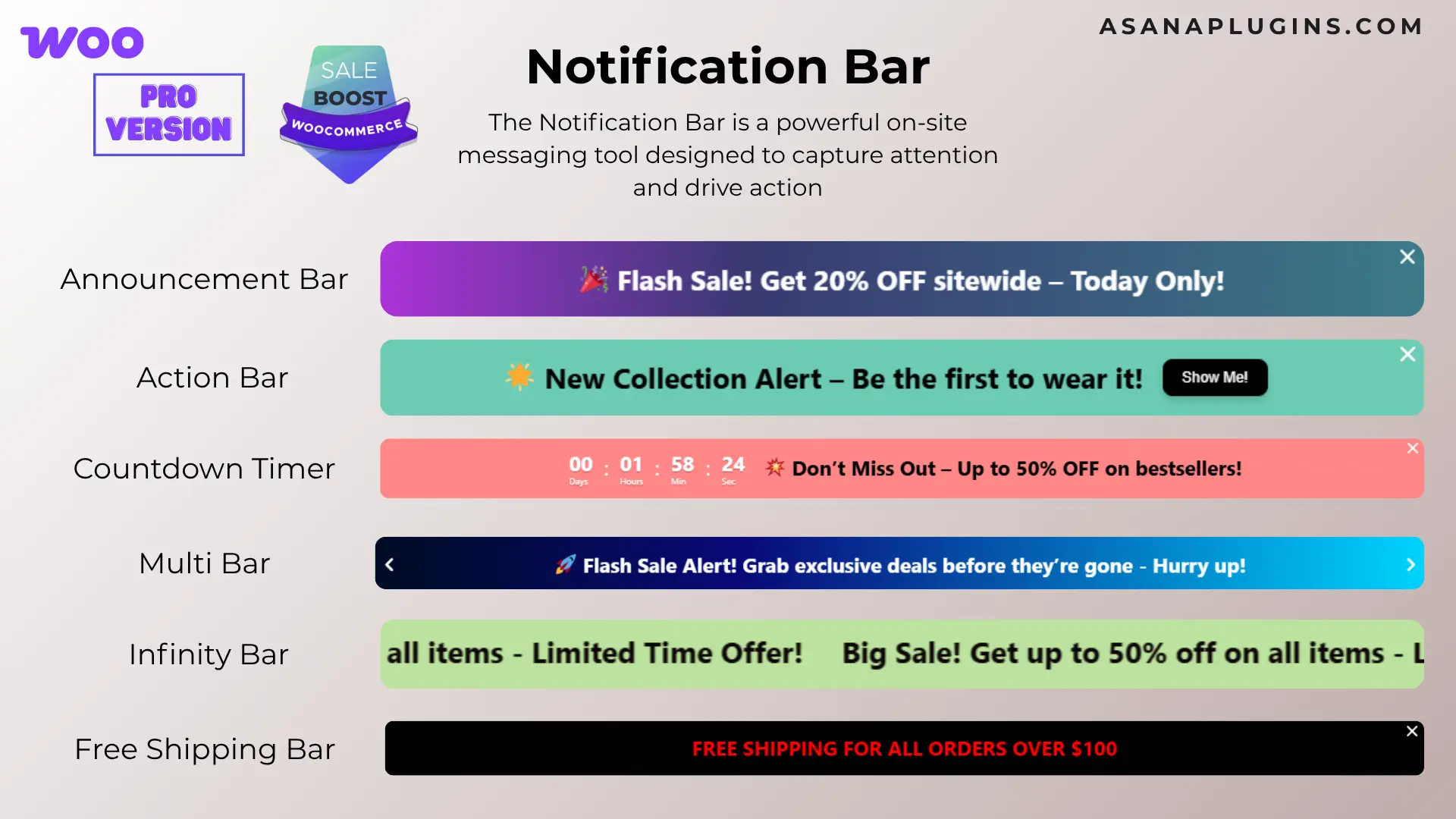
  • Add Multi Bar
  • Add Infinity Bar
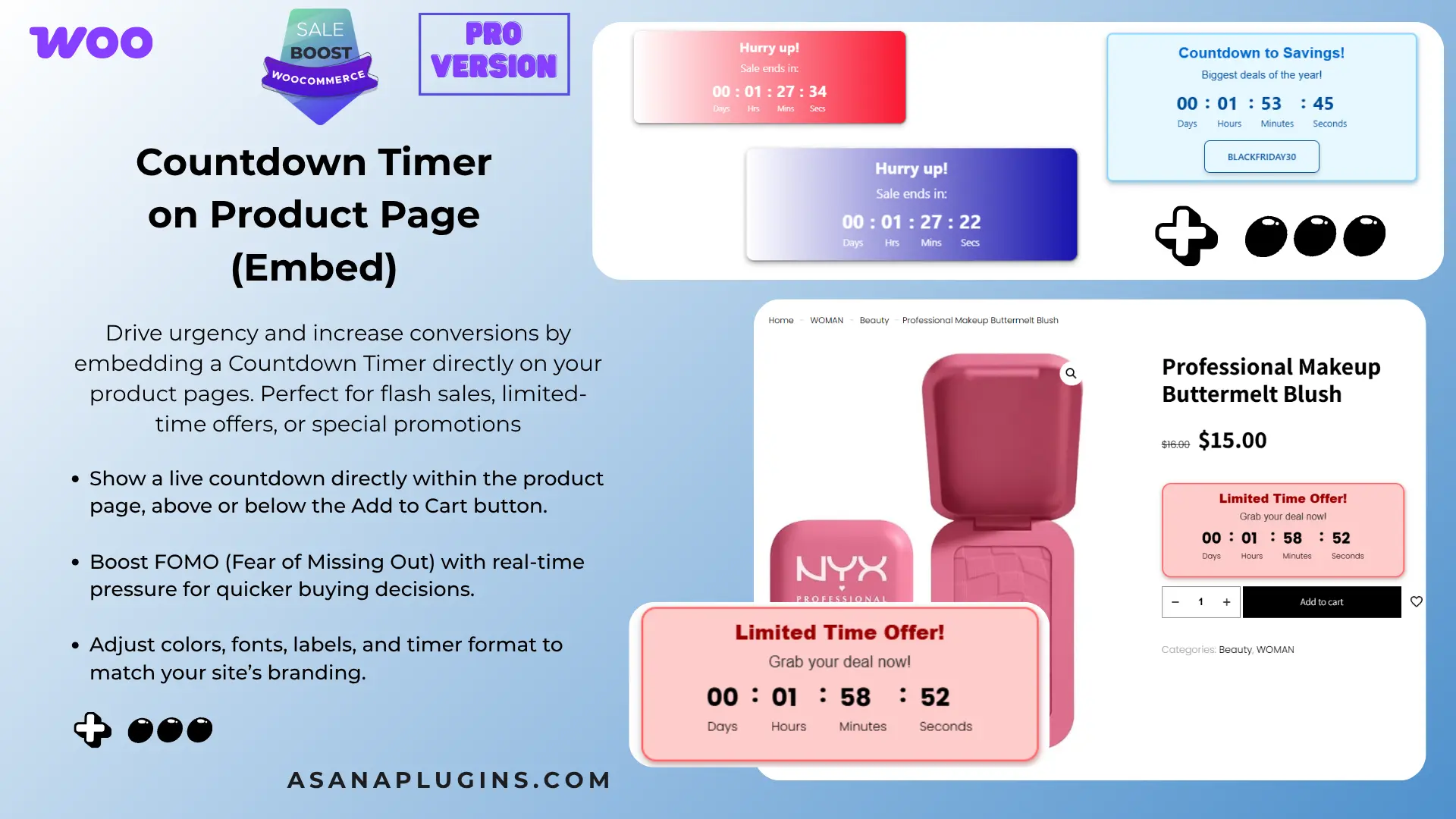
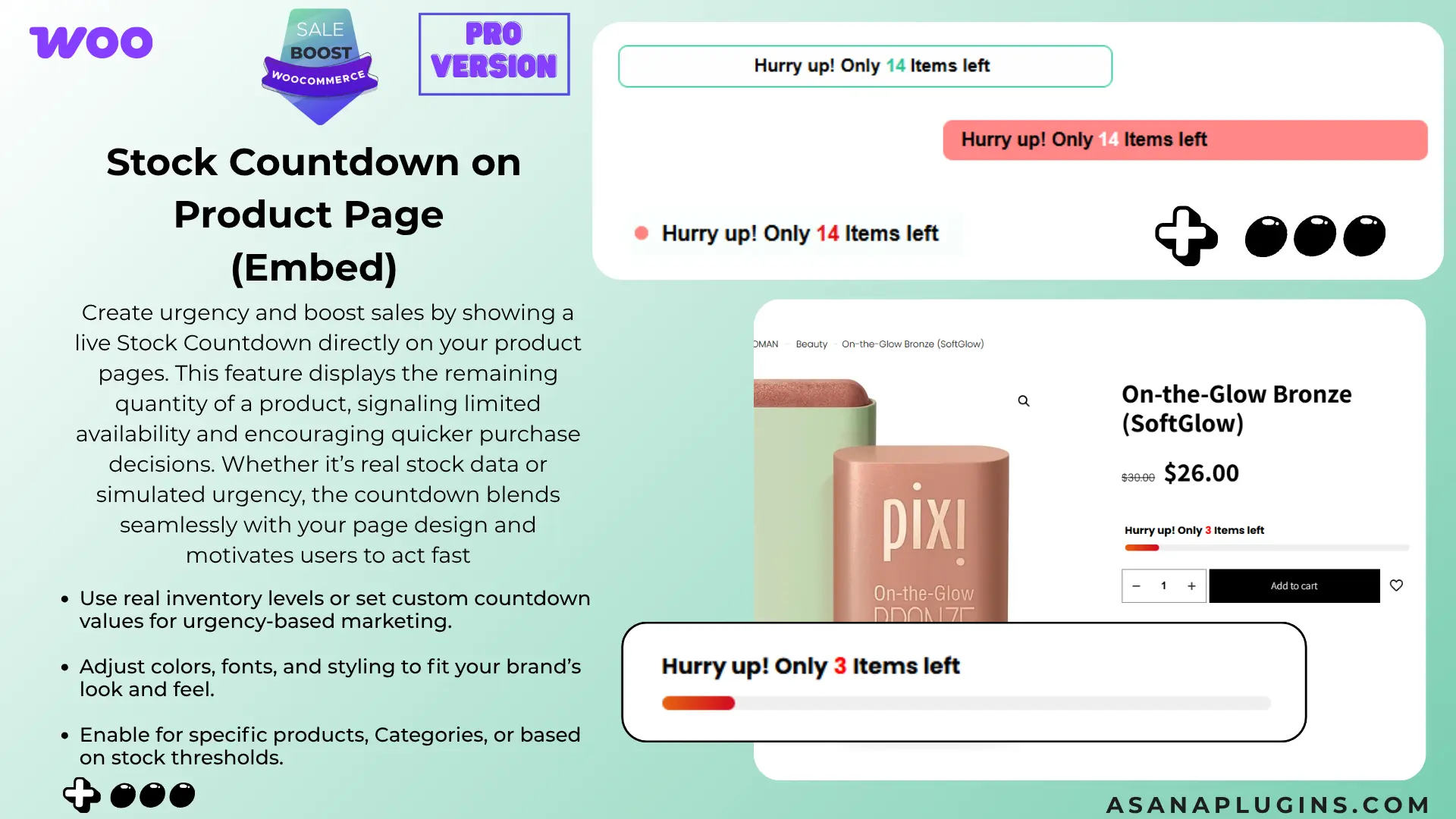
  • Add Countdown stock for embeds
  • Add Announcement feature for embeds
  • Add Sales Pop-up
  • Add Notification Bar
  • Add Free Shipping Bar
  • Over 200 Image Labels
  • Over 10 CSS Labels
  • Over 10 Countdown Timers Template
  • 10 Animation Effects
  • Add Badge to Out Of Image Position
  • Incorporate Gradient Colors
  • Implement Discount Rules
  • Add a Percentage Discount amount
  • Rotate CSS Labels, Image Labels, and Advanced Labels
  • Add Easy Custom labels on products
  • Access CSS label templates
  • Preview is available live for easy placement and customization
  • Add Badges to specific WooCommerce products, categories, or tags
  • Add Badges to “Is On Sale”
  • Add Badges to “In Stock” and “Out Of Stock”
  • Customize label attributes, including color, font size, line height, width, opacity, position, and much more
  • Transform And Rotate Css Labels
  • Set Toggle To the visibility of badges
  • Include an option to set an expiration Date and Time for badges
  • A unique feature for adjusting hooks that control the presentation of product labels, beneficial if your theme encounters issues displaying them or if you wish to reposition the labels
  • Adjust the Position of CSS Labels, Image Labels, and Advanced Labels
  • Include both Vertical and Horizontal Timers
  • Personalize Sale Timers with Styling Options
  • Sale Image Labels
  • Percentage Off Image Labels
  • Coming Soon Image Labels
  • Pre-Order Image Labels
  • Free Image Labels
  • Black Friday Image Labels
  • Valentine’s Day Image Labels
  • Xmas Image Labels

Tested with more than 40+ Themes

  • Flatsome
  • WoodMart 
  • Avada 
  • The7
  • Divi
  • Betheme
  • Uncode 
  • Enfold 
  • Bridge 
  • Salient
  • JupiterX 
  • XStore 
  • Porto 
  • StoreFront
  • Astra
  • OceanWP
  •  and much more

📽️Demo

Visit this plugin Live Demo here to see how it works.

💵Pricing

  • SINGLE SITE 👉 €60.00 €30.00
  • 5 SITES 👉 €200.00 €60.00
  • 25 SITES 👉 €400.00 €99.00

📽️ Video Tutorial

🖼️Screenshots

2. Advanced Woo Labels – Product Labels for WooCommerce


With the Advanced Woo Labels plugin, you can effortlessly generate labels or badges for all your WooCommerce products. Utilize label conditions to selectively display labels based on specific products, pages, or users. Customize label styles using the built-in options.

Capture users’ attention by incorporating information within labels such as discount value, product quantity, product rating, shipping class, stock status, sale status, and more.

🚀FEATURES

Let’s take a brief look at some of the cool features of this plugin:

  • Create unlimited number of labels for each WooCommerce product.
  • Display label in two positions: on product image or before title. Align label at any side of this position.
  • Use labels with custom text. Write any text inside product labels. Also use special text variables to show important product information like Price, Sale price, Discount percentage, Discount amount, SKU, Quantity.
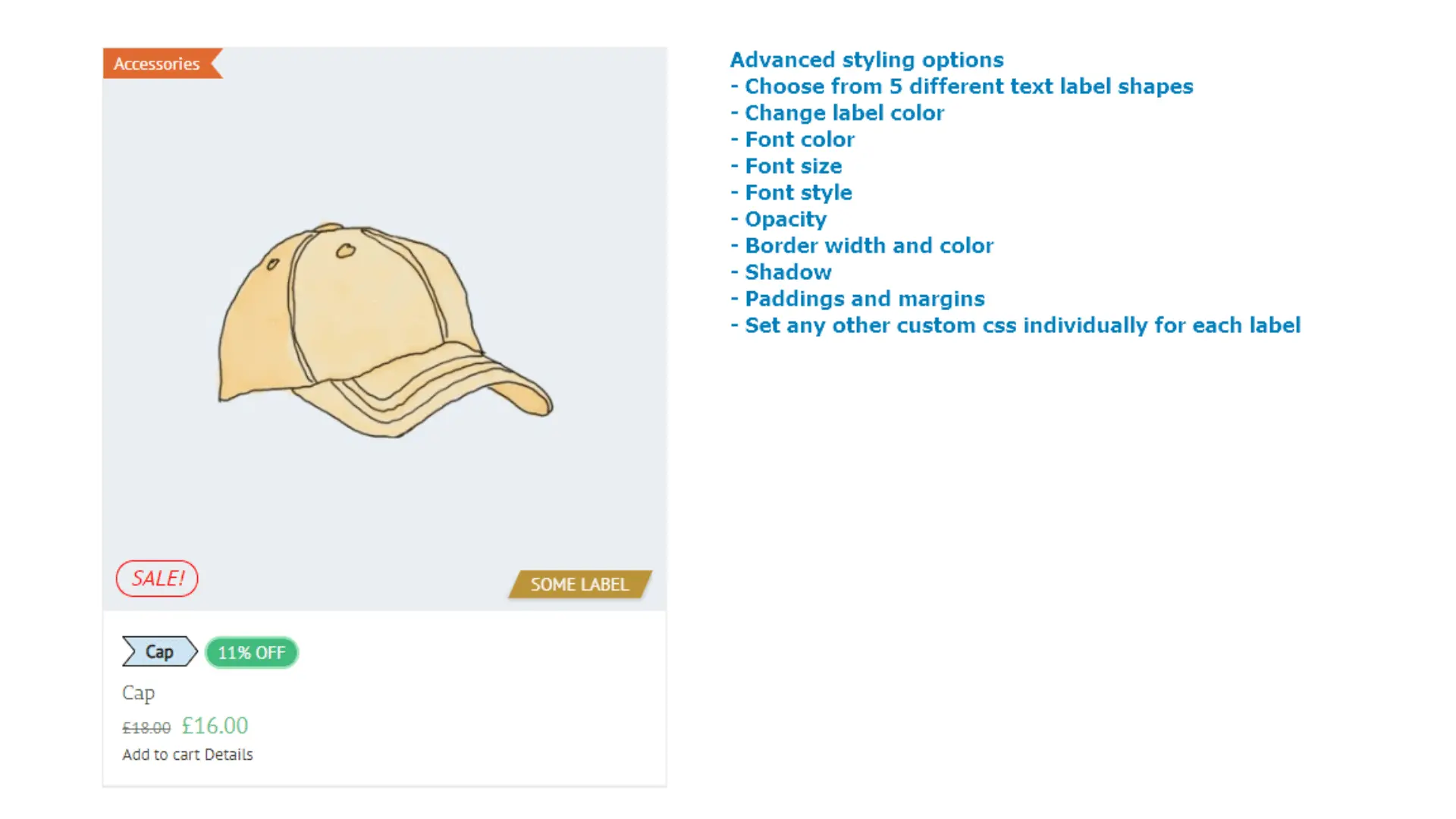
  • Choose from 5 different text label shapes. Set unique styles for each of them with help of custom styling options.
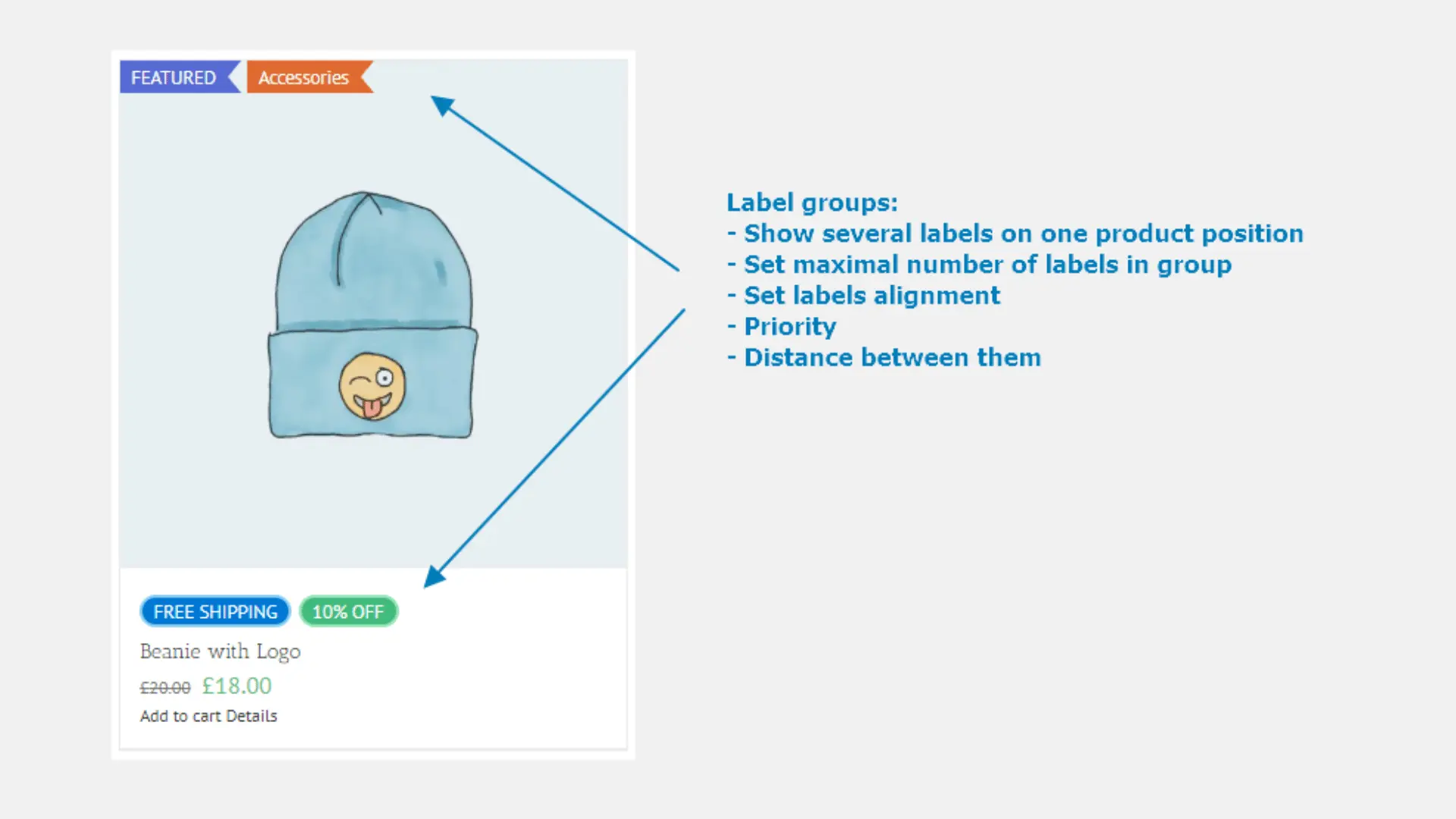
  • Label groups. Show several labels for one product. Set maximal number of such labels, their alignment, priority, distance between them.
  • Label conditions. Show labels based on specific product, page or user conditions. Combine conditions to ‘AND’ and ‘OR’ groups to create more complex label rules.
  • Create unlimited label variations with advanced styling options: change label color, font color, font size, opacity, paddings and margins, set any other custom css individually for each label.
  • Cool admin panel with labels live preview.
  • Special option to change hooks that used to display product labels if your theme has some problem with showing them or if you want to change labels position.
  • Page builder plugins support: Gutenberg, Elementor, Beaver Builder, WPBakery, Divi Builder, Avada Builder, etc.

📽️Demo

Visit this plugin Live Demo here to see how it works.

💵Pricing

  • SINGLE SITE 👉 $59
  • 5 SITES 👉 $79
  • Unlimited SITES 👉 $149

🖼️Screenshots

3. Advanced Product Labels for WooCommerce

The Advanced Product Labels plugin makes creating labels a breeze, allowing you to swiftly promote your free products or showcase special attributes such as “Free Shipping.” With the flexibility of conditions, you can assign each label to specific products within your shop, ensuring targeted promotion and highlighting of key features.

🚀FEATURES

Let’s take a brief look at some of the cool features of this plugin:

  • Custom labels on products
  • Labels for products by specific conditions
  • Labels by: product name, product category, sale status, stock status, bestsellers position, price, total sales count
  • Labels custom text and discount percentage type
  • Labels custom background and text colors
  • Custom label position
  • Multiple labels for one product
  • CSS templates
  • Custom image template
  • Better position for labels
  • Font size for labels
  • Font family for labels
  • Dimensions(px|em|%) for the Height, Width, Font size, Line height, Padding and Margin
  • z-index for labels

📽️Demo

Visit this plugin Live Demo here to see how it works.

💵Pricing

  • SINGLE SITE 👉 $34
  • 3 SITES 👉 $54
  • 5 SITES 👉 $84
  • 10 SITES 👉 $129

🖼️Screenshots

4. Product Labels For Woocommerce (Sale Badges)


The WooCommerce Product Labels plugin, also known as WooCommerce Sale Badges, simplifies the creation of product labels or badges effortlessly. With its user-friendly interface, you can easily craft custom product labels for WooCommerce products. Whether you want to add labels to specific products or categories or replace the default WooCommerce On Sale badges, this plugin offers the flexibility to do so with ease.

🚀FEATURES

Let’s take a brief look at some of the cool features of this plugin:

  • Can easily create / manage badges with our easy to use UI.
  • Option to customize badge color, font size, line height, width, opacity, position etc.
  • Live preview for easy positioning / styling.
  • Default / commonly used badge styles available to choose from.
  • Option to set hide / show badges.
  • Option to set badges to a set of products / category.
  • Option to set badges to all products ‘On Sale’.
  • Option to set badges to ‘Out Of Stock’ products.
  • Option to set expiry date & time on badges.
  • Option to hide the default WooCommerce ‘On Sale’ Badge.
  • Option to show discount percenatge (sale / regular price difference) as Badge text.

📽️Demo

Visit this plugin Live Demo here to see how it works.

💵Pricing

  • SINGLE SITE 👉 $43
  • 5 SITES 👉 $99

🖼️Screenshots

5. YITH WooCommerce Badge Management


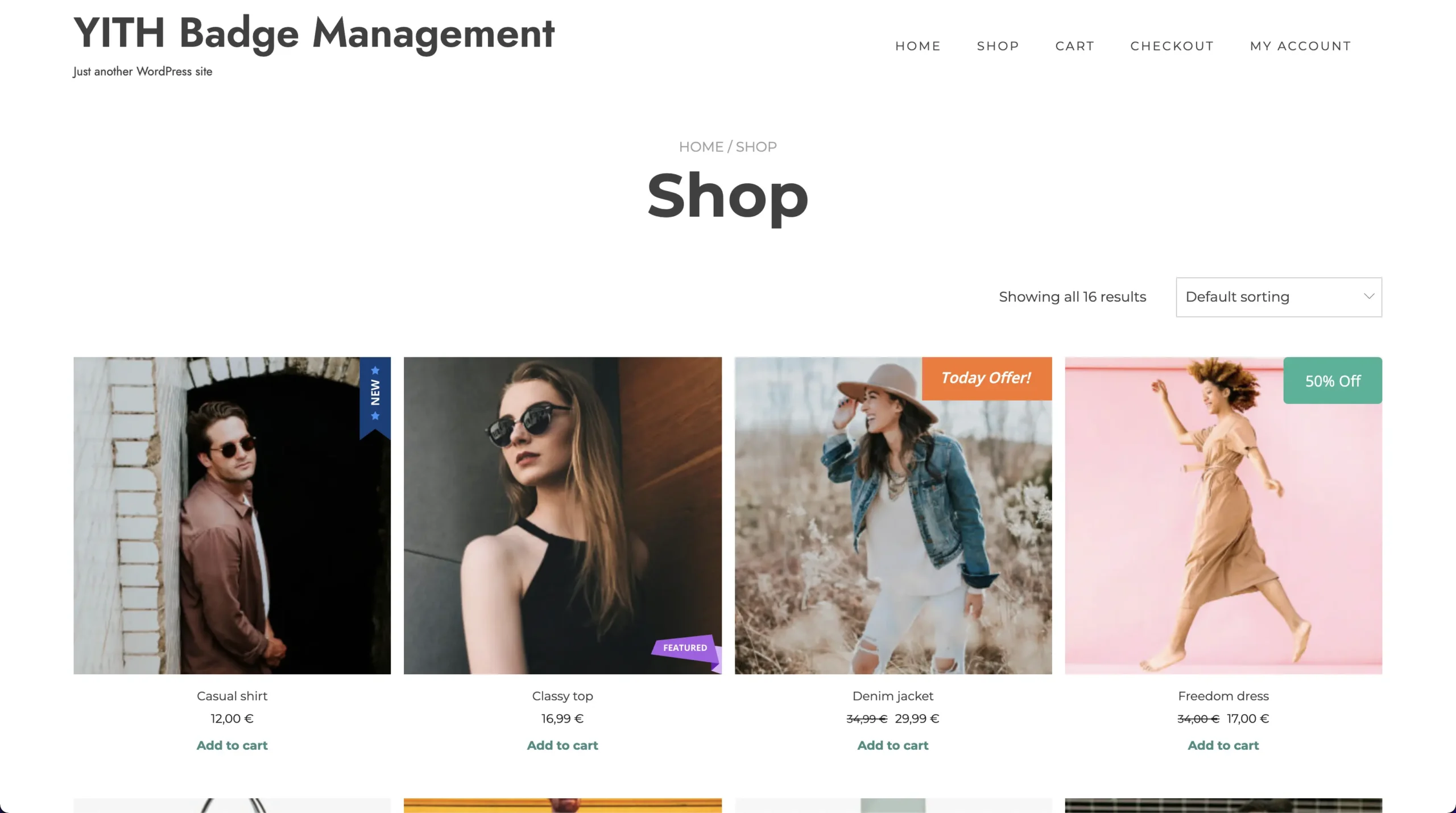
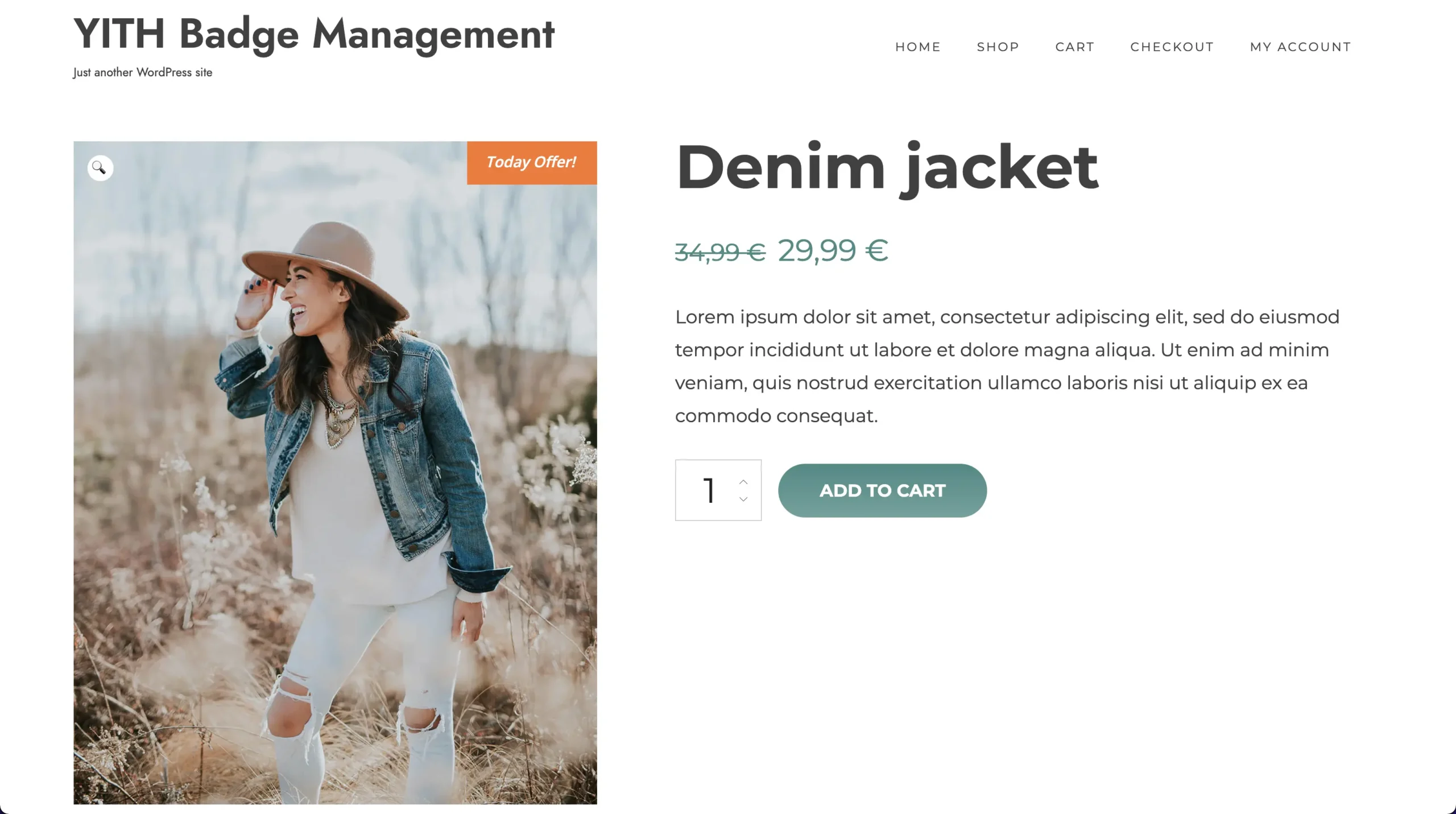
Utilizing product badges is an effective strategy for enhancing sales within your e-commerce platform. These badges serve to spotlight key products, whether they’re new arrivals, popular items, featured selections, or others. Moreover, product badges can leverage potent psychological triggers such as scarcity, social proof, and urgency, effectively stimulating sales.

🚀FEATURES

Let’s take a brief look at some of the cool features of this plugin:

  • Create unlimited badges using the advanced builder
  • Create simple textual badges, with or without background
  • Create image badges and choose from 9 different images
  • Set the badge size
  • Set the padding for the textual badges
  • Set the badges border radius
  • Set the badge position (top, bottom, center) and alignment (left, right, center)
  • Hide or replace the default WooCommerce “on sale” badge
  • Assign badges to products

📽️Demo

Visit this plugin Live Demo here to see how it works.

💵Pricing

  • € 79,99/ year

🖼️Screenshots

Updated on — Leave a comment

10 Best Woocommerce Product Label Plugins in 2026

If your WooCommerce store still relies on the default “Sale!” badge, you’re leaving conversions on the table. Product labels — the small badges, tags, and countdown stickers layered over your product images — do more than decorate a listing.

They flag urgency, highlight savings, call out bestsellers, and nudge a browsing visitor toward checkout, often without them consciously noticing why. That’s why choosing from the best WooCommerce product label plugins matters more than most store owners realize: the right plugin turns a plain catalog into a persuasive storefront, while the wrong one adds clutter, slows page speed, or breaks on your theme.

We’ve researched, compared, and refreshed this list for 2026, weighing setup ease, styling flexibility, performance, and free-vs-pro value across each option. Whether you want a simple “Out of Stock” sticker, an animated countdown timer, or fully custom image badges tied to specific sale rules, one of these ten plugins should fit your store.

1. Product Badge, Label, Countdown Timer for WooCommerce – Sale Booster

WooCommerce Product Badge, Label, Countdown Timer: Elevate your store’s appeal with customized badges and countdown timers (PRO Version). Enhance your WooCommerce store with sale badges, product labels, and countdown timers to drive sales. This all-in-one plugin empowers you to create eye-catching labels and scheduled badges for products, categories, and tags. Highlighting discount values, product quantities, ratings, shipping classes, stock status, and sale status, these labels provide valuable information to your customers. Plus, leverage the power of countdown timers to create urgency and drive conversions. With an intuitive interface, easily customize labels and replace default on-sale badges. Take your WooCommerce store to new heights with visually appealing badges, labels, and countdown timers tailored to your unique offerings.

Examples

🚀FEATURES

Let’s take a brief look at some of the cool features of this plugin:

  • Over 15 Product Badges
  • Over 10 Modern Badges
  • Free Shipping With Upsell
  • Free Shipping Bar
  • Order Notifications
  • Over 200 Image Labels
  • Trust Badges
  • Payment icons
  • Social Media Icons
  • Countdown Timer
  • Countdown Stock
  • Sales Pop-up
  • Notification Bar
  • Over 10 CSS Labels
  • Over 10 Countdown Timers
  • 10 Animation Effects
  • Add Badge to Out Of Image Position
  • Incorporate Gradient Colors
  • Implement Discount Rules
  • Add a Percentage Discount amount
  • Rotate CSS Labels, Image Labels, and Advanced Labels
  • Add Easy Custom labels on products
  • Access CSS label templates
  • Preview is available live for easy placement and customization
  • Add Badges to specific WooCommerce products, categories, or tags
  • Add Badges to “Is On Sale”
  • Add Badges to “In Stock” and “Out Of Stock”
  • Customize label attributes, including color, font size, line height, width, opacity, position, and much more
  • Transform And Rotate Css Labels
  • Set Toggle To the visibility of badges
  • Include an option to set an expiration Date and Time for badges
  • A unique feature for adjusting hooks that control the presentation of product labels, beneficial if your theme encounters issues displaying them or if you wish to reposition the labels
  • Adjust the Position of CSS Labels, Image Labels, and Advanced Labels
  • Include both Vertical and Horizontal Timers
  • Personalize Sale Timers with Styling Options
  • Sale Image Labels
  • Percentage Off Image Labels
  • Coming Soon Image Labels
  • Pre-Order Image Labels
  • Free Image Labels
  • Black Friday Image Labels
  • Valentine’s Day Image Labels
  • Xmas Image Labels

Tested with more than 40+ Themes

  • Flatsome
  • WoodMart 
  • Avada 
  • The7
  • Divi
  • Betheme
  • Uncode 
  • Enfold 
  • Bridge 
  • Salient
  • JupiterX 
  • XStore 
  • Porto 
  • StoreFront
  • Astra
  • OceanWP
  •  and much more

📽️Demo

Visit this plugin Live Demo here to see how it works.

💵Pricing

  • SINGLE SITE 👉 €60.00 €30.00
  • 5 SITES 👉 €200.00 €60.00
  • 25 SITES 👉 €400.00 €99.00

📽️ Video Tutorial

🖼️Screenshots

2. Advanced Woo Labels – Product Labels for WooCommerce


With the Advanced Woo Labels plugin, you can effortlessly generate labels or badges for all your WooCommerce products. Utilize label conditions to selectively display labels based on specific products, pages, or users. Customize label styles using the built-in options.

Capture users’ attention by incorporating information within labels such as discount value, product quantity, product rating, shipping class, stock status, sale status, and more.

🚀FEATURES

Let’s take a brief look at some of the cool features of this plugin:

  • Create unlimited number of labels for each WooCommerce product.
  • Display label in two positions: on product image or before title. Align label at any side of this position.
  • Use labels with custom text. Write any text inside product labels. Also use special text variables to show important product information like Price, Sale price, Discount percentage, Discount amount, SKU, Quantity.
  • Choose from 5 different text label shapes. Set unique styles for each of them with help of custom styling options.
  • Label groups. Show several labels for one product. Set maximal number of such labels, their alignment, priority, distance between them.
  • Label conditions. Show labels based on specific product, page or user conditions. Combine conditions to ‘AND’ and ‘OR’ groups to create more complex label rules.
  • Create unlimited label variations with advanced styling options: change label color, font color, font size, opacity, paddings and margins, set any other custom css individually for each label.
  • Cool admin panel with labels live preview.
  • Special option to change hooks that used to display product labels if your theme has some problem with showing them or if you want to change labels position.
  • Page builder plugins support: Gutenberg, Elementor, Beaver Builder, WPBakery, Divi Builder, Avada Builder, etc.

📽️Demo

Visit this plugin Live Demo here to see how it works.

💵Pricing

  • SINGLE SITE 👉 $59
  • 5 SITES 👉 $79
  • Unlimited SITES 👉 $149

🖼️Screenshots

3. Advanced Product Labels for WooCommerce

The Advanced Product Labels plugin makes creating labels a breeze, allowing you to swiftly promote your free products or showcase special attributes such as “Free Shipping.” With the flexibility of conditions, you can assign each label to specific products within your shop, ensuring targeted promotion and highlighting of key features.

🚀FEATURES

Let’s take a brief look at some of the cool features of this plugin:

  • Custom labels on products
  • Labels for products by specific conditions
  • Labels by: product name, product category, sale status, stock status, bestsellers position, price, total sales count
  • Labels custom text and discount percentage type
  • Labels custom background and text colors
  • Custom label position
  • Multiple labels for one product
  • CSS templates
  • Custom image template
  • Better position for labels
  • Font size for labels
  • Font family for labels
  • Dimensions(px|em|%) for the Height, Width, Font size, Line height, Padding and Margin
  • z-index for labels

📽️Demo

Visit this plugin Live Demo here to see how it works.

💵Pricing

  • SINGLE SITE 👉 $34
  • 3 SITES 👉 $54
  • 5 SITES 👉 $84
  • 10 SITES 👉 $129

🖼️Screenshots

4. Product Labels For Woocommerce (Sale Badges)


The WooCommerce Product Labels plugin, also known as WooCommerce Sale Badges, simplifies the creation of product labels or badges effortlessly. With its user-friendly interface, you can easily craft custom product labels for WooCommerce products. Whether you want to add labels to specific products or categories or replace the default WooCommerce On Sale badges, this plugin offers the flexibility to do so with ease.

🚀FEATURES

Let’s take a brief look at some of the cool features of this plugin:

  • Can easily create / manage badges with our easy to use UI.
  • Option to customize badge color, font size, line height, width, opacity, position etc.
  • Live preview for easy positioning / styling.
  • Default / commonly used badge styles available to choose from.
  • Option to set hide / show badges.
  • Option to set badges to a set of products / category.
  • Option to set badges to all products ‘On Sale’.
  • Option to set badges to ‘Out Of Stock’ products.
  • Option to set expiry date & time on badges.
  • Option to hide the default WooCommerce ‘On Sale’ Badge.
  • Option to show discount percenatge (sale / regular price difference) as Badge text.

📽️Demo

Visit this plugin Live Demo here to see how it works.

💵Pricing

  • SINGLE SITE 👉 $43
  • 5 SITES 👉 $99

🖼️Screenshots

5. YITH WooCommerce Badge Management


Utilizing product badges is an effective strategy for enhancing sales within your e-commerce platform. These badges serve to spotlight key products, whether they’re new arrivals, popular items, featured selections, or others. Moreover, product badges can leverage potent psychological triggers such as scarcity, social proof, and urgency, effectively stimulating sales.

🚀FEATURES

Let’s take a brief look at some of the cool features of this plugin:

  • Create unlimited badges using the advanced builder
  • Create simple textual badges, with or without background
  • Create image badges and choose from 9 different images
  • Set the badge size
  • Set the padding for the textual badges
  • Set the badges border radius
  • Set the badge position (top, bottom, center) and alignment (left, right, center)
  • Hide or replace the default WooCommerce “on sale” badge
  • Assign badges to products

📽️Demo

Visit this plugin Live Demo here to see how it works.

💵Pricing

  • € 79,99/ year

🖼️Screenshots

6. Sold Out Badge for WooCommerce


Show a “Sold Out!” badge on products that are out of stock. This plugin for WooCommerce will display a badge on the product thumbnail, featuring the text you’ve specified, when the product becomes out of stock.

🚀FEATURES

Let’s take a brief look at some of the cool features of this plugin:

  • Badge text (you can replace “Sold Out” with any text you want, like “Out of stock” or “Coming Soon“)
  • Badge background color
  • Badge text color
  • Badge font size
  • Badge width
  • Badge height
  • …
  • An option to hide “Sale” badge if you get an overlap (checked by default)

📽️Demo

Visit this plugin Live Demo here to see how it works.

🖼️Screenshots

7. WPC Badge Management for WooCommerce


The WPC Badge Management plugin is incredibly versatile, multipurpose, and powerful. Specifically designed for managing badges in online shops and WooCommerce sites, it goes beyond simple product labeling. It serves as a potent tool for ecommerce business owners, aiding them in increasing conversion rates, boosting sales and revenues, ensuring speedy checkout processes, and enhancing customer retention rates.

🚀FEATURES

Let’s take a brief look at some of the cool features of this plugin:

  • More than 22 styles of badges that diversify in images, colors, shapes, texts, etc.
  • Highly customizable Global Badges: excerpt, applicable objects, position, text, colors, tooltip & order
  • Multi-level object application: storewide (all products), on-sale, featured, out of stock, selected tags, categories, brands, product types, specific attributes
  • Various positions: Show or hide badges in more than 10 positions on pages & product images
  • Icons & short-code supported custom text for badges
  • Icon library: support FontAwesome, Feather, Ionicons
  • Orderable badges: input the order to be arranged when there are various badges inserted
  • Instant preview of badges on product image
  • Quickly preview all details of badges from the dashboard
  • (PREMIUM) Using a combination of conditionals
  • (PREMIUM) Groupable badges: manage positions of badges in groups on the single product page, archive page and product image
  • (PREMIUM) Product-level badge management: customize badges for specific products
  • WPC Smart Quick View integration: Customizable position on quick view popup
  • WPC Countdown Timer integration: Customizable badges using custom countdown timer short-code
  • Compatible with WPC plugins, most common WordPress themes and WooCommerce add-ons

📽️Demo

Visit this plugin Live Demo here to see how it works.

💵Pricing

  • SINGLE SITE 👉 $29
  • 5 SITES 👉 $59
  • UNLIMITED 👉 $99

🖼️Screenshots

8. Coming Soon Badge for WooCommerce

Easily design your “Coming Soon” badge for WooCommerce products and select which products will display it!

🚀FEATURES

Let’s take a brief look at some of the cool features of this plugin:

  • Custom badge with full control over design: position, size, colors, font-weight, margins, paddings, etc.
  • Super easy and friendly designer: all without writing one line of CSS, with visual live preview
  • Set the same or distinct badge for products loop / product page (or switch off the badge on one of them)
  • Upload your own image if you prefer, or de-activate all plugin CSS generation and add your own
  • After configuration, switch on/off product coming soon badge with a simple checkbox on product edition
  • Compatible with most of WooCommerce themes
  • Compatible with Elementor and Divi

📽️Demo

Visit this plugin Live Demo here to see how it works.

🖼️Screenshots

9. Product Badges For Woocommerce


The Product Badges for WooCommerce plugin provides an additional badge on the shop page, single product page, and category page.

🚀FEATURES

Let’s take a brief look at some of the cool features of this plugin:

  • Easy to use
  • You can add new product badges.
  • You can select Show Label.
  • Select Product badge position.
  • Customized Label font size, color and background color.
  • Add Product Discount Text.
  • You can Select Label Shape or Image Badge select.
  • Product Badges add conditionally with product wise and tag wise.
  • WPML Support

📽️Demo

Visit this plugin Live Demo here to see how it works.

💵Pricing

  • SINGLE SITE 👉 $25

🖼️Screenshots

10. Product Badge Manager For Woocommerce


Product Badge Manager for WooCommerce enables you to create unlimited product badges and assign them to your WooCommerce products based on various criteria such as category, attributes, terms, popularity, sales, time, stocks, and more. You can also filter the product archive using these badges.

🚀FEATURES

Let’s take a brief look at some of the cool features of this plugin:

  • Easy to use
  • You can add new product badges.
  • You can select Show Label.
  • Select Product badge position.
  • Customized Label font size, color and background color.
  • Add Product Discount Text.
  • You can Select Label Shape or Image Badge select.
  • Product Badges add conditionally with product wise and tag wise.
  • WPML Support

📽️Demo

Visit this plugin Live Demo here to see how it works.

💵Pricing

  • SINGLE SITE 👉 $25

🖼️Screenshots

Updated on — Leave a comment

WooCommerce Grouped Products (2024)

WooCommerce Grouped Products

In this article, we aim to provide a thorough and detailed review of WooCommerce Grouped Products. Subsequently, we will follow up with a step-by-step tutorial on creating and implementing them in your online store.

Looking to enhance your online store with product bundles? This guide to WooCommerce Grouped Products provides a comprehensive review and tutorial for creating and managing grouped products. Moreover, it is perfect for both seasoned pros and beginners. By following the guide, you can streamline store management and boost sales, as it improves the shopping experience. Consequently, dive in to unlock your WooCommerce store’s full potential!

What are WooCommerce Grouped Products?

WooCommerce Grouped Products let store owners showcase multiple related items together. Unlike simple or variable products, which are individual items or items with variations, grouped products are standalone items that can be purchased together or separately. This feature is ideal for selling complementary items like books, accessories, or tools. Consequently, it provides a more organized and appealing presentation, thereby making it easier for customers to find and buy what they need.

Benefits of Using Grouped Products

  • Cost Savings for Customers: Grouped products are attractive for customers buying related items together. Offering a discount on the group can increase appeal, providing value to customers and boosting sales.
  • Increased Sales Opportunities: Presenting related products as a group promotes cross-selling and upselling, encouraging customers to buy complementary items. This can increase average order values and overall sales.
  • Flexible Pricing and Promotions: Grouped products enable flexible pricing strategies. For instance, you can offer discounts or promotions to the entire group; alternatively, you can apply them to individual items. Consequently, this approach encourages customers to purchase more.
  • Enhanced Customer Experience: Grouped products display related items together. As a result, customers can more easily find and buy complementary products. Consequently, this enhances satisfaction and boosts purchases.
  • Improved SEO and Discoverability: Grouped products can boost your store’s SEO by adding more content and keywords. Consequently, this improves visibility in search results and makes it easier for customers to find your products.
  • Consistent Branding and Theming: Grouped products enable consistent branding and thematic presentation. As a result, they enhance your store’s aesthetic, strengthening brand identity. Consequently, this appeals to customers seeking specific styles or collections.
  • Enhanced Product Visibility: Grouped products can boost the visibility of less popular or new items by pairing them with best-sellers. Thus, this strategy helps introduce customers to products they might not have found otherwise.

Examples of Grouped Products

  • Fitness Starter Pack: A selection of fitness equipment is grouped for beginners, offering a comprehensive set for home workouts. For example, it includes dumbbells, a yoga mat, resistance bands, and a jump rope. Consequently, this collection provides everything needed to start an effective fitness routine at home.
  • Outdoor Adventure Gear: Key outdoor equipment is bundled together for camping enthusiasts, offering convenience for trip preparation. Specifically, it includes items such as a tent, sleeping bag, backpack, and camping stove. Consequently, this bundle simplifies the process of getting ready for a camping trip.
  • Gardening Starter Kit: A collection of essential gardening tools is grouped for easy purchase, making it ideal for new gardeners. For instance, it includes a trowel, pruning shears, gloves, and a watering can. As a result, this setup simplifies the process of getting started with gardening.
  • Kitchen Essentials Set: A grouped product of fundamental kitchen tools designed for cooking and baking. Specifically, it is perfect for new cooks or kitchen setups. Moreover, this collection provides essential items that facilitate a smoother cooking experience.
  • Art Supplies Collection: A set of basic art supplies is available for artists, allowing customers to purchase all necessary items in one go. For instance, this set includes sketchpads, coloured pencils, brushes, and acrylic paints. As a result, it simplifies the process of acquiring essential art materials.
  • Office Supplies Bundle: Essential office supplies are grouped together for easy restocking or setting up a new workspace. For instance, the collection includes notebooks, pens, a stapler, and a desk organizer. Consequently, this grouping streamlines the process of equipping an office efficiently.

Video Tutorial

Setting Up Grouped Products in WooCommerce

To set up a grouped product in WooCommerce, we use the free and powerful “ Product Bundle Builder for WooCommerce” plugin, one of the most popular WordPress plugins in 2025. This plugin is not only user-friendly but also offers numerous great tools for personalization.

Step 1: Installing Product Bundle Free Plugin

To install the Product Bundle Builder for the WooCommerce plugin, follow the below steps:

  1. Navigate to the Plugins >> Add New menu on your WordPress website
  2. Then search for “Product Bundle Builder for WooCommerce“ or “Asanaplugins”
  3. Find the “Product Bundle Builder for WooCommerce”
  4. Install the plugin and activate it.
Installing Product Bundle Free Plugin

Step 2: Create a Grouped Products

To create WooCommerce Grouped Products, follow the below steps:

1. Go to WooCommerce “Products”.

2. Click on “Add New” to create a new product.

3. Set a name for the Grouped Products.

4. Click on “Set product image” from the right sidebar and select an image for your Grouped Products.

5. Now go to the Product data section, and select “Product bundle” as the product type from the dropdown menu.

6. After selecting “Product bundle” as the product type the “Product Bundles” tab will appear in the product data panel.

7. Go to the “Product Bundles” tab and click on the “Add Item” button to add a new bundle item.

Create a Grouped Products

Step 3: Add product to the Grouped Products

8. Now scroll down to the item field, and in the “Products” field of the item Search and select the product you want, you can also set the default product for this item in the default product field.

  • Likewise, if you would like to include products from a category, you can do so with the “Categories” field of the item. therefore you can search for categories and add them. (PRO VERSION)
  • in addition, you can do the same for the product tags and include them in the “Tags” field. (PRO VERSION)
Add product to the Grouped Products

Step 4: Customising the Grouped Products

You can also configure the below settings to your grouped products in the item field:

  • Sort products: With this field, you can sort selected grouped products by “ID”, “Title”, “Menu order”,” Date”, “Price”, “popularity” and“Rating”.
  • Quantity: In this field, you can set the default quantity for each grouped product.
  • Edit quantity by user: Check this field to allow the user to change the quantity of product and Set the “min/max quantity” for each item.
  • Discount: In this field, you can set discounts for the grouped products by percentage, price or fixed price.
Customising the Grouped Products

Now you can go to the “display” tab of the item and configure the below sections:

  • Overwrite bundle item title.
  • Overwrite bundle item short description. (Show when the mouse hovers over it)
  • Change the title of the bundle empty item.
  • Change the product list product selection title.
  • Change the pop-up header title.
  • Set an image for the empty item.
Edit grouped products

9. Then you can click on “Add Item” to add a new item to the grouped products and Configure it as in the previous steps. We have created 2 other bundle items.

Step 5: Pricing for Grouped Products

After adding products and configuring settings for that you can choose how want to price your grouped products.

The Easy WooCommerce Product Bundles free plugin offers two pricing strategies:

  1. Fixed Price: Sets a fixed price for the whole assembled products.
  2. Auto Calculate Bundle Price: Allow the plugin to calculate the grouped product price using the selected products for the bundle items.

1. Fixed Price

If you want to set a fixed price for the whole assembled products, check the “Fixed Price” option.

Fixed Price for WooCommerce Combo offers

Navigate to the “General” tab and set a regular price for the grouped product. You can set a Sale price too.

Fixed Price for WooCommerce Combo offers

After setting a price, update the product

2. Auto Calculate Price

Auto calculates price helps to set a dynamic price for the grouped products on selected items for the bundle.

Therefore to use the auto-calculate price feature, uncheck the “Fixed Price” option and update the product.

10. At the end publish the grouped products.

Step 6: Configure the Plugin Settings

All the plugin settings you need can be found on the “Product Bundles” tab in the WordPress dashboard.

Configure the Product Bundles plugin Settings

Settings and customization are available on this page:

  • Item View: In this section, you can configure various settings, such as displaying stock availability, showing product ratings and descriptions, enabling modal quick views, adding a quantity field on item pages, displaying a plus icon for items, setting the theme and size options, positioning product bundles on the product page, defining custom CSS selectors, specifying the product price selector, and many other customizable options.
  • Change product model: In this section, you can configure the number of products per pop-up page.
  • Styles: In this section, you can customize the colours of different parts of your bundle and set the product image object-fit CSS.

Final Result

Now open the product page on the front end.
As a result, After selecting a product, for all of the bundle items, the WooCommerce grouped products will be shown as the image below.

Final result of Grouped Products

Grouped Products With Variable Product in WooCommerce

Creating Grouped Products in WooCommerce allows you to showcase multiple related items together as a single offering. This feature can be particularly powerful, especially when combined with Variable Products, as it provides even more flexibility and options for customers. Here’s how you can effectively use WooCommerce Grouped Products with Variable Products:

Step 1: Create a Grouped Products

To create WooCommerce Grouped Products with Variable products, you can follow the steps below:

1. Go to WooCommerce “Products”.

2. Click on “Add New” to create a new product.

3. Set a name for the Grouped Products with Variable.

4. Click on “Set product image” from the right sidebar and select an image for your Grouped Products.

5. Go to the Product data section, and select “Product bundle” as the product type from the dropdown menu.

6. After selecting “Product bundle” as the product type the “Product Bundles” tab will appear in the product data panel.

7. Go to the “Product Bundles” tab and click on the “Add Item” button to add a new bundle item.

Step 2: Add Variable product to the Grouped Products

8. Now scroll down to the item field, and in the “Products” field of the item Search and select the Variable products you want.

you can also set the default variation product for this item in the default product field. (PRO VERSION)

Add Variable product to the Grouped Products
  • Likewise, if you would like to include Variable products from a category, you can do so with the “Categories” field of the item. therefore you can search for variable product categories and add them. (PRO VERSION)
  • in addition, you can do the same for the variable product tags and include them in the “Tags” field. (PRO VERSION)

Step 3: Customising the Grouped Products

For customising the grouped products, therefore please Read this section of the article for more information.

9. Then you can click on “Add Item” to add a new item to the grouped products with Variable product and Configure it as in the previous steps. We have created 2 other bundle items.

Step 4: Pricing for Grouped Products with Variable Products

Now you should decide about the pricing of the Grouped Products with Variable Products. therefore You can use a fixed price for the whole bundle or use auto calculate price, to calculate the bundle price based on selected items.

Read this section of the article for more information.

Step 5: Configure the Plugin Settings

To configure the plugin settings, therefore please Read this section of the article for more information.

Final Result

Now open the product page on the front end.
As a result, After selecting a variation product, for all of the bundle items, the WooCommerce grouped products with Variable will be shown as the image below.

Final Result of Grouped Product With Variable

How to Create Flexible Optional Grouped Products

Flexible Optional Grouped Products offer a personalized shopping experience by allowing customers to customize combinations of products or services according to their preferences. This feature enables customers to choose whether or not to purchase additional products within the group, giving them full control over their shopping experience. As a result, this flexibility not only enhances customer satisfaction but also drives higher spending through cost savings and upselling opportunities. Businesses, in turn, benefit from increased revenue, improved customer loyalty, and a versatile marketing tool that adapts effectively to market trends.

If you are using the pro version of the Product Bundle Builder for WooCommerce To create flexible optional Product bundles, follow the below steps:

Step 1: Create Flexible Optional Grouped Products

1. GO to the WooCommerce “Products”.

2. Click on “Add New” to create a new product.

3. Set a name for the optional Grouped Products.

4. Click on “Set product image” from the right sidebar and select an image for your optional Grouped Products.

5. Go to the Product data panel, and select “Product bundle” as the product type.

6. Set the selling price for your parent product.

7. Now go to the “Product Bundles” tab.

8. Check “Include parent price” so that the price of the parent product is applied to the product bundle.

9. Click on the “Add Bundle” button to add a new bundle item.

Create flexible optional grouped products

Step 2: Add items to Flexible Optional Grouped Products

10. Now scroll down to the item field, and check the “Optional” field to make this bundle item optional.

11. Now select the default product for this item in the “Default Product” field.

12. In the “Categories” field search for a category and select it.

Add items to Flexible Optional Grouped Products

Step 3: Customising the Grouped Products

For customising the grouped products, therefore please Read this section of the article for more information.

13. Then you can click on “Add Bundle” to add a new item to the bundle and Configure it as in the previous steps. We created another bundle item.

Step 4: Pricing for Flexible Optional Grouped Products

Now you should decide about the pricing of the Flexible Optional Grouped Products. therefore You can use a fixed price for the whole bundle or use auto calculate price, to calculate the bundle price based on selected items.

Read this section of the article for more information.

Step 5: Configure the Plugin Settings

To configure the plugin settings, therefore please Read this section of the article for more information.

Final Result

Optional Grouped Products

After creating and publishing the flexible optional grouped products, open the product page on the front end.
The WooCommerce Flexible Optional Grouped Products will be shown as the image below.

Note: By clicking on the add to cart, the customer adds 1 parent product + 2 or 1 selected product to the cart and when the customer removes the chosen products, she/he can buy only the parent product.

The Best Way to Use WooCommerce Grouped Products

The best way to use WooCommerce grouped products is to strategically bundle complementary items together, as a result enhancing the shopping experience and increasing sales. Here are some tips:

  1. Bundle Related Items: First and foremost, group products that naturally go together, such as a camera with a memory card and camera case. This makes it convenient for customers to purchase all necessary items at once.
  2. Offer Discounts: Additionally, provide a slight discount when customers purchase the entire group. This encourages them to buy more, thereby boosting your sales.
  3. Promote Visibility: Moreover, use grouped products to highlight less popular or new items by pairing them with best-sellers. This can help introduce customers to products they might not have discovered otherwise.
  4. Simplify Shopping: Make it easier for customers to find and buy complementary products by presenting them together, Consequently, this streamlined shopping experience can increase customer satisfaction and encourage more purchases.
  5. Enhance SEO: Consequently, grouped products can improve your store’s SEO by adding more content and keywords, making it easier for potential customers to find your products through search engines.
  6. Consistent Branding: Finally, use grouped products to present items with consistent branding or themes, thereby enhancing your store’s aesthetic and strengthening your brand identity.

By leveraging these strategies, you can effectively use WooCommerce grouped products to enhance your store’s functionality and appeal.

Conclusion

In conclusion, using grouped products in WooCommerce offers a strategic advantage for enhancing your online store. By grouping related items, you can provide a more organized and appealing shopping experience for customers, making it easier for them to find and purchase complementary products. This approach not only simplifies the purchasing process but also boosts sales by encouraging customers to buy multiple items at once. Additionally, the flexibility to include variable products within grouped offerings allows for greater customization and personalization, further improving customer satisfaction. Effectively leveraging grouped products can streamline store management, increase visibility for less popular items, and enhance your store’s overall functionality and appeal.

FAQ

What is the difference between bundled products and grouped products in WooCommerce?

Grouped products in WooCommerce let customers buy related items individually or together, with each item managed separately. In contrast, bundled products create a custom package of items sold together at a discount, often with options for customization.

Why use product bundling?

Product bundling offers customers a convenient way to purchase related items at a discounted price, enhancing their shopping experience and increasing overall sales. It simplifies buying, promotes additional product purchases, and often leads to higher average order values.

Which is an example of product bundling?

Instead of purchasing a single pencil, customers can be offered a bundle that includes a pencil, eraser, and sharpener, encouraging them to buy multiple items at once and increasing the average order value.

Is product bundling effective?

Product bundling is a smart strategy for clearing obsolete or excess inventory. Excess stock ties up cash, reduces business agility, and increases storage costs. By bundling slow-moving items with popular products, you can efficiently clear shelf space and improve cash flow while making room for better-selling goods.

Related Resources

Want to learn more about WooCommerce product bundles and related strategies? Explore these helpful guides:

🌐SOCIAL MEDIA LINKS

Updated on — Leave a comment

WooCommerce Assembled Products

In this article, we thoroughly explore WooCommerce Assembled Products. We delve into its numerous benefits and advantages for online stores and provide a step-by-step guide on how to create WooCommerce Assembled Products for free in your online store.

Don’t miss out on this valuable information read the full article to discover how WooCommerce Assembled Products can enhance your business and streamline your online store setup!

What is Assembled Products?

Assembled Products refer to items created by combining multiple individual components into a single package, providing a unified product for customers. This concept is widely used across various industries to enhance convenience and increase sales. For example, consider a DIY electronics kit sold in an online store. Instead of purchasing each component separately—such as resistors, capacitors, wires, and a soldering iron—the customer can buy a complete kit that includes all these items, along with detailed instructions. This assembled product simplifies the purchasing process, ensuring that the customer has everything needed for the project, and often comes at a lower total cost than buying the parts individually. By offering such bundled products, businesses can improve the customer experience, manage inventory more effectively, and boost their average order value.

Benefits of Using WooCommerce Assembled Products

Utilizing WooCommerce Assembled Products provides numerous benefits for online store owners, significantly improving business operations and enhancing customer satisfaction. Here are some of the key advantages:

  1. Increased Product Visibility: Featuring assembled products can draw attention to individual items that customers might not have otherwise noticed. This can drive interest and sales for those components.
  2. Boosted Sales: By grouping related items together, you incentivize customers to purchase more in a single transaction, leading to higher average order values and increased overall revenue.
  3. Enhanced Customer Experience: Providing assembled products streamlines the shopping journey, enabling customers to easily acquire all the necessary items in one go. This added convenience can result in greater customer satisfaction and loyalty.
  4. Personalization Options: Customers often have the ability to select specific components or variations within the assembled product, offering a personalized shopping experience. This customization can attract broader customers.
  5. Cost Savings: Offering bundled items typically provide a cost-benefit for both the business and the customer. Businesses can offer discounts on these bundles, making them more appealing, while customers save money compared to purchasing each item separately.
  6. Increased Product Visibility: Featuring assembled products can draw attention to individual items that customers might not have otherwise noticed. This can drive interest and sales for those components.
  7. Enhanced Cross-Selling: Assembled products naturally promote cross-selling, as customers are introduced to complementary items they might not have considered purchasing together.
  8. Streamlined Order Processing: Managing a single order for an assembled product is often more efficient than handling multiple separate orders, reducing administrative tasks and speeding up fulfilment.
  9. Build Customer Loyalty: Offering thoughtfully curated bundles that meet your customers’ needs will foster loyalty. Customers will appreciate the convenience and value, making them more likely to return.

Examples of Assembled Products

  1. Custom Computer Build: Customers can customize their computer by selecting specific components like the processor, graphics card, and storage options, and have it assembled by the seller before shipping.
  2. Custom Gift Basket: Customers can select gourmet foods, skincare products, and candles to create a personalized gift basket that is carefully assembled and beautifully packaged.
  3. Fitness Equipment Package: Customers can choose a combination of fitness equipment like dumbbells, resistance bands, and a yoga mat, and have it packaged together and delivered fully assembled for a convenient workout experience.
  4. Custom Furniture Set: Customers can select different pieces of furniture, such as a desk, chair, and bookshelf, to create a coordinated set that is assembled and delivered by the seller for easy setup.
  5. Personalized Skincare Kit: Customers can select different skincare products, such as cleansers, toners, moisturizers, and serums, to create a customized skincare routine that is assembled and packaged together.
  6. Custom Bicycle Build: Customers can select the frame, handlebars, wheels, and other components to create a custom bicycle that is assembled by the seller and delivered ready to ride.
  7. Gourmet Cooking Kit: Customers can choose from a selection of high-quality ingredients, such as spices, oils, and speciality foods, to create a gourmet cooking kit that is assembled and packaged for a culinary experience.
  8. Custom Jewelry Set: Customers can select various pieces of jewellery, such as necklaces, bracelets, and earrings, to create a personalized jewellery set that is assembled and packaged in a gift box.
  9. Travel Essentials Kit: Customers can choose travel-sized toiletries, accessories, and comfort items to create a travel kit that is assembled and packaged for convenience.

Best Plugin to Create WooCommerce Assembled Products

To craft our assembled products, We utilize WordPress’s favourite plugin of 2023, Product Bundle Builder for WooCommerce. This dynamic tool offers an array of unique and innovative features, all at no cost. With its user-friendly interface and strong features, the plugin enables us to easily produce assembled products that improve the shopping experience and boost sales. Experience the convenience and flexibility of the WooCommerce Product Bundle Builder and transform your store’s product offerings today. therefore we’ll guide you through the step-by-step process of installing and creating assembled products in WooCommerce:

Video Tutorial

How To Create Assembled Products in WooCommerce

To create assembled products in WooCommerce, follow the steps below:

Step 1: Installing Product Bundle Free Plugin

To install the Product Bundle Builder for the WooCommerce plugin, follow the below steps:

  1. Navigate to the Plugins >> Add New menu on your WordPress website
  2. Then search for “Product Bundle Builder for WooCommerce“ or “Asanaplugins”
  3. Find the “Product Bundle Builder for WooCommerce”
  4. Install the plugin and activate it.
Installing Product Bundle Free Plugin

Step 2: Create Assembled Products in WooCommerce

To create WooCommerce Assembled Products, follow the below steps:

1. Go to WooCommerce “Products”.

2. Click on “Add New” to create a new product.

3. Set a name for the assembled products.

4. Click on “Set product image” from the right sidebar and select an image for your assembled products.

5. Now go to the Product data panel, and select “Product bundle” as the product type.

6. After selecting “Product bundle” as the product type the “Product Bundles” tab will appear in the product data panel.

7. Go to the “Product Bundles” tab and click on the “Add Item” button to add a new bundle item.

Create Assembled Products in WooCommerce

Step 3: Add items to Assembled Products in WooCommerce

8. Now in the “Products” field Search and select the product you want, you can also set the default product for this item in the default product field.

  • Likewise, if you would like to include products from a category, you can do it with the “Categories” field of the item. therefore you can search for categories and add them. (PRO VERSION)
  • in addition, you can do the same for the product tags and include them in the “Tags” field. (PRO VERSION)

You can also add the following settings to your assembled products:

  • Sort products: With this field, you can sort selected assembled products by “ID”, “Title”, “Menu order”,” Date”, “Price”, “popularity” and“Rating”.
  • Quantity: In this field, you can set the default quantity for each assembled product.
  • Edit quantity by user: Check this field to allow the user to change the quantity of product and Set the “min/max quantity” for each item.
  • Discount: In this field, you can set discount for the assembled products by percentage, price or fixed price.
Add items to Assembled Products in WooCommerce

9. Then you can click on “Add Item” to add a new item to the assembled products and Configure it as in the previous steps. We have created 8 bundle items like the below image.

items of Assembled product bundle

Step 4: Pricing for WooCommerce Assembled Products

After adding products you can choose how want to price your assembled products.

The Easy WooCommerce Product Bundles free plugin offers two pricing strategies:

  1. Fixed Price: Sets a fixed price for the whole assembled products.
  2. Auto Calculate Bundle Price: Allow the plugin to calculate the assembled product price using the selected products for the bundle items.

1. Fixed Price

If you want to set a fixed price for the whole assembled products, check the “Fixed Price” option.

Fixed Price for WooCommerce Combo offers

Navigate to the “General” tab and set a regular price for the assembled product. You can set a Sale price too.

Fixed Price for WooCommerce Combo offers

After setting a price, update the product

2. Auto Calculate Price

Auto calculates price helps to set a dynamic price for the assembled products on selected items for the bundle.

Therefore to use the auto-calculate price feature, uncheck the “Fixed Price” option and update the product.

Step 5: Position of WooCommerce Assembled Products

You can set a position for the assembled products on the product page by following the below steps.

  • Navigate to the “Product Bundles” menu page in WordPress admin.
  • In the settings tab, there is a “Bundle position” option to change the bundle position on the product page.
  • You can select the appropriate position from the available options like “before add to cart button”, “after add to cart button”, etc.
  • Also, there are options to show the product bundle before or after a CSS selector.
  • After selecting “before” or “after” CSS selector, find a CSS selector on the product page and put it in the “CSS Selector” field.
  • Save the settings, after selecting a position for the bundle.
Position of WooCommerce Assembled products bundle

In the case, that none of the listed positions helps, you can use the below shortcodes of the plugin.

  • Use it on the product page to show the bundles.
  • Use it on the product page to show the bundles + add to cart button.

After creating and publishing the assembled products, open the product page on the front end.
As a result, After selecting a product, for all of the bundle items, the WooCommerce assembled products will be shown as the image below.

Final Result

Assembled Products with WooCommerce Product Bundles plugin

When the user clicks on each bundle item, he can select the desired product from multiple available products like in the below image.

Multiple available products in product bundle

How to Create Assembled Variable Products with Discount

In an online store, using assembled variable products with discount benefits can enhance the shopping experience for customers and drive sales. By offering bundled products at a discounted price, you provide value and convenience to shoppers who are looking to purchase multiple items together. This strategy encourages customers to spend more by incentivizing them with cost savings and simplifying the decision-making process. Additionally, promoting these discounted assembled variable products can help increase average order value, loyalty, and customer satisfaction. Overall, utilizing assembled variable products with discount benefits in an online store can attract more customers, boost sales, and differentiate your store from competitors.

Step 1: Create assembled Variable products with discount

1. Navigate to WooCommerce “Products”.

2. Click on “Add New” to create a new product.

3. Set a name for the assembled products.

4. Click on “Set product image” from the right sidebar and select an image for your assembled products.

5. Now navigate to the Product data panel, and select “Product bundle” as the product type.

6. After selecting “Product bundle” as the product type the “Product Bundles” tab will appear in the product data panel.

7. Navigate to the “Product Bundles” tab and click on the “Add Item” button to add a new bundle item.

Create assembled Variable products with discount in WooCommerce

Step 2: Add items to assembled Variable products with a discount

8. Now in the “Products” field Search and select the variable product you want, also you can search for the variation product and select it, search and select the variation product is available in the pro version.

  • Likewise, if you would like to include variable products from a category, you can do it with the “Categories” field of the item, therefore you can search for categories and add them. (PRO VERSION)
  • in addition, you can do the same for the variable product tags and include them in the “Tags” field. (PRO VERSION)

You can also add the following settings to your products :

  • Sort products: With this field, you can sort selected variable products by “ID”, “Title”, “Menu order”,” Date”, “Price”, “popularity” and“Rating”.
  • Quantity: In this field, you can set the default quantity for each bundled product item.
  • Edit quantity by user: Check this field to allow the user to change the quantity of a product and Set the “min/max quantity” for each item.

9. Now In the discount field, set the discount for the assembled variable products by percentage, price or fixed price.

Add items to assembled Variable products with a discount

10. Then you can click on “Add Item” button to add a new item to the assembled variable products with discount and Configure it as in the previous steps. We have created two other bundle items with discounts.

11. After making the desired settings, at the end publish the changes.

After creating and publishing the assembled variable products with discount, open the product page on the front end.
As a result, After selecting a variation product, for all of the bundle items the WooCommerce variable assembled products with discount will be shown as the image below.

Final Result

Assembled Variable products with a discount in WooCommerce

Other features of the used plugin

In addition to its powerful product bundling capabilities, Product Bundle Builder for WooCommerce offers a variety of other features that can help boost the popularity and appeal of your online store. this plugin allows you to create unique and compelling offers that will attract and retain customers. By leveraging these tools effectively, you can enhance your store’s visibility and customer engagement, leading to increased sales and profitability. Below, we present some excellent features of this plugin:

💎 WooCommerce Product Bundle Features

  • Create Woocommerce Composite Products Allow customers to create and purchase customized products by selecting from a list of pre-defined components or options. Therefore with composite products, you can provide customers with a variety of options while simplifying the purchasing process and boosting sales and revenue in your online store.
  • Create Dynamic Product Bundles Allow your customers to create dynamic and advanced bundles at the same time.
  • Create Mix and Match Products
  • Create BOGO deals Offer Buy One Get One deal.
  • Create Buy 2 Get 1 deals
  • Create Personalized Products Allow customers to create a personalized product from multiple available products to pick from.
  • Gift Products Allow your customers to choose gift products from multiple available gift products.
  • Shipping fee Select to calculate the shipping fee for the whole bundle or each bundle item.
  • Drag & Drop Rearrange bundled product order.
  • Rules Select which products appear in the bundle item list.
  • Virtual or Downloadable product bundles Allow creating Virtual or Downloadable product bundles.
  • Show Stock Displays stock quantity for each of the bundle items.
  • Show Rating Displays rating for each of the bundle items.
  • Show Description Displays each of the bundle item’s description on hover.
  • Link to Products Choose how to link to the product bundle items when clicking on the title ( New Tab | No Link | Show the product change modal to select from available items)
  • Coupon Apply Method Control how coupons should be applied on the bundle product (Both bundle and bundle items | Only bundle | Only bundle items | None)
  • Cart Contents Count Choose how to count bundle products in the cart? Count both “bundle and its items” or “only bundle” or “only bundle items”.

🚀 WooCommerce Product Bundle PRO VERSION Feature

  • Exclude products Select which products can not appear on the bundle item list.
  • Exclude categories Select which categories can not appear on the bundle item list.
  • Exclude tags Select which tags can not appear on the bundle item list.
  • Optional Items Make an item of the product bundle optional so the customer does not have to choose a product for that item.
  • Themes Multiple and beautiful grids and list items theme.
  • Size Small/Medium/Large size for bundle items.
  • Item Gallery View the product gallery in a popup.
  • Product Quick View View the product quick view in a popup.
  • Total quantity Set min or max total quantity of bundled items.
  • Duplicate the item in the backend. (new)
  •  Empty item image assign a photo to the empty item. (new)

📚 SUPPORTED LANGUAGES

  • English
  • Български (Bulgarian)
  • Deutsch (German)
  • Español (Spanish)
  • Français (French)
  • Italiano (Italian)
  • Português (Portuguese)
  • Polski (Polish)
  • Русский (Russian)
  • Türkçe (Turkish)
  • עִבְרִית (Hebrew)
  • العربية (Arabic)
  • فارسی (Persian)

📽️Demo

Explore the links below to observe how this plugin functions:

💵Pricing

  • SINGLE SITE 👉 €60.00 €39.00
  • 5 SITES 👉 €200.00 €79.00
  • 25 SITES 👉 €400.00 €99.00

Conclusion

Utilizing the assembled products sales method in an online store allows retailers to offer a highly customizable and engaging shopping experience. By enabling customers to select and assemble their own products from various components or items, retailers can cater to individual preferences and needs, enhancing customer satisfaction. This approach not only adds value through personalization but also can streamline inventory management and boost sales by appealing to a broader audience. Overall, the assembled products method is a strategic way to differentiate an online store, attract diverse customers, and drive growth.

FAQ

What is the WooCommerce Product Bundle?

WooCommerce Product Bundle or Product Groups are a way to group products and offer them at a discounted price or individually. Ultimately, this approach encourages customers to increase their spending and boosts the average order value.

Can I use assembled products for any type of product?

Yes, assembled products can be used for a wide range of items, including electronics, furniture, gift baskets, fitness equipment, and more. The key is to define the components or options that customers can choose to build their customized product.

Can I set pricing for different components or options in assembled products?

Yes, you can set individual prices for each component or option. The final price of the assembled product will be dynamically calculated based on the components selected by the customer.

Related Resources

Want to learn more about WooCommerce product bundles and related strategies? Explore these helpful guides:

🌐SOCIAL MEDIA LINKS

Posted on — Leave a comment

WooCommerce Flash Sale: Plugins + Complete Guide

WooCommerce Flash Sale

WooCommerce flash sale is an exciting marketing strategy employed by online businesses using the popular WooCommerce platform. A flash sale is a limited-time promotion that offers significant discounts and exclusive deals on select products or services. This high-intensity sales event creates a sense of urgency and excitement among customers, encouraging them to make immediate purchases. With WooCommerce, online store owners can effectively implement flash sales by setting up time-limited discounts, showcasing countdown timers, and creating a dynamic shopping experience. By harnessing the power of flash sales, WooCommerce merchants can drive customer engagement, boost sales, and create a buzz around their brand, ultimately fostering customer loyalty and increasing revenue.

Adobe Analytics data reveals a record-breaking holiday season in terms of spending. Cyber Monday witnessed a remarkable 9.6% YoY growth, reaching an impressive $12.4 billion in sales. Additionally, Cyber Week experienced a substantial 7.8% YoY increase, generating a total of $38 billion in sales. These figures underscore the growing significance of online shopping during the holiday season, highlighting consumers’ preference for digital channels. To leverage this trend, businesses can capitalize on the momentum by incorporating enticing flash sales, particularly during prominent shopping events like Black Friday and Cyber Monday. By offering time-limited discounts and exclusive deals, businesses can create a sense of urgency and excitement among customers, boosting engagement, sales, and overall revenue.

What is a WooCommerce flash sale?

A WooCommerce flash sale is a powerful marketing tactic used by online businesses to drive sales and create a sense of urgency among customers. It is a time-limited promotion where select products or services are offered at significant discounts or exclusive deals. The concept behind a flash sale is to capture the attention of potential customers and encourage them to make immediate purchases. With WooCommerce, businesses can easily set up and manage flash sales, applying time-limited discounts, showcasing countdown timers, and creating a dynamic shopping experience. These flash sales not only generate a surge in sales within a short period but also create a buzz around the brand, attracting new customers and fostering loyalty.

By leveraging the power of a WooCommerce flash sale, businesses can boost their revenue and increase customer engagement. The combination of discounted prices, limited-time offers, and the sense of urgency created by countdown timers creates a compelling incentive for customers to take action. Additionally, the dynamic and interactive nature of flash sales helps businesses create a memorable shopping experience for their audience, leaving a positive impression. This encourages repeat purchases and strengthens customer loyalty. In conclusion, a WooCommerce flash sale is an effective strategy to drive sales, attract new customers, and foster long-term relationships with existing ones.

Benefits of a WooCommerce flash sale

WooCommerce flash sales offer several benefits for online businesses looking to drive sales and create a sense of urgency among customers. Here are some key advantages of implementing flash sales using WooCommerce:

  1. Increased Sales: Flash sales create a sense of urgency and exclusivity, encouraging customers to make immediate purchases. The limited-time nature of the sale motivates customers to take advantage of the discounted prices, resulting in increased sales for the business.
  2. Customer Engagement: Flash sales generate excitement and buzz around your brand. They capture the attention of customers and create a sense of anticipation, leading to increased engagement on your website and social media platforms. This heightened engagement can also translate into improved brand awareness and customer loyalty.
  3. Clear Inventory: If you have excess inventory or want to promote specific products, flash sales can effectively clear out unwanted stock. By offering attractive discounts, you can quickly sell off products that may otherwise have remained stagnant, freeing up space and resources for new inventory.
  4. Attract New Customers: Flash sales can serve as an effective strategy to attract new customers.
  5. Upselling and Cross-selling Opportunities: Flash sales can be an excellent opportunity to implement upselling and cross-selling techniques. By strategically offering related products or upgrades at discounted prices during the flash sale, you can encourage customers to spend more and increase their average order value.
  6. Social Proof and Word-of-Mouth Marketing: Successful flash sales can generate positive customer reviews, testimonials, and social proof. Satisfied customers are likely to share their purchase experience with others, leading to word-of-mouth marketing and potential referrals, further amplifying the impact of your flash sale.

Best WooCommerce flash sale plugin

Discount Rules and Dynamic Pricing for WooCommerce is the best discount plugin that helps you create flash sales easily and effortlessly. It supports various types of discounts like bulk discounts, BOGO (Buy One Get One Free), tiered discounts, buy 2 get 1 free, volume discounts, schedule discounts, category discounts, and more.

Steps to create a WooCommerce flash sale

Creating a WooCommerce flash sale is a straightforward process that can help businesses drive sales and create a sense of urgency among customers. Here’s a step-by-step guide on how to create a successful flash sale using WooCommerce:

  1. Define Your Goals: Determine the objectives of your flash sale. Are you aiming to increase sales, clear inventory, attract new customers, or promote specific products? Clearly defining your goals will help you shape the structure and strategy of your flash sale.
  2. Select Products or Categories: Choose the products or categories that will be included in the flash sale. Focus on items that are popular, have higher profit margins, or need a sales boost.
  3. Set Discounts and Time Frame: Decide on the discount percentage or fixed amount for the flash sale. Ensure that the discount is attractive enough to entice customers. Determine the start and end time of the flash sale to create a sense of urgency.
  4. Promote Your Flash Sale: Spread the word about your flash sale through various marketing channels. Utilize email marketing, social media, website banners, and other advertising platforms to create awareness and generate excitement.
  5. Enhance the Shopping Experience: Consider adding a countdown timer on your website or product pages to create a sense of urgency.
  6. Monitor and Analyze Results: Throughout the flash sale, monitor the performance of your campaign. Track sales, conversion rates, customer feedback, and engagement metrics.

By following these steps, you can effectively create a compelling WooCommerce flash sale. Remember to align your goals, select the right products, set enticing discounts, promote the sale, and analyze the results to continuously improve your flash sale strategies and maximize their impact on your business.

How to create a WooCommerce flash sale

To create a WooCommerce flash sale, follow the steps below:

1: Install plugin

The process of installing and activating the plugin is like any other plugin:

  1. Purchase the Discount Rules and Dynamic Pricing plugin and download the zip file from your account.
  2. To begin the installation and activation process, access your WordPress admin dashboard and sign in. Once signed in, navigate to the “Plugins” tab and click on “Add New” From there, locate and click on the “Upload Plugin” button to proceed.
  3. After selecting the “Upload Plugin” button, you will be prompted to choose the plugin ZIP file that you have recently downloaded. Simply locate the file on your computer and click on it. Next, click on the “Install Now” button to initiate the installation process. Once the installation is complete, click on the “Activate” button to activate the plugin and start using it.

2: Create a WooCommerce flash sale discount rule

  1. Navigate to the “Woo Pricing & Discounts” menu, then open the “Pricing” tab.
  2. Click on the Add New button to create a new pricing rule.
  3. Set a name for the rule. e.g: WooCommerce flash sale
  4. Select “Simple” for the “Mode”
  5. Select the appropriate discount type. e.g. Percentage discount
  6. Set the discount amount
WooCommerce flash sale discount config

3: Select Products for sale flash

You can offer a storewide sale flash by selecting all products under the “Discounted Products” section.

WooCommerce storwide flash sale

Give a sale flash discount on specific products.

WooCommerce sale flash products

Provide sale flash discounts on categories.

WooCommerce sale flash categories

Or apply a WooCommerce sale flash on a combination of products and categories.

WooCommerce sale flash on products and categories

4: Schedule WooCommerce flash sale

Under the “Date time” section, you can schedule sale flash to specific dates, days, date times, weekends, Black Friday, and Cyber Monday.

WooCommerce flash sale schedule discount

After configuring the discount rule, hit the save button to save the changes.

5: Final result

It is done successfully. You have created a WooCommerce sale flash discount easily and effortlessly in a few steps.

WooCommerce flash sale discount

Promote WooCommerce sale flash

To effectively promote a WooCommerce flash sale, employ various marketing strategies such as targeted email campaigns, social media engagement, paid ads, optimized website banners, influencer collaborations, and remarketing efforts. Create excitement, generate awareness, and drive customer engagement by utilizing these tactics. Monitor key metrics to evaluate the performance of your promotional efforts. Implementing a comprehensive and targeted promotional strategy will maximize the impact of your flash sale and generate significant awareness and sales.

To effectively promote a WooCommerce flash sale on your website, there are a few key strategies you can implement. Firstly, consider adding a sale flash badge to the products included in the flash sale. This visual indicator will catch the attention of visitors and clearly communicate that these items are part of a limited-time offer. Additionally, incorporating a countdown timer creates a sense of urgency and encourages immediate action from potential customers. The countdown timer visually displays the time remaining until the flash sale ends, further motivating visitors to make a purchase before the opportunity expires. By combining the sale flash badge and countdown timer, you create a compelling and visually enticing experience that grabs the attention of visitors, effectively communicates the urgency of the flash sale, and encourages them to take advantage of the discounted prices.
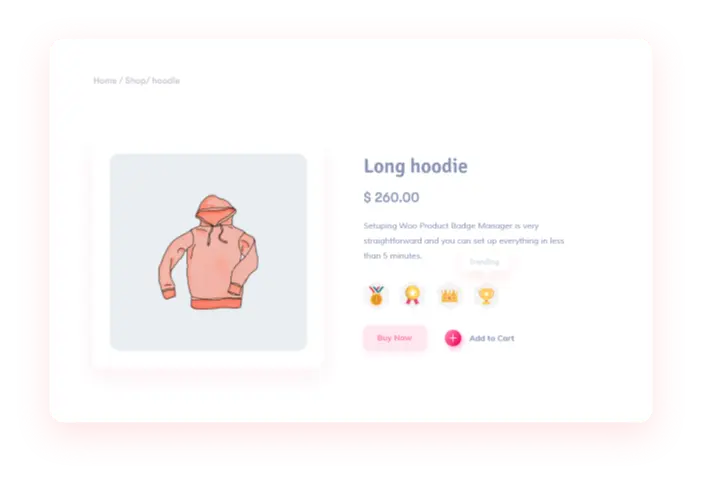
Create a WooCommerce sale flash badge

WooCommerce Product Badge and Product Label is an advanced plugin to create badges and countdown timers for WooCommerce products.

To create a badge or product label for a sale flash, first, you need to purchase and install the WooCommerce Product Badge and Product Label plugin.

After you have installed the plugin, then follow the below steps to create a badge.

1: Create a badge

  1. Navigate to the “Product Badges” menu, then open the “Badges” tab.
  2. Click on the Add New button to create a new product badge.
  3. Set a name for the product badge like the “Flash sale badge”.
  4. Under the “CSS Labels” tab, use the “Label” field to set a label for the badge like “Flash Sale {saved_percent}”.
  5. Use the “Text color” field to set the product label text color.
WooCommerce flash sale badge config

2: Select product label style

  1. Under “label styles”, select the label that you want. like the below image.
  2. Use the “Label color” field to set the label color. You can set a gradient color too.
WooCommerce flash sale badge config 2

3: Schedule sale flash badge

If you schedule your “flash sale” discount to a specific date time, then you can schedule the countdown timer to the same date time too.

  1. Navigate to the “Schedule” tab.
  2. Schedule the “Countdown timer” to your “flash sale” discount time.
WooCommerce sale flash badge schedule

4: Select products

  1. Navigate to the “Products” tab.
  2. Add a “Discount rules” condition and search and select the flash sale discount rule that is created in the previous step.
  3. Save the badge.
Sale flash badge products config

It is done successfully. As a result, if you open the products list page or the product page a “Flash Sale” badge will be shown on the product images.

WooCommerce flash sale badge and product label

WooCommerce flash sale countdown timer

When it comes to your online store’s promotional campaigns, one powerful feature that can significantly enhance the shopping experience for your customers is the WooCommerce flash sale countdown timer. This tool allows you to visually display the time remaining until the end of your flash sale, creating a dynamic and engaging atmosphere. The countdown timer serves as a constant reminder of the limited-time nature of the sale, effectively encouraging visitors to make their purchase before the opportunity expires. With WooCommerce, you have the flexibility to customize various aspects of the countdown timer, such as its design, placement, and behavior, ensuring it aligns perfectly with your brand and website aesthetics.

You can choose to showcase the countdown timer as a prominent banner at the top of the page or seamlessly integrate it into your product listings for a more subtle approach. Regardless of the chosen style, the countdown timer captures attention and motivates customers to act quickly, fostering a sense of urgency. By leveraging the power of the WooCommerce flash sale countdown timer, you can effectively drive sales and increase conversions. This valuable tool not only creates a sense of exclusivity but also adds an element of excitement to the shopping experience, leading to higher customer engagement and overall sales performance.

Create a WooCommerce flash sale countdown timer

To create a WooCommerce flash sale countdown timer, We will use the WooCommerce Product Badge and Product Label plugin.

Follow the below steps to create a countdown timer for WooCommerce sale flash.

1: Create a countdown timer

  1. Navigate to the “Product Badges” menu, then open the “Badges” tab.
  2. Click on the Add New button to create a new product badge.
  3. Set a name for the product badge like the “Flash sale countdown timer”.
  4. Navigate to the “Timer” tab and enable the “Status” field.
  5. Set a “From date/time” and “To date/time” for the countdown timer.
WooCommerce countdown timer config

2: Select countdown timer style

  1. Select a style for the countdown timer from the available styles.
  2. Set the “background” and “text” colors of the timer.
WooCommerce countdown timer styles

3: Configure countdown timer size

  1. Configure the timer sizes for the best values based on your theme.
WooCommerce countdown timer size

4: Set countdown timer position

  1. Set the countdown timer position to one of the “on image” or “out of image” values. In this example, we selected “out of image”
WooCommerce countdown timer position

5: Schedule countdown timer

If you schedule your “flash sale” discount to a specific date time, then you can schedule the countdown timer to the same date time too.

  1. Navigate to the “Schedule” tab.
  2. Schedule the “Countdown timer” to your “flash sale” discount time.
Schdule WooCommerce countdown timer

6: Select Products

  1. Navigate to the “Products” tab.
  2. Add a “Discount rules” condition and search and select the flash sale discount rule that is created in the previous step.
  3. Save the countdown timer.
WooCommerce countdown timer products config

7: Final result

The final result of the countdown timer for the WooCommerce flash sale will be like the below image.

WooCommerce countdown timer for flash sale discounts

Conclusion

In conclusion, implementing a WooCommerce flash sale can be a highly effective strategy to drive sales, engage customers, and create a sense of urgency. By following the steps to create a flash sale, businesses can strategically select products, set attractive discounts, and establish a time-limited promotion. Moreover, promoting the flash sale with the use of a flash sale badge and a countdown timer enhances its impact. The flash sale badge visually highlights the discounted products, catching the attention of visitors and conveying the exclusivity of the offer. Meanwhile, the countdown timer creates a sense of urgency, reminding customers of the limited time remaining to take advantage of the sale. Together, these elements create an enticing and engaging shopping experience, motivating customers to make immediate purchases. By leveraging the power of WooCommerce, businesses can effectively create and promote flash sales, leading to increased sales, customer engagement, and a memorable shopping experience.
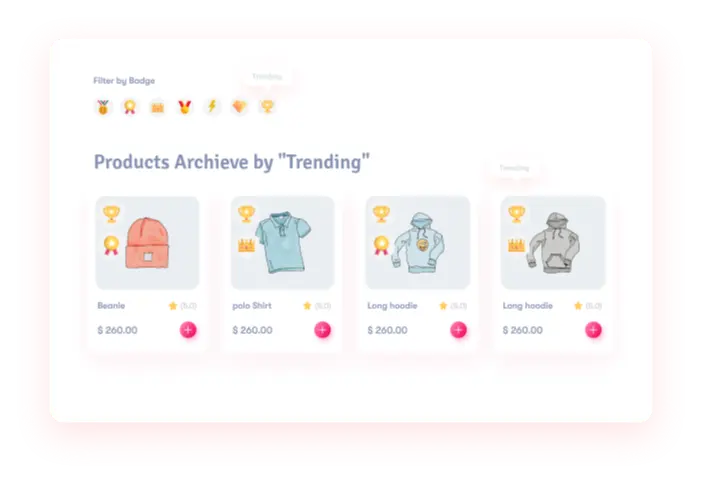
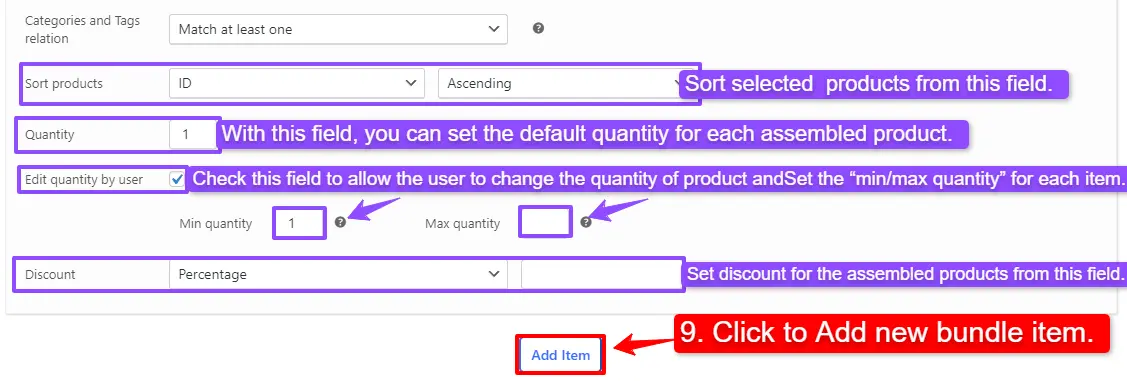
FAQ

What is a WooCommerce flash sale?

A WooCommerce flash sale is a limited-time promotion where products are offered at discounted prices to create a sense of urgency and drive sales. It is a time-limited opportunity for customers to purchase products at reduced prices.

How do I create a WooCommerce flash sale?

To create a WooCommerce flash sale, you can begin by defining your goals. Next, select products or categories to include, set discounts and time frames, configure coupons or sale pricing, promote the sale, and finally, monitor and analyze the results. By following this strategic process, you can effectively create an impactful flash sale campaign.

How long should a WooCommerce flash sale last?

The duration of a WooCommerce flash sale depends on your marketing strategy and goals. Typically, flash sales last between a few hours to a couple of days. The shorter the duration, the more urgency it creates among customers. However, ensure the time frame is long enough to allow sufficient customer engagement and awareness.

How can I promote my WooCommerce flash sale?

You can promote your WooCommerce flash sale through various channels such as targeted email campaigns, social media engagement, paid ads, optimized website banners, flash sale badges, countdown timers, influencer collaborations, and remarketing efforts. Utilize these strategies to generate awareness, excitement, and engagement among your target audience.