Create Tiered Pricing for Categories in WooCommerce (Mix & Match Tiered Discounts)
Learn how to create tiered pricing for product categories in WooCommerce using the Discount Rules and Dynamic Pricing for WooCommerce plugin. This complete guide covers category-wide tiered discounts where customers can mix and match different products from the same category, with each quantity range having its own discount percentage.
📋 Table of Contents
- Understanding Tiered Pricing vs. Bulk Discounts
- Step-by-Step: Create a Tiered Pricing Rule for Categories
- Result Examples
- Quick Reference Table
- Next Steps
🚀 Understanding Tiered Pricing vs. Bulk Discounts
Tiered pricing and bulk discounts are two different approaches to quantity-based pricing. Understanding the difference is crucial for choosing the right strategy for your store.
The Key Difference
In tiered pricing, each quantity range has its own specific price or discount. As customers buy more, they unlock better pricing for the additional units they purchase. For example, the first 5 items might be full price, items 6-10 get 10% off, and items 11+ get 20% off.
In bulk pricing (also called volume pricing), once a customer reaches a certain quantity threshold, the discount applies to all units in the cart, not just the additional ones. For example, if a customer buys 10 items, all 10 items get the same 20% discount.
| Pricing Model | How It Works | Example (5 items) | Example (10 items) |
|---|---|---|---|
| Bulk Pricing | One discount applied to all units once threshold is reached | No discount if threshold is 10 | 20% off all 10 items |
| Tiered Pricing | Different price for each quantity range | 1-5: Full price, 6-10: 10% off | 1-5: Full price, 6-10: 10% off |
When to Use Each
| Business Model | Recommended Approach | Why |
|---|---|---|
| B2C / Retail | Bulk pricing | Simpler, easier for customers to understand |
| B2B / Wholesale | Tiered pricing | More strategic, better for profit control |
| High-Volume Repeat Buyers | Tiered pricing | Rewards larger orders incrementally |
Key Statistic: Stores using tiered pricing report average order value increases of 20-30%.
Category Tiered Pricing in Action
When you create a tiered pricing rule for categories, the discount applies to the total quantity of all products from that category in the cart. This means customers can mix and match different products from the same category to unlock better discounts.
Example: If a customer buys 4 shirts and 6 pants from the "Clothing" category, the total is 10 items. This qualifies them for the 6-10 item tier, so all 10 items get the 20% discount.
Now you're ready to create tiered pricing rules for categories under the Woo Pricing & Discounts > Pricing tab.
Step-by-Step: Create a Tiered Pricing Rule for Categories
Best for: Running category-wide promotions where customers can mix and match different products from the same category to unlock tiered discounts. Perfect for clothing stores, accessories, and any store with product categories.
Scenario: Create a tiered pricing rule on the Shirts category with the following tiers:
- 1st item: Full price ($25.00)
- 2nd to 5th item: 10% off ($22.50 each)
- 6th to 10th item: 20% off ($20.00 each)
- 11th item & more: 30% off ($17.50 each)
Step 1: Access Pricing and Choose a Template
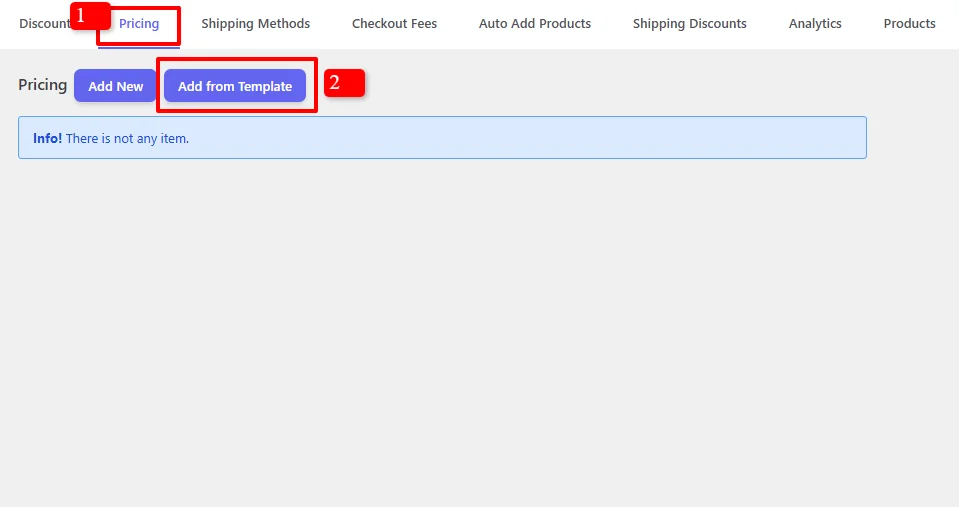
- In your WordPress admin, go to the Woo Pricing & Discounts menu
- Open the Pricing tab
- Click on the Add from Template button to quickly start a new rule
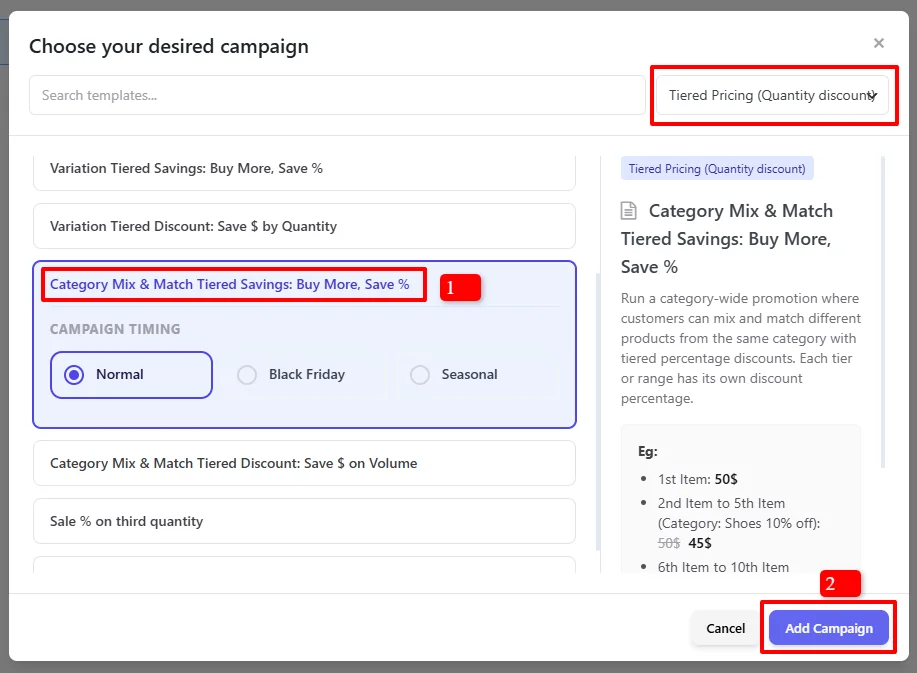
- In the "Choose your desired campaign" modal, search for templates
- Under Tiered Pricing (Quantity discount), find and select "Category Mix & Match Tiered Savings: Buy More, Save %"
- Click "Add Campaign"
Step 2: Configure the Discount Rule
-
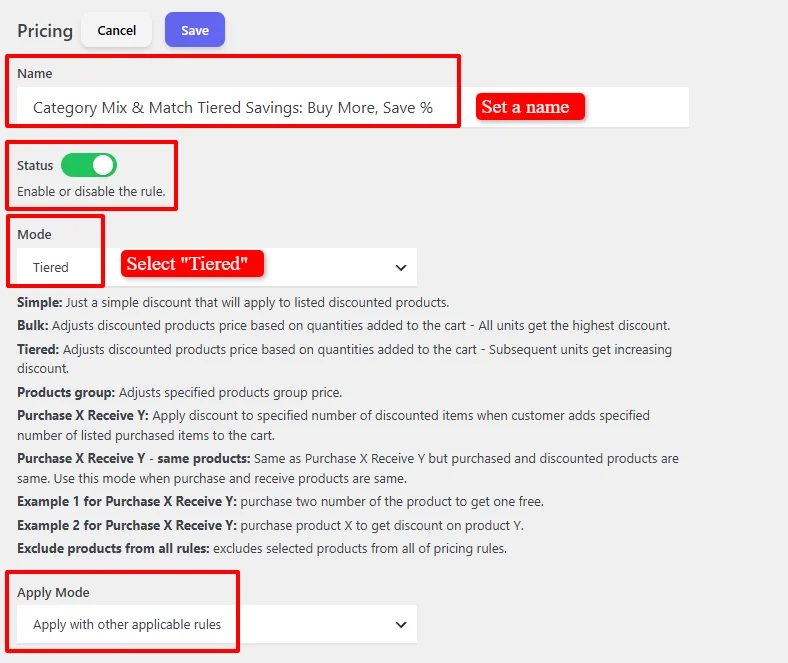
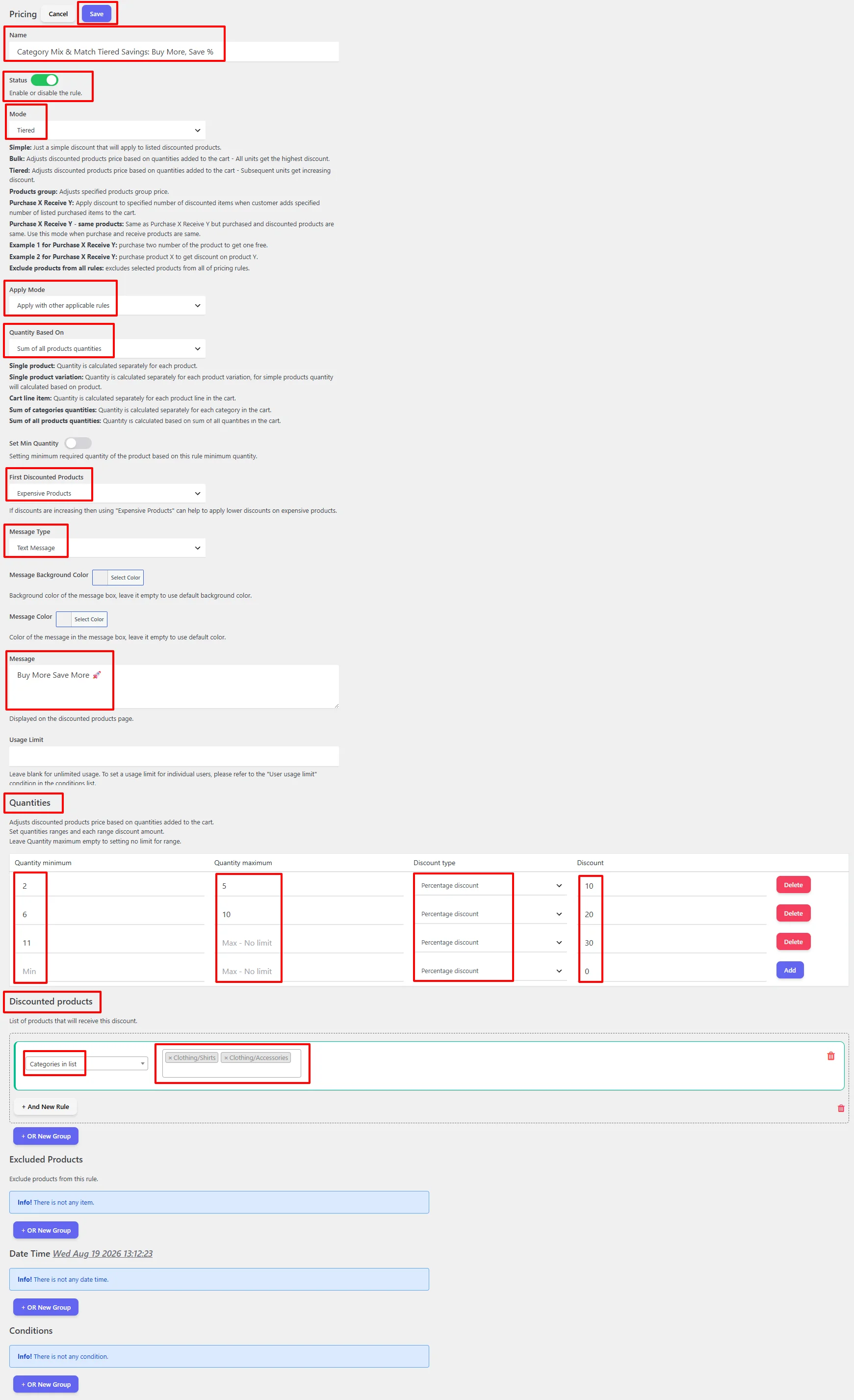
Name: "Category Mix & Match Tiered Savings: Buy More, Save %" (customizable)
-
Status: Ensure Enable is checked
-
Mode: Select "Tiered" — This adjusts discounted products price based on quantities added to the cart — Subsequent units get increasing discount
Mode Descriptions:
- Simple: Just a simple discount that will apply to listed discounted products
- Bulk: Adjusts discounted products price based on quantities added to the cart — All units get the highest discount
- Tiered: Adjusts discounted products price based on quantities added to the cart — Subsequent units get increasing discount
-
Apply Mode: Choose how this rule interacts with other pricing rules
- Apply with other applicable rules (Non-Exclusive): Works alongside other discounts
- Apply this rule and disregard other rules - Exclusive: Disregards all other applicable rules
- Apply if other rules are not applicable: Acts as a fallback
Step 3: Configure Quantity Calculation
Under Quantity Based On, select "Sum of all products quantities" to calculate total quantity across all products in the category:
- Single product: Quantity is calculated separately for each product
- Single product variation: Quantity is calculated separately for each product variation
- Cart line item: Quantity is calculated separately for each product line in the cart
- Sum of categories quantities: Quantity is calculated separately for each category in the cart
- Sum of all products quantities: Quantity is calculated based on sum of all quantities in the cart
Important: With "Sum of all products quantities", the tier is calculated using the combined quantity of all products in the category. This includes products that belong to multiple categories — they count toward the total quantity in every category they belong to.
Example: Select "Sum of all products quantities" to calculate total quantity across all products from the selected category.
Step 4: Configure Display Options
-
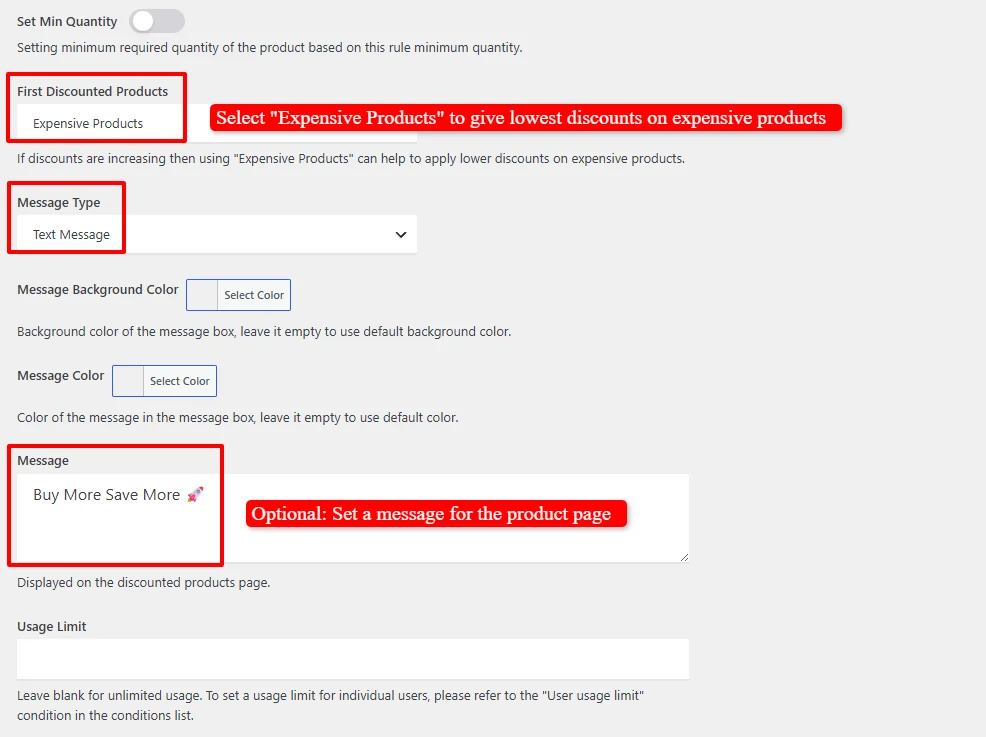
Set Min Quantity: Set the minimum required quantity for the rule (optional)
-
First Discounted Products: Choose which items get discounted first — this setting controls how the system applies tiered discounts across different products in the category:
Option 1: Cheapest Products (Default)
- The system sorts products by price in ascending order (cheapest first)
- The cheapest products are at the top of the list and receive the lowest discounts or no discount
- The most expensive products are at the bottom and receive the highest discounts
- Use this when: You want to give the best discounts to your most expensive items to make them more attractive
Option 2: Expensive Products
- The system sorts products by price in descending order (most expensive first)
- The most expensive products are at the top of the list and receive the lowest discounts or no discount
- The cheapest products are at the bottom and receive the highest discounts
- Use this when: You want to give the best discounts to your cheapest items while protecting profit margins on expensive products
Think of it this way: The system creates a list of products sorted by price. The products at the top of the list get the lowest discounts (or no discount). The products at the bottom of the list get the highest discounts.
-
Message Type: Select "Text Message"
-
Message: Set a compelling message, e.g., "Buy More Save More"
-
Message Background Color: (Optional) Customize the message box background color
-
Message Color: (Optional) Customize the message text color
-
Usage Limit: Leave blank for unlimited uses
Step 5: Set Quantity Ranges
Under the Quantities section, you define the quantity ranges and associated discounts:
- Quantity Minimum: Set the minimum quantity for each tier
- Quantity Maximum: Set the maximum quantity (leave blank for no limit)
- Discount Type: Choose between Percentage discount, Price discount, or Fixed price
- Discount: Set the discount value for each tier
- Click "Add" to add more tiers as needed
Example Tiers:
| Quantity Minimum | Quantity Maximum | Discount Type | Discount |
|---|---|---|---|
| 2 | 5 | Percentage discount | 10 |
| 6 | 10 | Percentage discount | 20 |
| 11 | Max - No limit | Percentage discount | 30 |
Important: In tiered pricing, the first tier (1 item) typically has no discount. The discount applies only to the specified quantity ranges.
Step 6: Select Discounted Categories
Under the Discounted products section, you define which categories receive the tiered discount:
- Add a "Categories in list" condition
- Search for and select your desired categories
- You can add multiple categories into the search field

Example: Select Shirts as the discounted category.
For detailed information on filtering products by categories, variations, attributes, stock status, or dynamic segments, check out our Product Selection Guide.
Step 7: Schedule the Discount (Optional)
By default, the campaign is unscheduled and runs immediately:

For scheduled promotions, under the "Date Time" section to configure:
- Date Range — Run a promotion over a period
- Date Time Range — Precise start and end date/time for flash sales
- Specific Date — Single date activation
- Days — Recurring weekly promotions
- Time — Daily time ranges

Use "+ And New Rule" to combine conditions or "+ OR New Group" for alternative schedules.
For a deep dive into timezone setup, recurring schedules, and multi-tier scheduling logic, read our comprehensive Scheduling & Date-Time Guide.
Step 8: Save and Test
Click Save and test by adding different quantities of products from the selected category to the cart.
Result Examples
Example 1: Cart with 10 Identical Shirts
Scenario: Customer adds 10 identical shirts from the Shirts category to their cart.
Cart with 10 units of the same Shirt (Original Price: $25.00 each):
| Item | Original Price | Discount | Discounted Price |
|---|---|---|---|
| 1st unit | $25.00 | 0% | $25.00 |
| 2nd-5th units | $25.00 each | 10% | $22.50 each |
| 6th-10th units | $25.00 each | 20% | $20.00 each |
Calculation:
- 1st unit: $25.00 × 1 = $25.00
- 2nd-5th units: $22.50 × 4 = $90.00
- 6th-10th units: $20.00 × 5 = $100.00
- Total: $215.00
- Original total: $250.00
- You Saved: $35.00
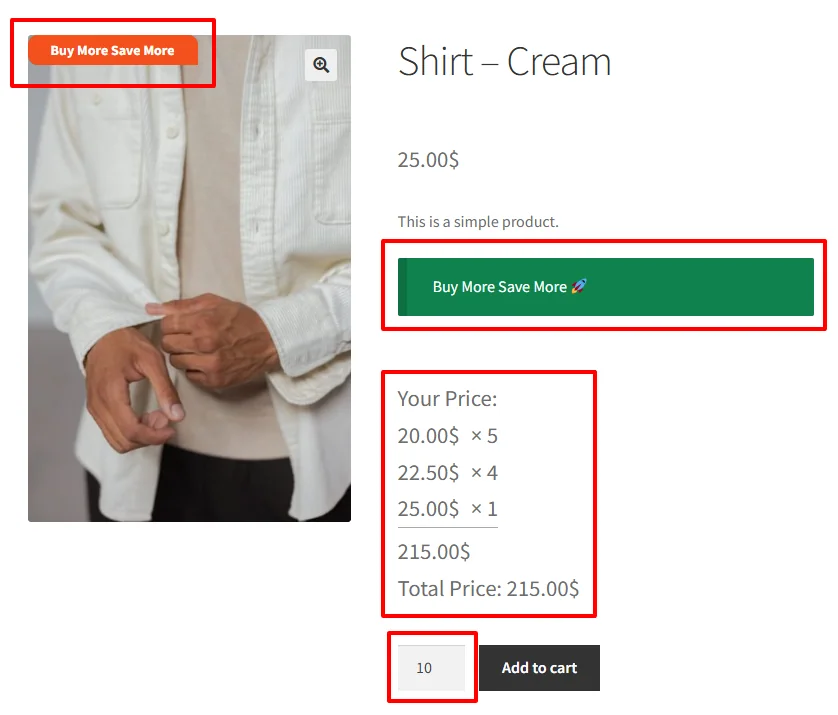
Product page display shows:
- Your Price: 20.00$ × 5
- 22.50$ × 4
- 25.00$ × 1
- Total Price: 215.00$
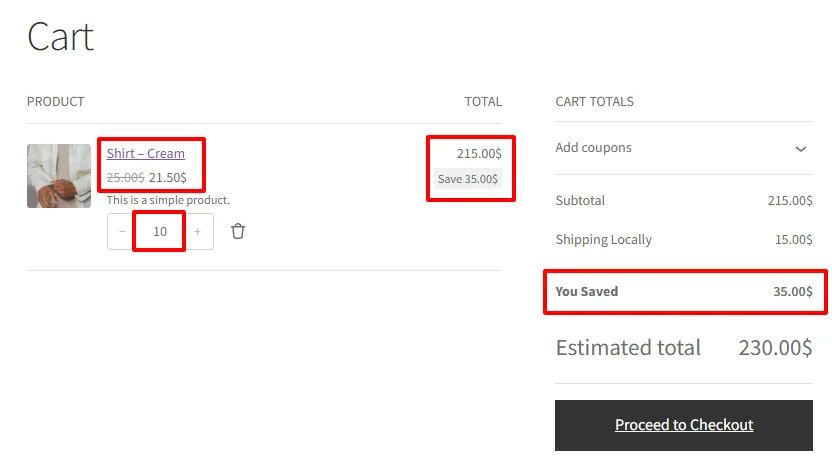
Cart display shows:
- Subtotal: $215.00
- You Saved: $35.00
Example 2: Cart with 3 Different Shirts
Scenario: Customer adds 3 different shirts from the Shirts category to their cart (mix and match).
Cart with 3 different shirts (Original Prices: $20.00, $25.00, $25.00):
| Item | Original Price | Discount | Discounted Price |
|---|---|---|---|
| 1st item (Shirt - Green) | $25.00 | 0% | $25.00 |
| 2nd item (Shirt - Cream) | $25.00 | 10% | $22.50 |
| 3rd item (Shirt) | $20.00 | 10% | $18.00 |
Calculation:
- 1st item: $25.00 × 1 = $25.00
- 2nd item: $22.50 × 1 = $22.50
- 3rd item: $18.00 × 1 = $18.00
- Total: $65.50
- Original total: $70.00
- You Saved: $4.50
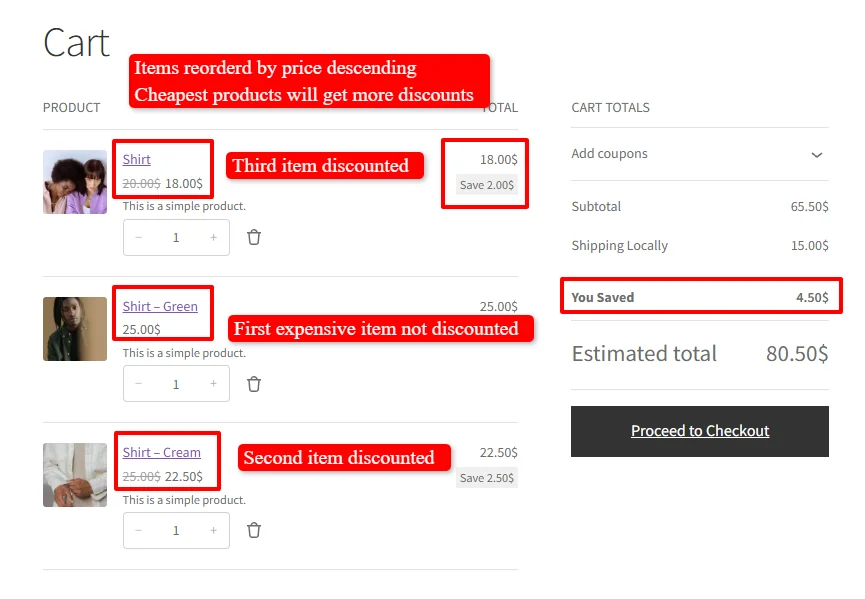
How the "Expensive Products" setting works in this example:
Since we have selected "Expensive Products" as the First Discounted Products setting:
The system sorts products by price in descending order:
- Most expensive products are at the top → get lowest discounts
- Cheapest products are at the bottom → get highest discounts
| Item | Price | Position | Discount | Discounted Price |
|---|---|---|---|---|
| Shirt - Green | $25.00 | Top (Expensive) | 0% (No discount) | $25.00 |
| Shirt - Cream | $25.00 | Middle | 10% | $22.50 |
| Shirt | $20.00 | Bottom (Cheapest) | 10% | $18.00 |
In this case, the system sorted the items by price (expensive first). The most expensive items got the lowest discounts (0% and 10%), while the cheapest item also got the 10% discount because it was at the bottom of the list.
Example 3: Cart with 6 Different Shirts
Scenario: Customer adds 6 different shirts from the Shirts category to their cart.
Cart with 6 different shirts:
- Shirt: $20.00 × 2 units
- Shirt - Cream: $25.00 × 3 units
- Shirt - Green: $25.00 × 1 unit
Total quantity: 6 items (qualifies for 2-5 tier with 10% off)
How discounts are applied with "Expensive Products" setting:
The system sorts products by price in descending order (most expensive first):
| Item | Quantity | Price | Position | Discount | Discounted Price | Total |
|---|---|---|---|---|---|---|
| Shirt - Green | 2 units | $25.00 | Top (Expensive) | (0% + 10%) / 2 = 5% | $23.75 | $47.50 |
| Shirt - Cream | 2 units | $25.00 | Middle | 10% | $22.50 | $45.00 |
| Shirt | 2 units | $20.00 | Bottom (Cheapest) | (10% + 20%) / 2 = 15% | $17.00 | $34.00 |
Calculation:
- Shirt - Green: ($25.00 × 1) + ($22.50 × 1) = $47.50 (0% discount and 10% discount)
- Shirt - Cream: $22.50 × 2 = $45.00 (10% discount)
- Shirt: ($18.00 × 1) + ($16.00 × 1) = $34.00 (10% discount and 20% discount)
- Total: $126.50
- Original total: (2×$25 + 2×$25 + 2×$20) = $75 + $25 + $40 = $140.00
- You Saved: $13.50
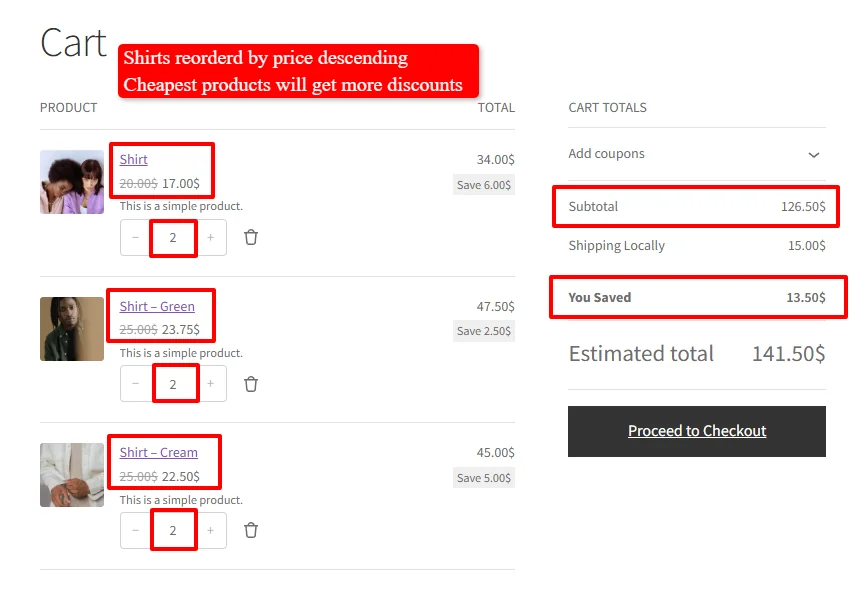
Key Takeaway: With the "Expensive Products" setting, the most expensive products get the lowest discounts (or no discount), while the cheapest products get the highest discounts. This protects your profit margins on expensive items while still offering attractive discounts on lower-priced items.
Quick Reference Table
| Quantity | Discount Type | Discount | Price Per Item | Total Savings |
|---|---|---|---|---|
| 1 item | No discount | 0% | $25.00 | $0.00 |
| 2-5 items | Percentage | 10% | $22.50 | $2.50-$12.50 |
| 6-10 items | Percentage | 20% | $20.00 | $30.00-$50.00 |
| 11+ items | Percentage | 30% | $17.50 | $82.50+ |
🎉 Success!
You've learned how to create tiered pricing for categories using the Discount Rules and Dynamic Pricing plugin for WooCommerce. This powerful feature allows you to:
- Run mix-and-match category promotions where customers can combine different products from the same category
- Encourage larger purchases by offering incremental discounts across product lines
- Increase average order value with category-wide tiered incentives
- Display clear discount information on product pages
- Automatically apply tiered discounts based on total category quantity in the cart
The tiered pricing mode applies increasing discounts to subsequent units from the selected category, creating a powerful incentive for customers to buy more across your product lines.
Experience all discount rules and pricing strategies in action on our Live Demo Website.
Upgrade to Discount Rules and Dynamic Pricing for WooCommerce PRO to unlock advanced conditions, user role pricing, recurring schedules, tiered variations, and priority support.
📚 Next Steps
Now that you've mastered category tiered pricing, explore related mix & match and bundle options:
- Mix & Match Product Discounts — Create "Buy Any 4 for $50" style bundle discounts.
- Bulk Discounts for Categories — Apply standard bulk discount rates across categories.
- Tiered Pricing for Products — Set up tiered pricing brackets for individual products.
- Display Quantity Table on Product Pages — Guide customers with a clear pricing tier breakdown table.
- Create Category-Wide Cart Discounts — Apply automatic cart-level discounts for category purchases.
🔍 SEO Keywords
Primary Keywords: tiered pricing WooCommerce, category tiered discounts, mix and match discounts WooCommerce, WooCommerce discount rules, dynamic pricing WooCommerce, quantity based discounts WooCommerce
Secondary Keywords: WooCommerce tiered pricing plugin, quantity discount WooCommerce, bulk vs tiered pricing, tiered pricing for categories, wholesale pricing WooCommerce, increase average order value, WooCommerce quantity breaks, category mix and match, Discount Rules and Dynamic Pricing plugin